Animals Need Food Science Concept Posters
$5.00
6-Piece Visual Science Poster Set | Animal Needs | Herbivores | Carnivores | Omnivores | Energy | CER
Bring Animals Need Food to life with this bold, colorful, and highly visual 6-poster Science Concept Set!
Designed to do much more than simply decorate your science wall, these posters help students understand why animals need food, compare what different animals eat, distinguish plant eaters from meat eaters, classify herbivores, carnivores, and omnivores, connect food to energy and survival, use observations as evidence, build science vocabulary, and think like scientists.
Each poster combines large, engaging animal visuals with clear student-friendly explanations, discussion prompts, vocabulary, simple sorting and matching activities, and introductory Claim-Evidence-Reasoning (CER) opportunities. Students explore how food gives animals the energy they need to grow, move, stay healthy, and survive while discovering that different animals eat different kinds of food.
WHAT’S INCLUDED
This set includes 6 full-color, print-ready science posters:
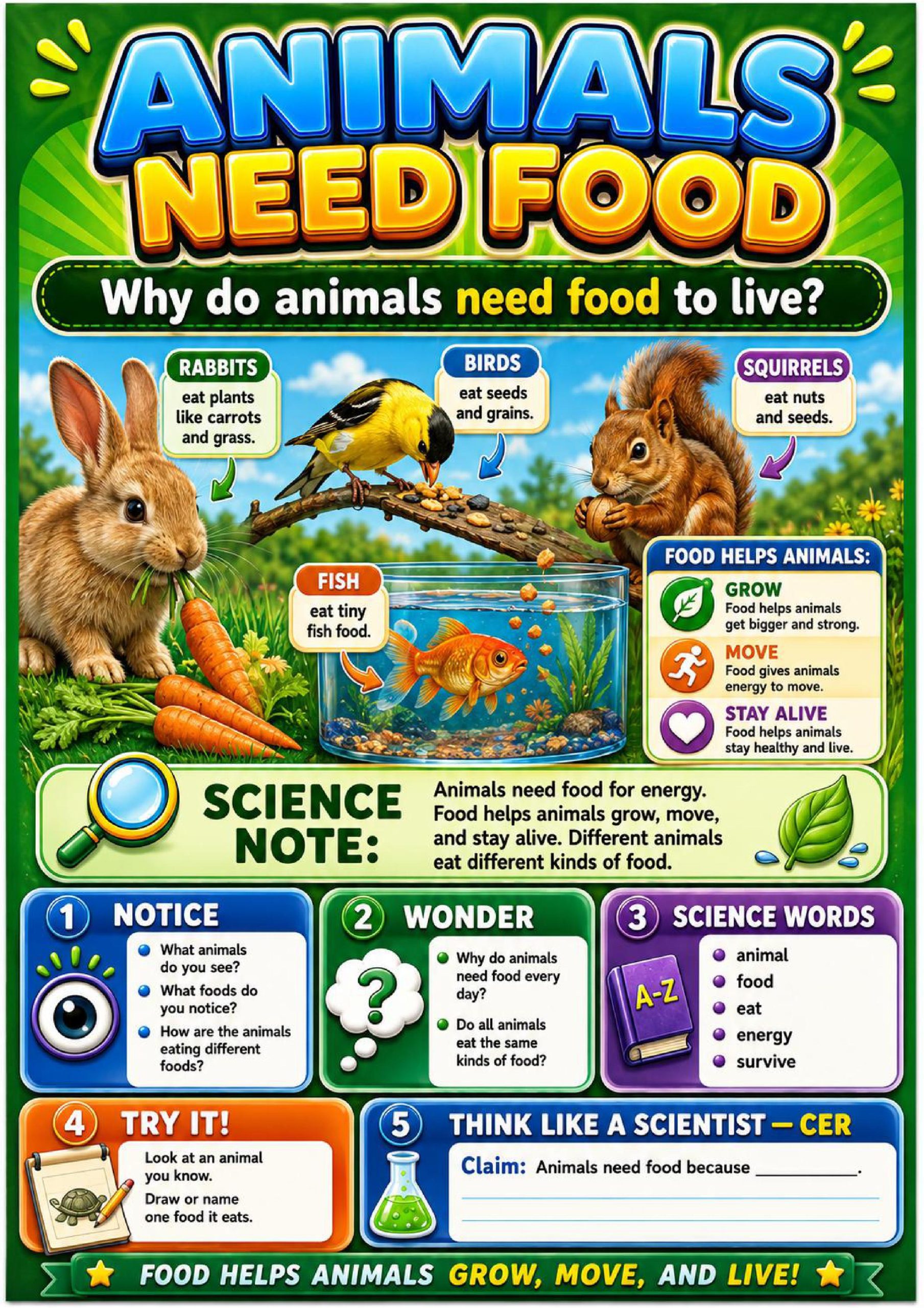
- Animals Need Food — Introduce food as a basic animal need and explore how different animals eat different foods for energy, growth, movement, and survival.
- Plant Eaters — Discover animals that eat plants and introduce herbivores using examples such as rabbits, cows, giraffes, and caterpillars.
- Meat Eaters — Explore animals that eat other animals and introduce carnivores using owls, frogs, sharks, and foxes.
- Who Eats What? — Compare herbivores, carnivores, and omnivores and sort animals according to the kinds of food they eat.
- Food Helps Animals Live — Investigate how food helps animals grow, move, stay healthy, stay strong, and remain alive.
- Be the Scientist! — Students match animals to their foods, use clues and observations, and explain one of their matches with evidence.
Each poster includes a large guiding question, vivid science illustrations, a concise Science Note, Notice & Wonder prompts, key Science Words, a Try It! activity, and a Think Like a Scientist — CER response opportunity. Science Concept Poster Set_Anim…
MORE THAN A POSTER — A TEACHING TOOL
These posters are designed to help students move beyond simply knowing that animals eat and begin understanding why food is necessary and why different animals eat different things.
Students investigate questions such as:
Why do animals need food?
How does food give animals energy?
Do all animals eat the same foods?
Which animals eat plants?
Which animals eat other animals?
What is the difference between a herbivore, carnivore, and omnivore?
How does food help animals grow and move?
How can scientists use clues to determine what an animal eats?
Use the posters to introduce an animal-needs unit, activate prior knowledge, guide whole-group conversations, reinforce vocabulary, support small-group instruction, provide science-center references, or create an engaging classroom life science display.
WHY ANIMALS NEED FOOD
The introductory Animals Need Food poster establishes food as one of the basic needs animals must meet in order to live.
Students see familiar examples such as:
- rabbits eating carrots and grass
- birds eating seeds and grains
- squirrels eating nuts and seeds
- fish eating fish food
The poster emphasizes three major ways food helps animals:
Grow — food helps animals become bigger and stronger.
Move — food provides energy for movement.
Stay Alive — food helps animals stay healthy and survive.
This gives young learners an accessible connection between what animals eat and what their bodies are able to do.
PLANT EATERS AND HERBIVORES
The Plant Eaters poster introduces animals whose diets come from plants.
Students explore examples such as:
- rabbits eating grass and carrots
- cows eating grass
- giraffes eating leaves
- caterpillars eating leaves
The poster introduces the science word herbivore and explains that herbivores are animals that eat plants.
Students also see that plant food can include more than leaves. Herbivores may eat:
- grass
- leaves
- fruit
- seeds
- flowers
This expands student understanding beyond the idea that all plant-eating animals eat exactly the same things.
MEAT EATERS AND CARNIVORES
The Meat Eaters poster focuses on animals that obtain food by eating other animals.
Students examine examples such as:
- owls eating mice
- frogs eating insects
- sharks eating fish
- foxes hunting small animals
The poster introduces the term carnivore and explains that carnivores may catch insects, fish, or other animals for food.
This provides a clear contrast with plant eaters while introducing age-appropriate ideas such as hunting and prey.
Students can compare both the animals and the types of food they eat.
HERBIVORES, CARNIVORES, AND OMNIVORES
The Who Eats What? poster expands the classification system to three groups.
Students learn:
Herbivores eat plants.
Carnivores eat other animals.
Omnivores eat both plants and animals.
Visual examples help students compare the groups and connect each category to examples of food.
The herbivore section includes plant foods such as grass, leafy plants, and carrots.
The carnivore section includes examples such as mice, fish, and worms.
The omnivore section includes both plant and animal foods.
This makes the poster an especially useful visual reference for classification, review, science centers, and formative assessment.
FOOD HELPS ANIMALS LIVE
The Food Helps Animals Live poster shifts the focus from what animals eat to why eating is important.
Students investigate four major benefits of food:
Grow — food helps young animals become bigger and stronger.
Move — food provides energy for running, jumping, swimming, and playing.
Stay Healthy — food helps animals remain strong and healthy.
Stay Alive — food helps animals maintain the energy and strength they need to survive.
The visual examples of a growing fawn, running cheetah, healthy dog, and bear reinforce the idea that food supports many different life processes.
The Science Note summarizes the core concept:
Food gives animals energy. It helps them grow, move, stay healthy, and live.
MATCH ANIMALS TO THEIR FOOD
The culminating Be the Scientist! poster turns the topic into an evidence-based matching investigation.
Students examine animals including:
- rabbit
- squirrel
- cow
- frog
- owl
- bear
They then match them with foods such as:
- carrots
- nuts
- grass
- insects
- mice
- fish and berries
Students are prompted to consider:
Which matches seem easy?
What clues helped you decide?
How can body parts help animals get food?
What other animals could you match?
This encourages students to use what they know about animals, their structures, and their diets rather than simply guessing.
BUILDS SCIENCE THINKING
Rather than simply memorizing dietary categories, students are encouraged to observe, compare, sort, match, and explain.
Throughout the set, students practice:
- identifying animal needs
- recognizing food as a source of energy
- comparing different diets
- identifying plant eaters
- identifying meat eaters
- distinguishing herbivores, carnivores, and omnivores
- sorting animals into food groups
- matching animals to foods
- observing clues
- making claims
- using evidence to explain reasoning
These foundational concepts prepare students for later learning about habitats, food chains, food webs, ecosystems, adaptations, and animal survival.
INTRODUCES CER IN A STUDENT-FRIENDLY WAY
Each poster includes a simple Think Like a Scientist — CER component.
Students complete sentence frames such as:
“Animals need food because ___.”
“This animal is a plant eater because ___.”
“I know this animal is a meat eater because ___.”
“This animal belongs in the ___ group because ___.”
“Animals need food because it helps them ___.”
“I matched ___ to ___ because ___.”
These prompts provide an age-appropriate introduction to making a scientific claim and supporting it with observable evidence or known information.
KEY SCIENCE CONCEPTS
Students will explore concepts including:
animal, food, eat, energy, survive, grow, move, healthy, plant, grass, leaves, seeds, herbivore, carnivore, omnivore, hunt, prey, insects, meat, food group, sort, match, clue, observe, evidence, claim, and reasoning.
PERFECT FOR
Kindergarten science, first grade science, early elementary life science, animal-needs units, animal diet lessons, herbivore/carnivore/omnivore instruction, living-things units, animal survival lessons, classification activities, science anchor charts, classroom science walls, vocabulary reinforcement, morning review, small groups, science centers, CER introductions, matching activities, and hands-on science lessons.
DESIGNED FOR YOUNG SCIENTISTS
Bold headings, vivid colors, familiar animals, clear food examples, simple dietary classifications, comparison layouts, and easy-to-read information boxes make animal needs and feeding relationships understandable and memorable for younger elementary learners.
The coordinated design allows all six posters to work together as a complete instructional sequence:
Understand why animals need food → explore plant eaters → explore meat eaters → classify herbivores, carnivores, and omnivores → connect food to growth and survival → match animals to foods using clues and evidence
Display all six together for an engaging Animals Need Food science wall, or introduce them individually as students progress through the topic.
Turn your classroom walls into interactive science learning tools and help students discover that food is more than something animals eat—it provides the energy animals need to grow, move, stay healthy, and survive.
- Grades K-5
- Instant digital download
- Print & reuse in class