Balanced and Unbalanced Forces Science Concept Posters
$5.00
6-Piece Visual Science Poster Set | Forces | Motion | Pushes & Pulls | Balanced vs. Unbalanced | CER
Bring Balanced and Unbalanced Forces to life with this bold, colorful, and highly visual 6-poster Science Concept Set!
Designed to do much more than simply decorate your science wall, these posters help students understand forces, compare balanced and unbalanced forces, analyze pushes and pulls, recognize changes in motion, interpret force arrows, collect evidence, and think like scientists.
Each poster combines large, engaging science visuals with clear student-friendly explanations, discussion prompts, vocabulary, simple investigations, and Claim-Evidence-Reasoning (CER) opportunities. Students explore how forces can act in opposite directions, how equal forces affect motion, and how unequal forces can cause an object to start, stop, speed up, slow down, or change direction.
WHAT’S INCLUDED
This set includes 6 full-color, print-ready science posters:
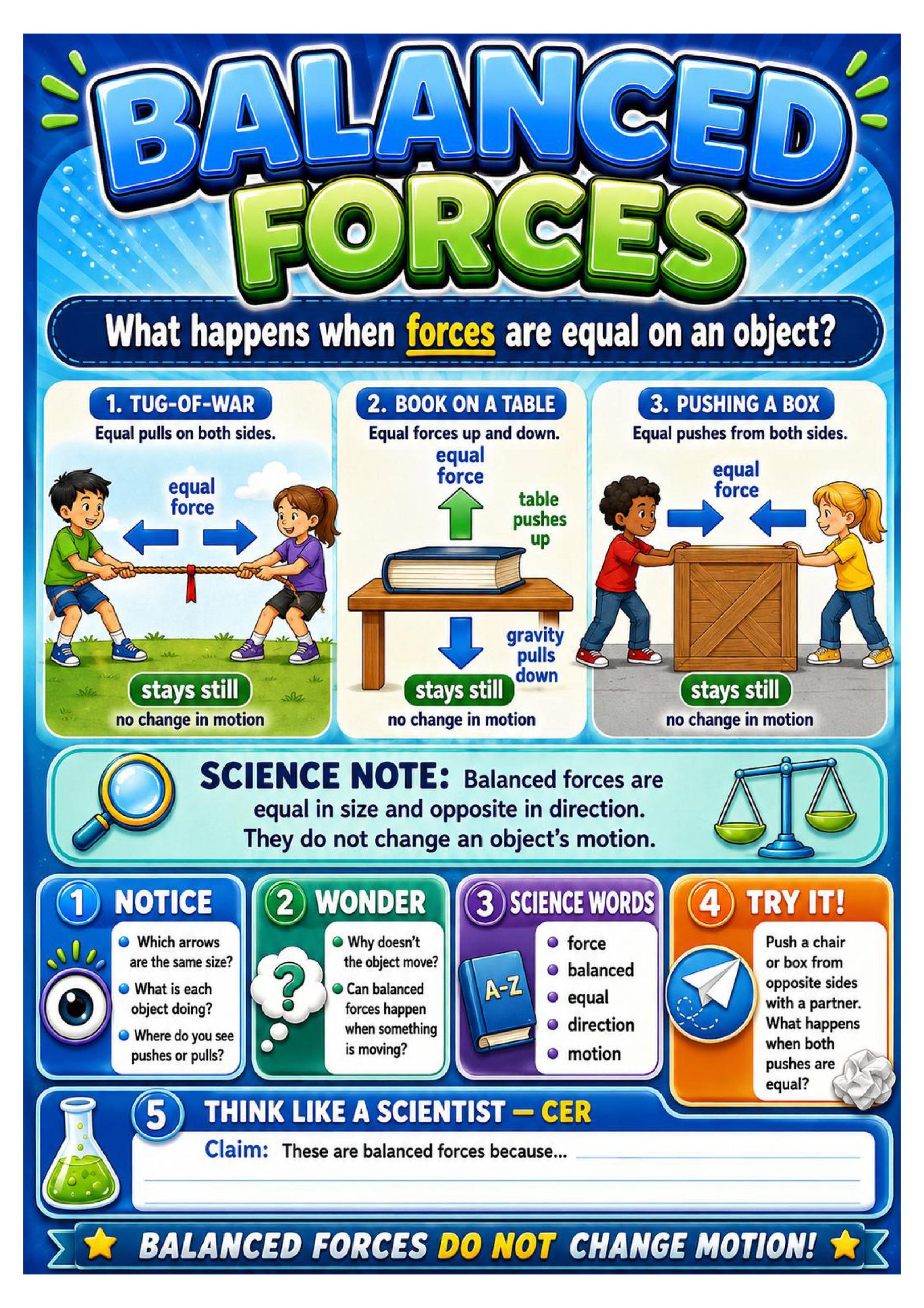
- Balanced Forces — Explore what happens when forces are equal in size and opposite in direction using examples such as tug-of-war, a book resting on a table, and equal pushes on a box.
- Unbalanced Forces — Investigate how unequal forces can change an object’s motion through examples such as kicking a soccer ball, pulling a wagon, and pushing a box.
- Clues of Unbalanced Forces — Identify observable evidence that forces are unbalanced when an object starts moving, stops, speeds up, slows down, or changes direction.
- Balanced or Unbalanced? — Compare balanced and unbalanced force situations and use changes in motion as evidence to classify each example.
- Still or Steady? — Discover that balanced forces do not always mean an object is standing still; an object can also move at a constant speed when the forces are balanced.
- Be the Scientist! Investigate Forces — Students observe, test, record evidence, and use their results to determine whether forces are balanced or unbalanced.
Each poster includes a large Essential Question, vivid science illustrations, a concise Science Note, Notice & Wonder prompts, key Science Words, a Try It! activity, and a Think Like a Scientist — CER response prompt.
MORE THAN A POSTER — A TEACHING TOOL
These posters are designed to help students move beyond simply memorizing the definitions of balanced and unbalanced forces and begin understanding how scientists use evidence from motion to determine what forces are doing.
Students investigate questions such as:
What happens when forces on an object are equal?
How can an unbalanced force change motion?
What clues tell us that forces are unbalanced?
How can force arrows help us compare pushes and pulls?
Can balanced forces act on an object that is moving?
What is the difference between standing still and moving steadily?
How can observations and evidence help us determine whether forces are balanced or unbalanced?
Use the posters to introduce a lesson, activate prior knowledge, guide whole-group conversations, reinforce vocabulary, support small-group instruction, review important concepts, or provide visual references throughout a forces and motion unit.
UNDERSTANDING BALANCED FORCES
The Balanced Forces poster introduces the idea that balanced forces are equal in size and opposite in direction.
Students examine examples such as:
- two students pulling equally during a tug-of-war
- a book resting on a table
- two students pushing equally on opposite sides of a box
In each example, the forces balance one another and there is no change in the object’s motion.
The book-on-a-table example also helps students see that more than one force can act on an object at the same time. Gravity pulls the book downward while the table pushes upward with an equal force.
This helps students understand that an object can experience forces even when it does not appear to be moving.
UNDERSTANDING UNBALANCED FORCES
The Unbalanced Forces poster shows what happens when the forces acting on an object are not equal.
Students examine examples such as:
- kicking a soccer ball
- pulling a wagon
- pushing a box harder from one side
The force arrows make it easy to see when one force is larger than another.
Students learn that unbalanced forces can cause an object to:
- start moving
- stop moving
- speed up
- slow down
- change direction
This gives students a clear connection between unequal forces and changes in motion.
LOOK FOR CHANGES IN MOTION
The Clues of Unbalanced Forces poster helps students recognize observable evidence that an unbalanced force is acting.
Students examine five important clues:
- an object starts moving
- an object stops
- an object speeds up
- an object slows down
- an object changes direction
Examples such as a soccer ball beginning to roll, a toy car stopping, a wagon speeding up, a bicycle slowing down, and a ball changing direction help students connect the abstract idea of force to familiar motion.
The poster reinforces a powerful scientific shortcut:
If the motion changes, the forces are unbalanced.
BALANCED OR UNBALANCED?
The Balanced or Unbalanced? poster provides a direct side-by-side comparison.
Students compare balanced examples such as:
- a tied tug-of-war
- a book resting on a table
- a box pushed equally from opposite sides
with unbalanced examples such as:
- kicking a soccer ball
- pulling a wagon
- pushing harder on one side of a box
The central question asks:
Does the motion change?
Students learn to use this question, along with the size and direction of force arrows, to classify force situations.
This comparison helps students develop a practical strategy they can apply to unfamiliar examples.
BALANCED CAN MEAN STILL OR STEADY
The Still or Steady? poster addresses an important misconception: balanced forces do not always mean that an object must be standing still.
Students compare:
- a book sitting still with balanced forces
- a toy car moving at a steady, constant speed with balanced forces
- a toy car slowing down because friction creates an unbalanced force
Students learn that when forces are balanced, there is no change in motion.
That can mean an object remains still, but it can also mean that an object continues moving at a constant speed.
This provides a deeper and more accurate understanding of balanced forces than simply associating “balanced” with “not moving.”
PUSHES, PULLS, AND FRICTION
Throughout the set, students see forces represented as pushes and pulls.
They also begin connecting friction to changes in motion.
For example, the Still or Steady? poster shows that when friction becomes greater than the forward force on a moving toy car, the forces become unbalanced and the car slows down.
This helps students see how familiar forces interact in real situations rather than studying them as isolated vocabulary terms.
INVESTIGATE LIKE A SCIENTIST
The culminating Be the Scientist! Investigate Forces poster turns the concepts into a simple hands-on investigation.
Students follow a four-step process:
Observe → Test → Record → Conclude
Students can:
- give a toy car a gentle push
- give the same car a stronger push
- apply equal pushes from opposite sides
- observe what happens
- record the evidence in a table
- classify the forces as balanced or unbalanced
The investigation encourages students to base their conclusions on what they actually observe rather than simply guessing.
This provides meaningful practice with experimental testing, observation, data recording, comparison, classification, and evidence-based reasoning.
BUILDS SCIENCE THINKING
Rather than simply memorizing vocabulary, students are encouraged to look for evidence in the motion of an object.
Throughout the set, students practice:
- identifying forces
- interpreting force arrows
- comparing force size
- comparing force direction
- observing motion
- recognizing changes in speed
- identifying changes in direction
- distinguishing balanced and unbalanced forces
- recognizing steady motion
- conducting simple force tests
- recording evidence
- supporting claims with reasoning
The recurring CER prompts help students explain why they believe forces are balanced or unbalanced using evidence from the situation.
KEY SCIENCE CONCEPTS
Students will explore concepts including:
- force
- push
- pull
- balanced force
- unbalanced force
- equal
- unequal
- direction
- motion
- speed
- start
- stop
- slow down
- speed up
- change direction
- steady
- constant speed
- friction
- observe
- test
- evidence
- record
- conclude
- compare
PERFECT FOR
Whole-group science instruction, physical science units, forces and motion lessons, balanced and unbalanced force units, pushes and pulls lessons, friction connections, phenomenon-based learning, science anchor charts, classroom science walls, vocabulary reinforcement, morning review, small groups, science centers, CER practice, toy car investigations, motion observations, science discussions, and unit review.
DESIGNED FOR STUDENT ENGAGEMENT
Bold headings, vivid colors, familiar motion examples, large directional arrows, comparison layouts, force diagrams, hands-on investigation ideas, and easy-to-read information boxes help make invisible forces understandable and memorable for elementary learners.
The coordinated design allows all six posters to work together as a complete instructional sequence:
Explore balanced forces → investigate unbalanced forces → identify changes in motion → compare balanced and unbalanced situations → understand still versus steady motion → observe, test, record, and explain with evidence
Display all six together for an engaging Balanced and Unbalanced Forces science wall, or introduce them individually as students progress through the topic.
Turn your classroom walls into interactive science learning tools and help students discover how equal and unequal forces affect motion, why balanced does not always mean still, and how scientists use changes in motion as evidence to understand the forces acting on an object.
- Grades K-5
- Instant digital download
- Print & reuse in class