Chemical Reactions Phenomena Poster Set
$5.00
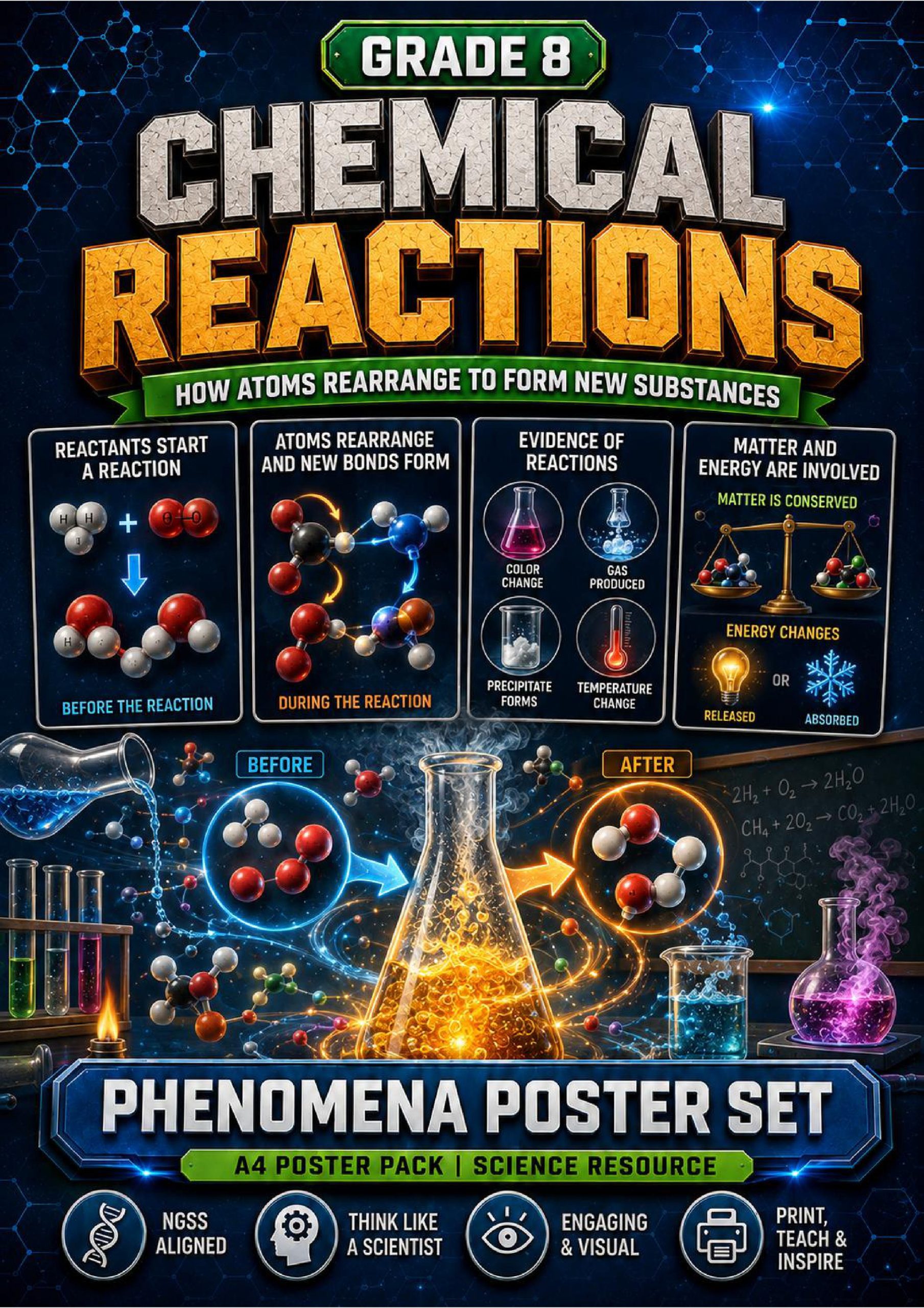
Help students investigate what happens when substances interact and form new substances with this engaging Chemical Reactions phenomena resource.
This six-poster collection uses visually rich science phenomena to encourage students to observe changes, analyze evidence, interpret particle models, ask questions, and develop explanations about reactants, products, conservation of matter, and the signs that a chemical reaction has occurred.
Students move beyond simply identifying “chemical changes” and begin thinking about how atoms rearrange during reactions and how evidence can be used to explain what happened.
What’s Included
This resource includes six individual full-color portrait phenomena posters.
Each poster includes:
A high-interest phenomenon question
A detailed science visual, model, or real-world chemical reaction scenario
“What do you notice?” observation prompts
“What do you wonder?” discussion questions
Key science vocabulary
A “Try This Thinking” activity or challenge
A CER Starter for Claim, Evidence, and Reasoning practice
A concise science statement reinforcing the main concept
Explore Evidence of Chemical Reactions
Students investigate observable changes that may indicate a chemical reaction has occurred.
The phenomena provide opportunities to examine changes such as:
Color changes
Gas production
Temperature changes
Formation of a solid
Light production
New odors or other observable evidence
Students learn that one observation alone may not always prove that a reaction occurred and that scientists use multiple pieces of evidence to develop explanations.
Investigate Reactants and Products
Students explore how starting substances, called reactants, can interact and form different substances called products.
They can consider questions such as:
What substances were present before the reaction?
What evidence suggests something new formed?
How are the products different from the reactants?
What changed during the reaction?
What stayed the same?
How can a particle model help explain what happened?
These questions help students connect observable changes with processes occurring at the atomic and molecular level.
Use Particle Models to Explain Reactions
Chemical reactions involve changes that cannot be fully understood through observation alone.
Visual particle models help students examine how atoms can separate from one arrangement and recombine in new ways.
Students can compare before-and-after models, identify patterns, and use those models to explain how new substances form.
Explore Conservation of Matter
Students investigate the important idea that matter is conserved during a chemical reaction.
Although atoms may be rearranged into new substances, the atoms themselves do not disappear or suddenly appear.
Students can use particle models and other evidence to explain how the same atoms are present before and after a reaction even though they are organized differently.
Distinguish Chemical and Physical Changes
The phenomena provide opportunities for students to compare chemical reactions with physical changes.
Students can consider whether a substance has simply changed form or whether new substances have been produced.
These comparisons help students develop more precise explanations rather than relying only on visible changes.
Analyze Energy Changes During Reactions
Chemical reactions can involve changes in energy.
Students may examine phenomena in which energy is released or absorbed and consider evidence such as temperature changes, light production, or other observable effects.
This allows students to connect chemical reactions with broader ideas about energy transfer.
Build Observation and Questioning Skills
Each poster includes structured Notice and Wonder prompts that encourage students to investigate before forming an explanation.
Students can:
Describe observable changes
Compare substances before and after a reaction
Analyze particle models
Identify evidence
Generate scientific questions
Make predictions
Develop and revise explanations
These routines support inquiry-based science learning and meaningful classroom discussion.
Strengthen Science Vocabulary
Important science vocabulary is embedded within meaningful phenomena.
Students encounter concepts related to chemical reaction, reactant, product, atom, molecule, substance, conservation of matter, evidence, energy, and rearrangement while actively using those terms to explain what they observe.
Displaying the posters throughout the unit provides students with an ongoing visual vocabulary reference.
Support CER Practice
Each poster includes a student-friendly CER Starter.
Students practice making a Claim about whether a chemical reaction occurred, identifying Evidence from the phenomenon or particle model, and using Reasoning to explain how that evidence supports their scientific conclusion.
Repeated CER opportunities help students become more confident distinguishing observations from evidence-based explanations.
Connect the Observable and Particle Levels
Students can see bubbling, color changes, temperature changes, and other effects of a reaction, but they cannot directly see atoms rearranging.
These posters help students connect what they can observe with scientific models representing what may be happening at the particle level.
This connection is essential for developing a deeper understanding of chemical reactions.
Great for Classroom Use
Use these posters for:
Whole-group science instruction
Phenomenon launches
Science focus walls
Notice and Wonder routines
Small-group instruction
Science centers
Science notebook responses
Vocabulary development
CER practice
Particle modeling
Chemical reaction investigations
Conservation of matter discussions
Evidence analysis
Partner discussions
Unit introductions
Review and reinforcement
Classroom displays
Revisit the Phenomena Throughout the Unit
Introduce each phenomenon before students have developed a complete explanation and collect their initial ideas.
As students investigate chemical reactions, particle rearrangements, and conservation of matter, return to the posters and ask them to revise their thinking.
Students can identify stronger evidence, improve their particle models, and use increasingly precise scientific vocabulary to explain what occurred.
Make Chemical Reactions Easier to Understand
Students can easily observe the effects of many chemical reactions, but the particle-level processes responsible for those changes remain invisible.
These posters bridge that gap by combining engaging visual phenomena with particle models, structured questioning, evidence analysis, vocabulary development, and CER practice.
The result is a versatile instructional resource that supports deeper understanding throughout a Chemical Reactions unit.
Important Disclaimer
This resource is independently created and is not affiliated with, endorsed by, sponsored by, or produced by Amplify Education. The use of “Amplify” in the product title is intended only to help educators identify the curriculum topic with which this supplemental resource may be used. Amplify Education owns its respective trademarks and curriculum materials.
- Grade 8
- Instant digital download
- Print & reuse in class