Chemical Versus Physical Change Science Concept Posters
$5.00
6-Piece Visual Science Poster Set | Physical Changes | Chemical Changes | Evidence | Reversible or Irreversible | CER
Bring Chemical Versus Physical Change to life with this bold, colorful, and highly visual 6-poster Science Concept Set!
Designed to do much more than simply decorate your science wall, these posters help students distinguish physical changes from chemical changes, identify evidence of new substances, compare examples, analyze clues, build science vocabulary, and think like scientists.
Each poster combines large, engaging science visuals with clear student-friendly explanations, discussion prompts, vocabulary, simple investigations, and Claim-Evidence-Reasoning (CER) opportunities. Students explore how matter can sometimes change form while staying the same substance, and at other times change into something new.
WHAT’S INCLUDED
This set includes 6 full-color, print-ready science posters:
- Physical Changes — Explore examples such as melting ice, cutting paper, and reshaping clay to show that matter can change form without becoming a new substance.
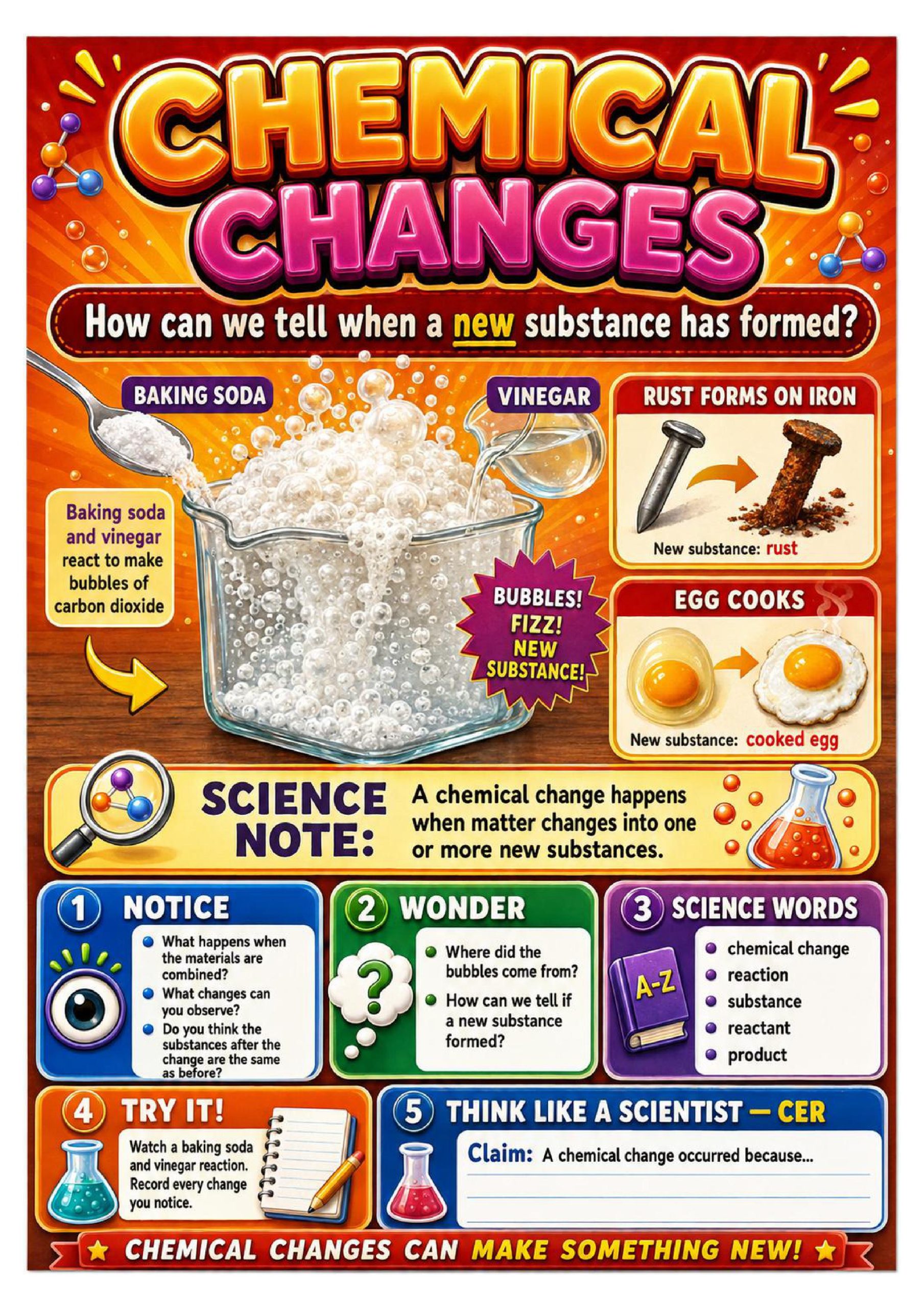
- Chemical Changes — Investigate examples such as baking soda and vinegar reacting, iron rusting, and an egg cooking to show that chemical changes form new substances.
- Evidence of Chemical Change — Identify clues scientists use, such as gas production, temperature change, color change, light produced, formation of a new solid, and a new odor.
- Same Substance or New Substance? — Compare physical and chemical changes by asking the most important question: did the material stay the same substance or become something new?
- Reversible or Irreversible? — Examine how reversibility can be a helpful clue, but does not define whether a change is physical or chemical.
- Chemical or Physical? — Students investigate mystery changes, classify them using evidence, and explain their reasoning like scientists.
Each poster includes a large Essential Question, vivid science illustrations, a concise Science Note, Notice & Wonder prompts, key Science Words, a Try It! activity, and a Think Like a Scientist — CER response prompt.
MORE THAN A POSTER — A TEACHING TOOL
These posters are designed to help students move beyond simply memorizing definitions and begin understanding how scientists decide what kind of change has happened.
Students investigate questions such as:
What makes a change physical?
What makes a change chemical?
How can matter change without becoming something new?
How can scientists tell when a new substance has formed?
Which clues show that a chemical change may have happened?
Does reversible always mean physical?
Does irreversible always mean chemical?
How can evidence help us classify a mystery change?
Use the posters to introduce a lesson, activate prior knowledge, guide whole-group conversations, reinforce vocabulary, support small-group instruction, review important concepts, or provide visual references throughout a matter unit.
UNDERSTANDING PHYSICAL CHANGES
The Physical Changes poster helps students understand that a physical change affects how matter looks, feels, or exists, but it does not create a new substance.
Students examine examples such as:
- ice melting into water
- paper being cut
- clay being reshaped
Students learn that in a physical change, properties such as shape, size, or state may change, but the substance remains the same.
This gives students a strong foundation for recognizing that not every visible change means a new substance has formed.
UNDERSTANDING CHEMICAL CHANGES
The Chemical Changes poster introduces the idea that a chemical change happens when matter changes into one or more new substances.
Students examine examples such as:
- baking soda and vinegar reacting
- iron rusting
- an egg cooking
These examples help students recognize that chemical changes are different from physical changes because the original materials are transformed into something new.
The poster helps students focus on the key scientific idea that new substances are the defining feature of a chemical change.
EVIDENCE OF CHEMICAL CHANGE
The Evidence of Chemical Change poster provides students with important observable clues scientists use when deciding whether a chemical change may have happened.
Students explore signs such as:
- gas produced
- temperature change
- color change
- light produced
- a new solid forms
- a new odor
This poster helps students understand that scientists do not usually rely on a single clue alone. Instead, they gather evidence and look carefully at observations before making a conclusion.
SAME SUBSTANCE OR NEW SUBSTANCE?
The Same Substance or New Substance? poster gives students a direct compare-and-contrast view of physical and chemical changes.
On one side, students see examples of physical changes where the material remains the same substance:
- ice melting
- paper being cut
- clay being reshaped
On the other side, students see examples of chemical changes where a new substance forms:
- a nail rusting
- an egg cooking
- baking soda and vinegar reacting
This poster reinforces the most important question students can ask:
Did the material stay the same substance, or did it become something new?
That question helps students move beyond surface features and focus on the real difference between the two kinds of change.
REVERSIBLE OR IRREVERSIBLE?
The Reversible or Irreversible? poster helps students address a common misconception.
Students explore examples such as:
- ice melting and freezing
- clay being reshaped
- an egg cooking
- iron rusting
The poster explains that reversibility can be a helpful clue, but it does not define the type of change by itself.
Students learn that the better question is still:
Did a new substance form?
This section helps students think more carefully and avoid overgeneralizing based only on whether a change can be undone.
INVESTIGATE LIKE A SCIENTIST
The culminating Chemical or Physical? poster turns the topic into a classification investigation.
Students observe mystery changes such as:
- ice melting
- a nail rusting
- paper tearing
- an egg cooking
- clay being flattened
- baking soda and vinegar reacting
They use a simple scientific approach:
Observe → Look for Clues → Classify → Explain
This investigation encourages students to use evidence rather than guesses when deciding whether a change is physical or chemical.
It also provides meaningful practice with scientific observation, classification, reasoning, and CER writing.
BUILDS SCIENCE THINKING
Rather than simply memorizing examples, students are encouraged to look for evidence, compare changes, and explain their thinking.
Throughout the set, students practice:
- observing carefully
- comparing before and after changes
- identifying clues
- distinguishing physical changes from chemical changes
- recognizing when a new substance forms
- using reversibility as a clue
- classifying mystery examples
- supporting claims with evidence and reasoning
The recurring CER prompts help students connect their observations to scientific explanations.
KEY SCIENCE CONCEPTS
Students will explore concepts including:
- physical change
- chemical change
- substance
- matter
- shape
- size
- state
- reaction
- reactant
- product
- evidence
- gas
- temperature
- color change
- new solid
- odor
- reversible
- irreversible
- observe
- classify
- compare
- claim
- reasoning
PERFECT FOR
Whole-group science instruction, physical science units, matter units, physical and chemical change lessons, science anchor charts, classroom science walls, vocabulary reinforcement, morning review, small groups, science centers, CER practice, observation activities, compare-and-contrast lessons, science discussions, and unit review.
DESIGNED FOR STUDENT ENGAGEMENT
Bold headings, vivid colors, realistic science examples, before-and-after visuals, comparison layouts, clear clues, and easy-to-read information boxes help make abstract matter concepts understandable and memorable for elementary learners.
The coordinated design allows all six posters to work together as a complete instructional sequence:
Explore physical changes → investigate chemical changes → identify evidence → compare same substance versus new substance → use reversibility as a clue → classify mystery changes with evidence
Display all six together for an engaging Chemical Versus Physical Change science wall, or introduce them individually as students progress through the topic.
Turn your classroom walls into interactive science learning tools and help students discover that some changes only affect the form of matter, while other changes create entirely new substances—and that scientists use evidence to tell the difference.
- Grades K-5
- Instant digital download
- Print & reuse in class