Conservation of Matter Science Concept Posters
$5.00
6-Piece Visual Science Poster Set | Physical & Chemical Changes | Open & Closed Systems | Mass | CER
Bring Conservation of Matter to life with this bold, colorful, and highly visual 6-poster Science Concept Set!
Designed to do much more than simply decorate your science wall, these posters help students understand that matter is conserved during changes, distinguish physical and chemical changes, compare open and closed systems, investigate changes in mass, analyze evidence, and think like scientists.
Each poster combines large, engaging science visuals with clear student-friendly explanations, discussion prompts, vocabulary, simple investigations, and Claim-Evidence-Reasoning (CER) opportunities. Students explore what happens when matter melts, tears, changes shape, dissolves, evaporates, or reacts chemically while developing the important understanding that matter may change form or become difficult to see, but it does not simply disappear.
WHAT’S INCLUDED
This set includes 6 full-color, print-ready science posters:
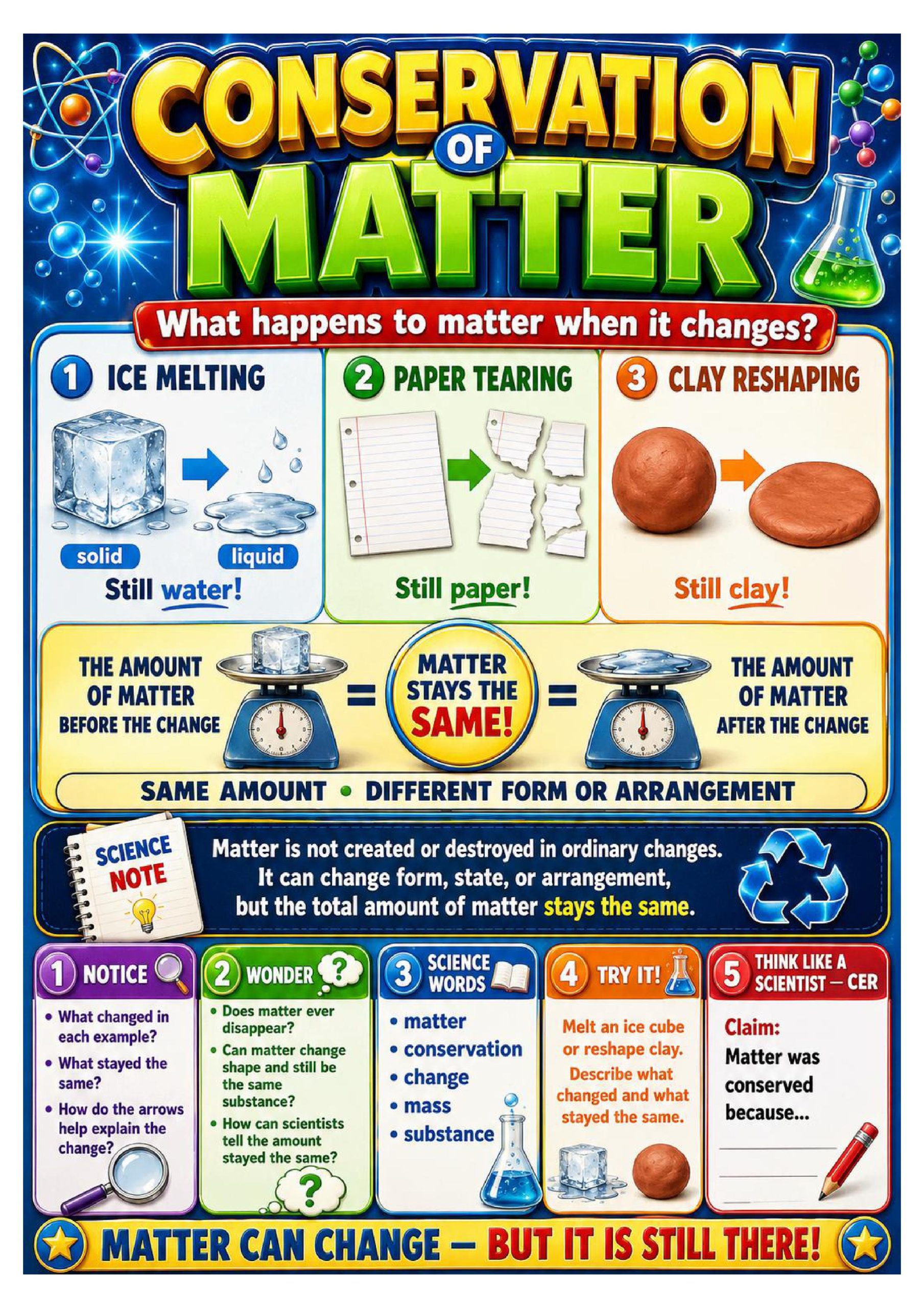
- Conservation of Matter — Introduce the idea that matter can change form, state, shape, or arrangement while the total amount of matter remains the same.
- Physical Changes Keep Matter — Explore melting, tearing, crushing, and reshaping as examples in which the material changes physically but remains the same substance.
- Chemical Changes Conserve Matter — Investigate how atoms rearrange to form new substances while the total amount of matter remains conserved.
- Open or Closed? — Compare open and closed systems and discover why closed systems make it easier to track all of the matter during a change.
- Did It Disappear? — Examine evaporation, dissolving, and spreading to understand that matter can become difficult to see without actually being gone.
- Be the Scientist! Matter Investigation — Students observe, measure, compare, and explain evidence showing whether matter was conserved during different changes.
Each poster includes a large Essential Question, vivid science illustrations, a concise Science Note, Notice & Wonder prompts, key Science Words, a Try It! activity, and a Think Like a Scientist — CER response prompt.
MORE THAN A POSTER — A TEACHING TOOL
These posters are designed to help students move beyond simply memorizing that “matter is conserved” and begin understanding what conservation of matter actually looks like during real changes.
Students investigate questions such as:
What happens to matter when it changes?
Can matter change shape and still be the same substance?
Does melting cause matter to disappear?
What happens to matter during a chemical reaction?
Why does a closed system help scientists measure matter?
Where does water go when it evaporates?
Is dissolved material still present even when we cannot see it?
What evidence can scientists use to show that matter was conserved?
Use the posters to introduce a lesson, activate prior knowledge, guide whole-group conversations, reinforce vocabulary, support small-group instruction, review important concepts, or provide visual references throughout a physical science or matter unit.
CONSERVATION OF MATTER
The introductory Conservation of Matter poster establishes the central idea of the set: matter is not created or destroyed during ordinary changes.
Students examine familiar examples such as:
- ice melting into liquid water
- paper being torn into smaller pieces
- clay being reshaped
Although each example looks different after the change, the material is still present.
The poster reinforces the important relationship:
Same amount of matter → different form, state, shape, or arrangement
This provides a strong foundation for understanding conservation before students investigate more complicated physical and chemical changes.
PHYSICAL CHANGES KEEP MATTER
The Physical Changes Keep Matter poster helps students recognize that physical changes can alter how matter looks without changing what substance it is.
Students examine examples including:
- ice melting
- paper tearing
- an aluminum can being crushed
- clay being reshaped
Students learn that a physical change may affect size, shape, or state, but the substance and total amount of matter remain the same.
Before-and-after examples make this idea especially clear and help students focus on the difference between what changed and what stayed the same.
CHEMICAL CHANGES CONSERVE MATTER
The Chemical Changes Conserve Matter poster extends the concept to reactions in which new substances form.
Using a sealed baking soda and vinegar reaction, students see that:
- reactants can change into new products
- gas may form
- atoms are rearranged
- the total mass of a closed system remains the same
The poster introduces the important idea that new substances can form without matter being created or destroyed.
Students also see an example of iron rusting, reinforcing that chemical changes involve new substances while conservation of matter still applies.
OPEN AND CLOSED SYSTEMS
The Open or Closed? poster helps students understand why scientists often use closed systems when investigating conservation of matter.
Students compare:
Open System
- matter can escape
- gases may leave the system
- measured mass may appear to decrease
Closed System
- matter stays inside
- gases remain contained
- scientists can measure the total matter more accurately
The visual comparison helps students understand an important scientific idea: if matter leaves the area being measured, it may look as though matter disappeared even though it simply moved somewhere else.
DID IT DISAPPEAR?
The Did It Disappear? poster tackles one of the most common misconceptions students have about matter.
Students investigate examples such as:
- an evaporating puddle
- sugar dissolving in water
- perfume or food coloring spreading out
Students learn that matter can:
- become a gas
- dissolve into another substance
- spread through air or water
- become too small or spread out to see easily
The key idea is that being invisible is not the same as being gone.
This poster provides a powerful visual foundation for helping students reason about matter they cannot directly observe.
INVESTIGATE LIKE A SCIENTIST
The culminating Be the Scientist! Matter Investigation poster turns conservation of matter into an evidence-based investigation.
Students examine mystery changes such as:
- melting ice
- reshaping clay
- dissolving salt in water
- reacting baking soda and vinegar in a sealed bag
They are encouraged to:
Observe → Measure → Compare → Explain
Students look for what changed, identify what stayed the same, use measurements when appropriate, and explain whether the evidence supports conservation of matter.
This gives students meaningful practice with scientific observation, measurement, comparison, classification, evidence, and CER reasoning.
BUILDS SCIENCE THINKING
Rather than simply memorizing a conservation rule, students are encouraged to look for evidence that matter is still present.
Throughout the set, students practice:
- comparing before and after changes
- identifying what changed and what stayed the same
- distinguishing physical and chemical changes
- measuring mass
- comparing open and closed systems
- reasoning about gases and dissolved substances
- recognizing that invisible matter is still matter
- using observations and measurements as evidence
- supporting scientific claims with reasoning
The recurring CER prompts help students connect concrete examples to the larger scientific principle of conservation.
KEY SCIENCE CONCEPTS
Students will explore concepts including:
- matter
- conservation
- mass
- substance
- physical change
- chemical change
- state
- shape
- atom
- reactant
- product
- conserved
- open system
- closed system
- gas
- measure
- evaporate
- dissolve
- vapor
- mixture
- observe
- evidence
- compare
- classify
PERFECT FOR
Whole-group science instruction, physical science units, matter units, conservation of matter lessons, physical and chemical change lessons, mass investigations, open and closed system lessons, science anchor charts, classroom science walls, vocabulary reinforcement, morning review, small groups, science centers, CER practice, hands-on investigations, measurement activities, science discussions, and unit review.
DESIGNED FOR STUDENT ENGAGEMENT
Bold headings, vivid colors, before-and-after comparisons, balanced-scale visuals, particle and reaction models, open-versus-closed system diagrams, real-world examples, and easy-to-read information boxes help make an abstract conservation principle understandable and memorable for elementary learners.
The coordinated design allows all six posters to work together as a complete instructional sequence:
Introduce conservation of matter → investigate physical changes → explore chemical changes → compare open and closed systems → investigate matter that seems to disappear → observe, measure, compare, and explain with evidence
Display all six together for an engaging Conservation of Matter science wall, or introduce them individually as students progress through the topic.
Turn your classroom walls into interactive science learning tools and help students discover that matter may melt, tear, reshape, react, dissolve, evaporate, or spread out—but careful observations and measurements reveal that the matter is still there.
- Grades K-5
- Instant digital download
- Print & reuse in class