Ecosystems Science Concept Posters
$5.00
6-Piece Visual Science Poster Set | Food Chains | Food Webs | Biotic & Abiotic Factors | Habitats | Niches | CER
Bring Ecosystems to life with this bold, colorful, and highly visual 6-poster Science Concept Set!
Designed to do much more than simply decorate your science wall, these posters help students identify the living and nonliving parts of ecosystems, explore how organisms interact with their environments, trace the flow of energy through food chains and food webs, distinguish habitats from niches, investigate ecosystem changes, analyze evidence, and think like scientists.
Each poster combines large, engaging science visuals with clear student-friendly explanations, discussion prompts, vocabulary, simple observation activities, and Claim-Evidence-Reasoning (CER) opportunities. Students see how plants, animals, fungi, microorganisms, sunlight, water, air, soil, and other components are connected within an ecosystem and how a change in one part can affect many others.
WHAT’S INCLUDED
This set includes 6 full-color, print-ready science posters:
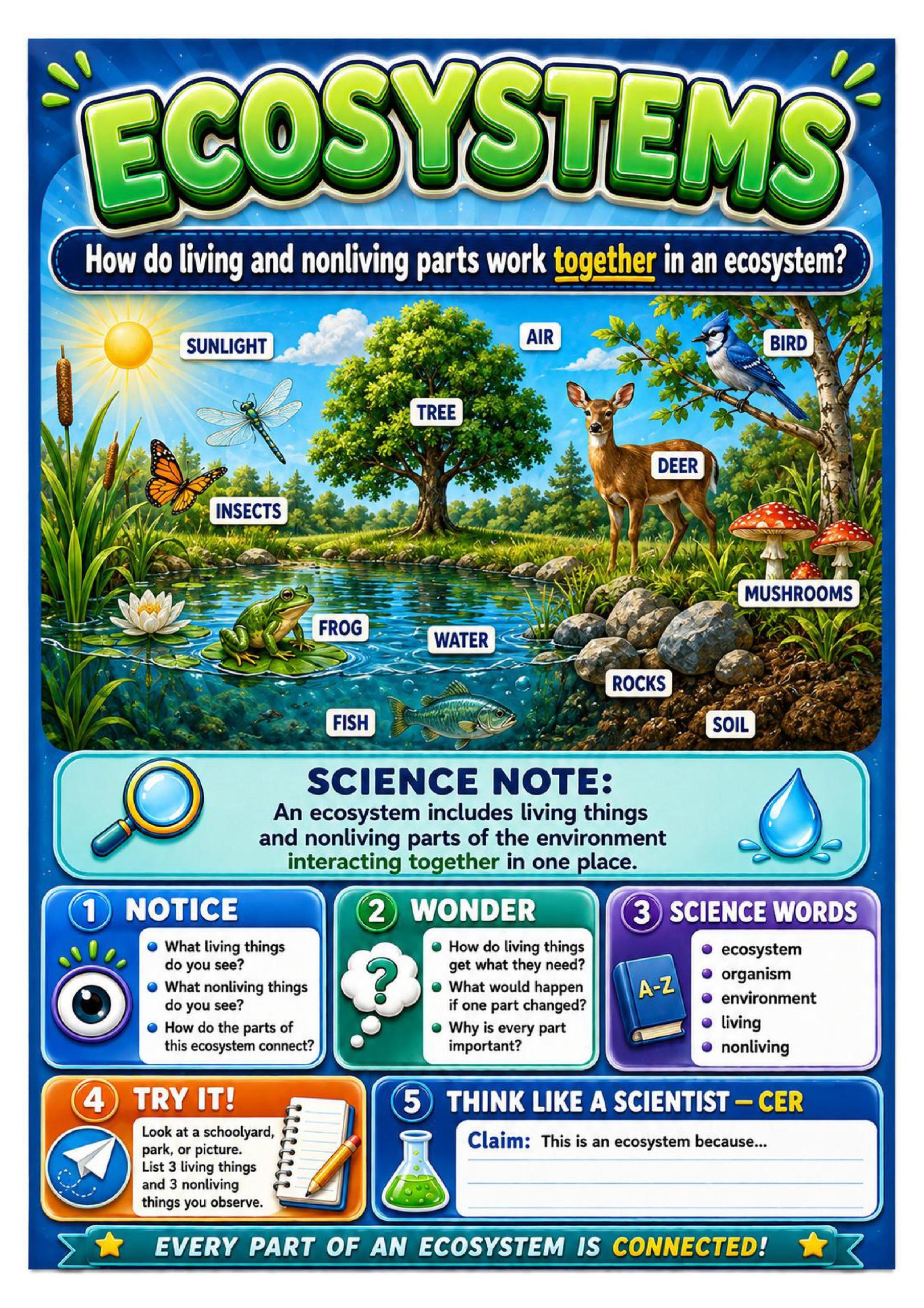
- Ecosystems — Introduce ecosystems as places where living organisms and nonliving parts of the environment interact.
- Be the Scientist! Investigate an Ecosystem — Students observe an ecosystem, record evidence, analyze patterns, and share what they discover.
- Food Chains and Food Webs — Explore how energy moves from the Sun to producers and consumers through individual food chains and interconnected food webs.
- Components of an Ecosystem — Compare biotic, or living, components with abiotic, or nonliving, components and examine how they work together.
- Habitats and Niches — Distinguish between the place an organism lives and the role or job it performs within an ecosystem.
- Balance and Change in Ecosystems — Investigate how changes such as pollution, habitat damage, population changes, or invasive species can affect many interconnected parts of an ecosystem.
Each poster includes a large Essential Question, vivid science illustrations, a concise Science Note, Notice & Wonder prompts, key Science Words, a Try It! activity, and a Think Like a Scientist — CER response prompt.
MORE THAN A POSTER — A TEACHING TOOL
These posters are designed to help students move beyond simply memorizing ecosystem vocabulary and begin understanding how the parts of an ecosystem are connected.
Students investigate questions such as:
What makes something an ecosystem?
How do living and nonliving parts interact?
What do organisms need from their environments?
How does energy move through an ecosystem?
How are food chains and food webs different?
What is the difference between a habitat and a niche?
What happens when one part of an ecosystem changes?
How can scientists collect evidence and identify patterns in an ecosystem?
Use the posters to introduce a lesson, activate prior knowledge, guide whole-group conversations, reinforce vocabulary, support small-group instruction, review important concepts, or provide visual references throughout a life science or ecosystems unit.
LIVING AND NONLIVING PARTS WORK TOGETHER
The introductory Ecosystems poster gives students a visual overview of the many parts that can exist together in one environment.
Students observe living components such as:
- trees
- insects
- birds
- deer
- frogs
- fish
- mushrooms
They also identify nonliving components such as:
- sunlight
- air
- water
- rocks
- soil
The poster reinforces the central idea that an ecosystem includes living things and nonliving parts of the environment interacting together in one place.
This provides a strong foundation for understanding why every part of an ecosystem can matter.
BIOTIC AND ABIOTIC COMPONENTS
The Components of an Ecosystem poster introduces the scientific terms biotic and abiotic.
Students learn that biotic components include living things such as:
- plants
- animals
- fungi
- bacteria
Abiotic components include nonliving environmental factors such as:
- sunlight
- water
- air
- soil
- rocks
The visual organization helps students classify ecosystem components while emphasizing that both groups are needed and interact with one another.
Rather than seeing living and nonliving factors as separate lists, students begin to recognize that sunlight, water, air, soil, plants, animals, and decomposers are all part of an interconnected system.
FOOD CHAINS AND FOOD WEBS
The Food Chains and Food Webs poster helps students visualize how energy moves through ecosystems.
Students examine a food chain beginning with the Sun and continuing through:
Sun → Grass → Grasshopper → Frog → Snake → Hawk
This introduces producers and different consumers while showing one pathway through which energy can move.
Students then compare that simple food chain with a more complex food web in which plants and multiple animals are connected through many feeding relationships.
The poster emphasizes that:
- producers begin many feeding pathways
- consumers obtain energy by eating other organisms
- arrows show the direction of energy flow
- food chains show a single pathway
- food webs show many interconnected pathways
This visual comparison makes an abstract concept easier for elementary students to understand.
HABITATS AND NICHES
The Habitats and Niches poster helps students distinguish two concepts that are often confused.
Students learn that:
- a habitat is the place where an organism lives
- a niche is the role or job an organism performs in its ecosystem
Examples of habitats include:
- forests
- ponds
- deserts
- oceans
Examples of niches include organisms acting as:
- pollinators
- decomposers
- nighttime hunters
- food seekers
Students can see that organisms may share the same habitat while performing very different roles.
This helps students understand that survival involves both living in an appropriate place and performing a role within the ecosystem.
INVESTIGATE LIKE A SCIENTIST
The Be the Scientist! Investigate an Ecosystem poster turns ecosystem learning into an observation-based investigation.
Students follow a four-step process:
Observe → Record → Analyze → Share
They look carefully at a local ecosystem, record living and nonliving things, collect evidence, identify patterns in their observations, and communicate what they discovered.
Students are encouraged to ask questions such as:
What organisms are present?
Which nonliving factors can be observed?
What patterns appear in the data?
How might the different parts be connected?
This provides a natural opportunity to practice scientific observation, data collection, pattern recognition, evidence-based explanation, and communication.
BALANCE AND CHANGE IN ECOSYSTEMS
The Balance and Change in Ecosystems poster helps students explore what can happen when one part of an ecosystem changes.
Students compare a balanced ecosystem with one that has been disrupted.
Examples of changes shown include:
- pollution affecting water and air
- habitat damage
- fewer plants and less shelter
- changes in available food
- changing populations
- invasive species crowding out native organisms
The visual comparison reinforces the important systems-thinking idea that one change can affect many parts of an ecosystem.
Students begin to see that ecosystems are networks of relationships rather than collections of unrelated organisms.
BUILDS SCIENCE THINKING
Rather than simply asking students to memorize terms, this set encourages them to observe relationships, identify patterns, trace energy, compare components, and explain cause and effect.
Throughout the set, students practice:
- identifying living and nonliving components
- classifying biotic and abiotic factors
- tracing energy through food chains
- interpreting food webs
- comparing habitats and niches
- observing ecosystem interactions
- collecting and analyzing evidence
- recognizing patterns
- predicting the effects of change
- supporting claims with evidence and reasoning
The recurring CER prompts help students connect their observations to scientific explanations.
KEY SCIENCE CONCEPTS
Students will explore concepts including:
- ecosystem
- organism
- environment
- living
- nonliving
- biotic
- abiotic
- component
- interact
- producer
- consumer
- food chain
- food web
- energy
- habitat
- niche
- shelter
- role
- survive
- balance
- change
- impact
- population
- evidence
- data
- pattern
- conclusion
PERFECT FOR
Whole-group science instruction, life science units, ecosystems lessons, habitats lessons, food chain and food web units, biotic and abiotic factor lessons, environmental science connections, phenomenon-based learning, science anchor charts, classroom science walls, vocabulary reinforcement, morning review, small groups, science centers, CER practice, outdoor observations, science investigations, science discussions, and unit review.
DESIGNED FOR STUDENT ENGAGEMENT
Bold headings, vivid colors, detailed ecosystem scenes, labeled organisms and environmental components, clear energy-flow arrows, food-web diagrams, habitat examples, comparison visuals, and easy-to-read information boxes help make complex ecological relationships understandable and memorable for elementary learners.
The coordinated design allows all six posters to work together as a complete instructional sequence:
Explore ecosystem interactions → investigate an ecosystem → trace energy through food chains and food webs → classify biotic and abiotic components → connect habitats and niches → analyze balance and change
Display all six together for an engaging Ecosystems science wall, or introduce them individually as students progress through the topic.
Turn your classroom walls into interactive science learning tools and help students discover that ecosystems are connected systems where living things depend on one another and on their environment, energy moves through feeding relationships, and changes in one part can affect the whole.
- Grades K-5
- Instant digital download
- Print & reuse in class