Energy Transfer Science Concept Posters
$5.00
6-Piece Visual Science Poster Set | Conduction | Convection | Radiation | Thermal Energy | CER
Bring Energy Transfer to life with this bold, colorful, and highly visual 6-poster Science Concept Set!
Designed to do much more than simply decorate your science wall, these posters help students understand how thermal energy moves, distinguish conduction, convection, and radiation, compare different methods of energy transfer, analyze evidence, build science vocabulary, and think like scientists.
Each poster combines large, engaging science visuals with clear student-friendly explanations, discussion prompts, vocabulary, simple investigations, and Claim-Evidence-Reasoning (CER) opportunities. Students explore how energy moves from warmer places to cooler places through direct contact, moving liquids and gases, or waves that can travel across a distance.
WHAT’S INCLUDED
This set includes 6 full-color, print-ready science posters:
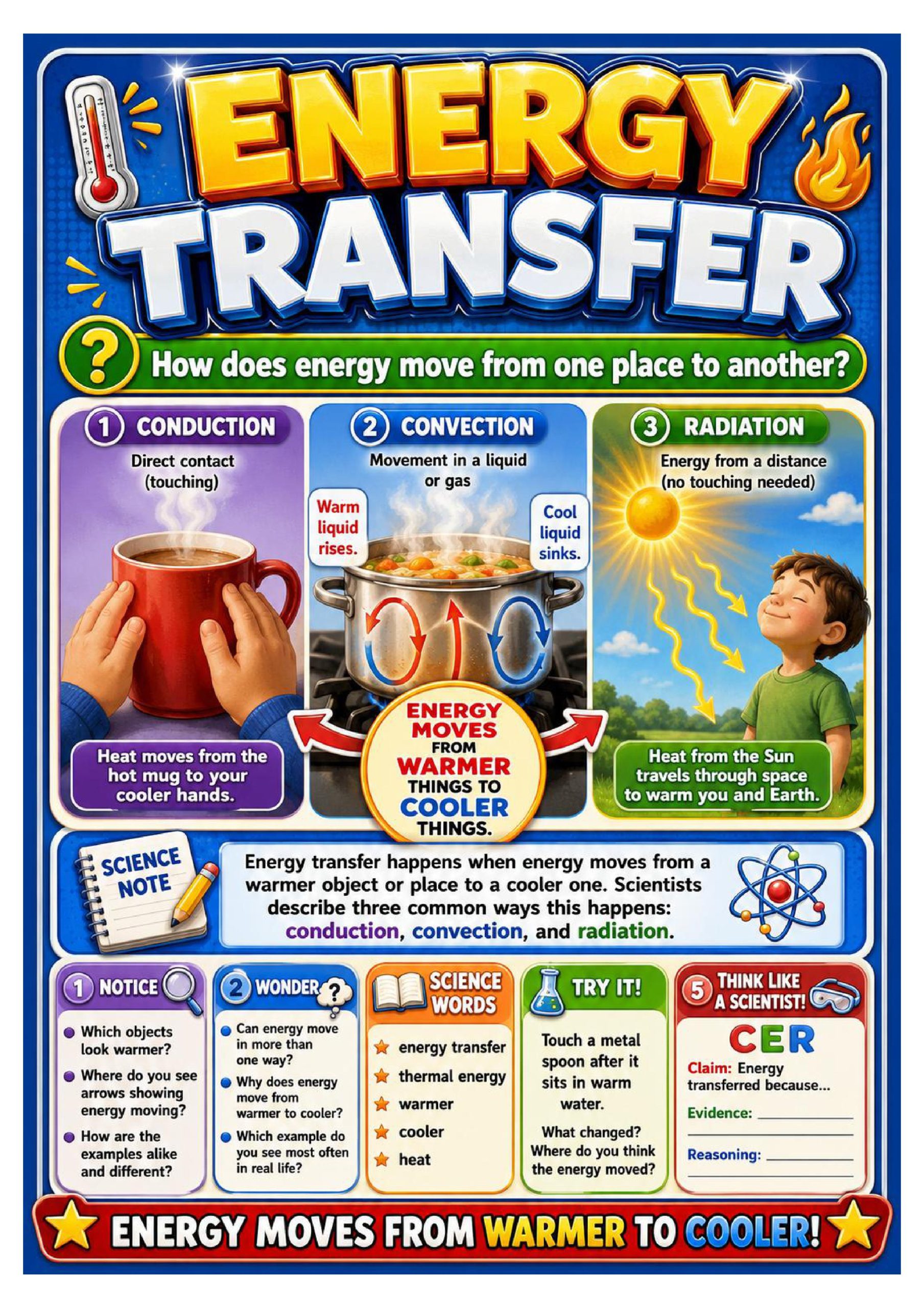
- Energy Transfer — Introduce conduction, convection, and radiation and explore three common ways thermal energy moves from warmer objects or places to cooler ones.
- Conduction — Investigate energy transfer through direct contact using examples such as a warm mug, metal spoon, and heated pan.
- Convection — Explore how thermal energy moves through liquids and gases as warmer fluid rises and cooler fluid sinks.
- Radiation — Discover how energy can travel as waves across a distance without direct contact, including energy from the Sun and heat from a campfire.
- Conduction, Convection, or Radiation? — Compare the three types of energy transfer and identify each one by looking for clues about how energy is moving.
- Be the Scientist! Investigate Energy Transfer — Students observe, test, record data, identify the type of transfer, and use evidence to explain their conclusions.
Each poster includes a large Essential Question, vivid science illustrations, a concise Science Note, Notice & Wonder prompts, key Science Words, a Try It! activity, and a Think Like a Scientist — CER response prompt.
MORE THAN A POSTER — A TEACHING TOOL
These posters are designed to help students move beyond simply memorizing three definitions and begin understanding how energy actually moves from one place to another.
Students investigate questions such as:
How does energy move from one place to another?
Why does thermal energy move from warmer objects to cooler objects?
How does direct contact transfer energy?
How do moving liquids and gases carry energy?
How can energy travel without touching?
How can we tell whether an example shows conduction, convection, or radiation?
Can more than one type of energy transfer happen at the same time?
Use the posters to introduce a lesson, activate prior knowledge, guide whole-group conversations, reinforce vocabulary, support small-group instruction, review important concepts, or provide visual references throughout a physical science, heat, or energy unit.
UNDERSTANDING ENERGY TRANSFER
The introductory Energy Transfer poster presents the three major types of thermal energy transfer side by side.
Students learn that:
- Conduction transfers energy through direct contact.
- Convection transfers energy through the movement of liquids or gases.
- Radiation transfers energy across a distance as waves without direct contact.
The poster also reinforces the important idea that thermal energy moves from warmer objects or places toward cooler ones.
This gives students a strong conceptual foundation before they explore each transfer method in greater detail.
CONDUCTION
The Conduction poster helps students see how touching can transfer thermal energy.
Students examine examples such as:
- a warm spoon heating a hand
- a metal pan handle becoming warmer
- a hot mug warming cooler hands
Clear arrows show the direction of energy movement and help students recognize that conduction depends on direct contact between materials.
Students also explore the idea that some materials conduct heat more effectively than others.
CONVECTION
The Convection poster focuses on thermal energy moving through fluids.
Students observe examples of:
- warm liquid rising
- cool liquid sinking
- circulating water in a heated pot
- warm air rising in a room
- cooler air moving downward
These visuals help students understand convection as a continuous movement in which warmer fluids rise, cooler fluids sink, and the moving fluid carries thermal energy.
RADIATION
The Radiation poster introduces energy transfer without direct contact.
Students explore how radiant energy can travel:
- from the Sun through space to Earth
- from a campfire to nearby hands
- across a distance without objects touching
The visual examples help students recognize that radiation transfers energy as waves and does not require direct contact or moving matter between the source and receiver.
COMPARE THE THREE TYPES OF ENERGY TRANSFER
The Conduction, Convection, or Radiation? poster gives students a clear strategy for distinguishing among the three processes.
Students can ask:
Are objects touching?
Then it may be conduction.
Is a liquid or gas moving?
Then it may be convection.
Is energy traveling from a distance?
Then it may be radiation.
This comparison helps students move from recognizing isolated examples to identifying the scientific pattern behind each type of transfer.
It also provides an excellent visual reference for review, discussion, sorting activities, and assessment preparation.
INVESTIGATE LIKE A SCIENTIST
The culminating Be the Scientist! Investigate Energy Transfer poster turns the topic into an evidence-based investigation.
Students follow a five-step process:
Observe → Test → Record Data → Identify the Transfer → Explain With Evidence
Students can observe a warm object or energy source, make careful measurements, track temperature changes over time, identify which transfer processes are occurring, and use evidence to explain their reasoning.
The poster models the use of a data table and graph, helping students connect scientific observations to measurable evidence.
This provides a natural opportunity to practice investigation planning, data collection, pattern recognition, scientific explanation, and CER reasoning.
BUILDS SCIENCE THINKING
Rather than simply labeling examples, students are encouraged to look for evidence of how energy is moving.
Throughout the set, students practice:
- observing temperature differences
- tracing the direction of energy movement
- identifying warmer and cooler objects
- comparing conduction, convection, and radiation
- interpreting arrows and diagrams
- using observations as evidence
- collecting temperature data
- looking for patterns over time
- explaining energy transfer
- supporting claims with evidence and reasoning
The recurring CER prompts help students connect what they observe to scientific explanations.
KEY SCIENCE CONCEPTS
Students will explore concepts including:
- energy
- energy transfer
- thermal energy
- heat
- temperature
- warmer
- cooler
- conduction
- direct contact
- convection
- liquid
- gas
- rise
- sink
- radiation
- radiant energy
- waves
- source
- receiver
- space
- compare
- observe
- investigate
- data
- evidence
- transfer
PERFECT FOR
Whole-group science instruction, physical science units, thermal energy lessons, heat transfer units, conduction lessons, convection lessons, radiation lessons, science anchor charts, classroom science walls, vocabulary reinforcement, morning review, small groups, science centers, CER practice, temperature investigations, data collection activities, science discussions, and unit review.
DESIGNED FOR STUDENT ENGAGEMENT
Bold headings, vivid colors, realistic heat-transfer examples, directional arrows, temperature visuals, comparison diagrams, data tables, graphs, and easy-to-read information boxes help make invisible energy movement understandable and memorable for elementary learners.
The coordinated design allows all six posters to work together as a complete instructional sequence:
Introduce energy transfer → investigate conduction → investigate convection → investigate radiation → compare the three processes → observe, test, record, and explain with evidence
Display all six together for an engaging Energy Transfer science wall, or introduce them individually as students progress through the topic.
Turn your classroom walls into interactive science learning tools and help students discover how thermal energy moves through touching objects, moving fluids, and radiant waves—and how scientists use observations and evidence to explain that movement.
- Grades K-5
- Instant digital download
- Print & reuse in class