Evolutionary History Phenomena Poster Set
$5.00
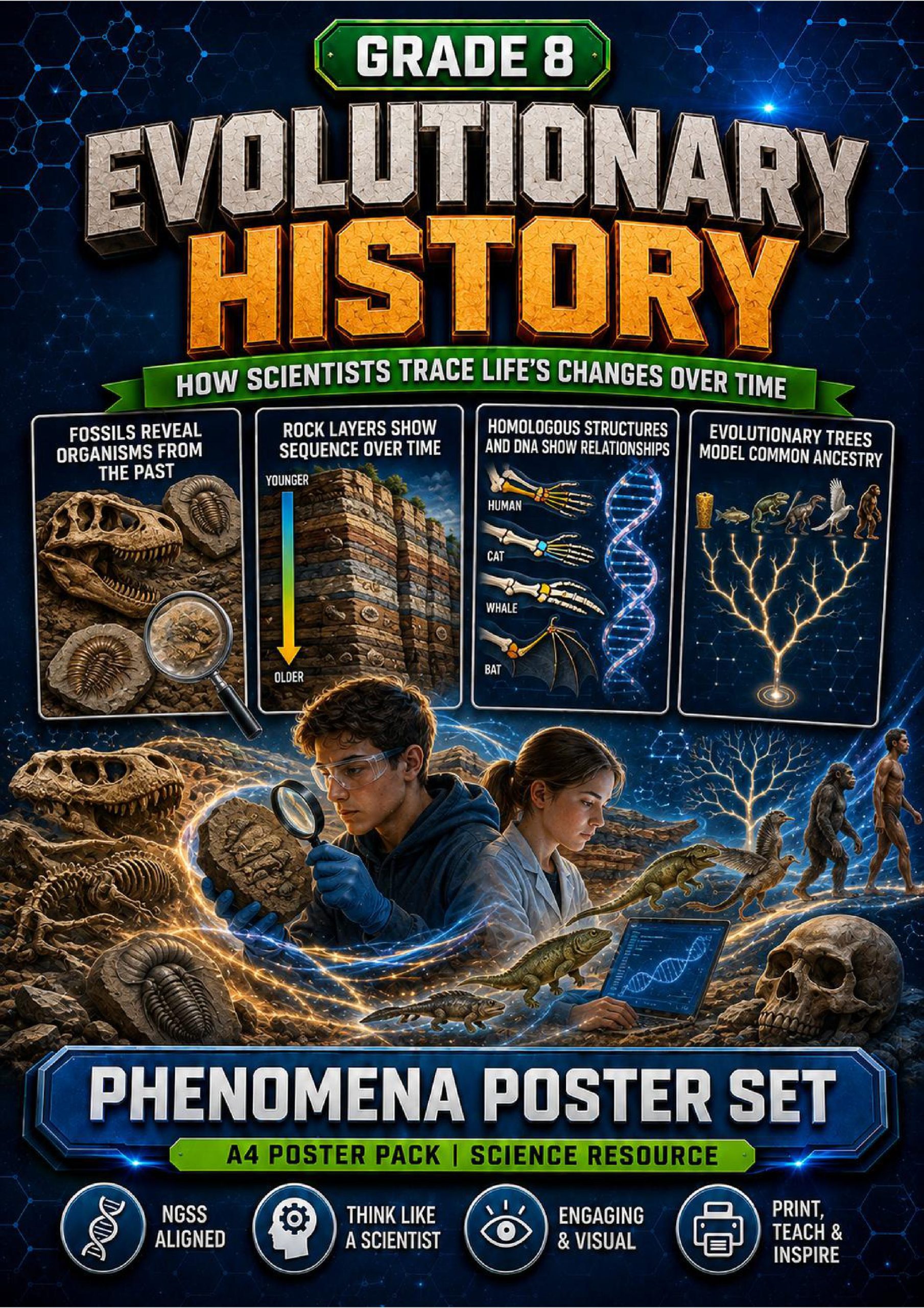
Help students investigate how scientists use evidence to reconstruct the evolutionary history of organisms with this engaging Evolutionary History phenomena resource.
This six-poster collection uses visually rich science phenomena to encourage students to compare structures, analyze fossils, interpret patterns, examine relationships, and develop explanations about common ancestry and how species have changed over long periods of time.
Students move beyond simply identifying fossils and begin thinking about how multiple lines of evidence can be used to explain relationships among organisms from the past and present.
What’s Included
This resource includes six individual full-color portrait phenomena posters.
Each poster includes:
A high-interest phenomenon question
A detailed science visual, fossil comparison, model, or evolutionary scenario
“What do you notice?” observation prompts
“What do you wonder?” discussion questions
Key science vocabulary
A “Try This Thinking” activity or challenge
A CER Starter for Claim, Evidence, and Reasoning practice
A concise science statement reinforcing the main concept
Explore Evidence From the Past
Students investigate how scientists study organisms that lived long ago.
The phenomena provide opportunities to examine fossils, preserved structures, rock layers, and other evidence that can reveal information about past life.
Students begin considering what scientists can infer from evidence even when the organisms themselves are no longer alive.
Compare Structures Across Organisms
Similar body structures can provide important evidence about evolutionary relationships.
Students can compare anatomical features and consider questions such as:
What structures are similar?
What differences do you notice?
Could these organisms share a common ancestor?
How might the structures have changed over time?
What evidence supports a possible relationship?
Why might related organisms have different structures today?
These questions help students connect observable similarities with evolutionary explanations.
Investigate Common Ancestry
Students explore the idea that different species can share ancestors from the past.
The posters encourage students to analyze patterns among organisms and use evidence to develop explanations about how groups may be related.
Students begin thinking about evolutionary history as a branching pattern rather than a simple straight line from one organism to another.
Analyze the Fossil Record
Fossils provide evidence about organisms that lived at different times in Earth’s history.
Students can compare fossils from different rock layers, identify patterns of appearance and change, and consider how the fossil record helps scientists reconstruct biological history.
These phenomena help students connect geological evidence with evolutionary explanations.
Use Multiple Lines of Evidence
Scientists rarely rely on one piece of evidence when studying evolutionary history.
Students can compare information from fossils, body structures, patterns of development, and other evidence to determine which explanations are best supported.
This helps students understand that stronger scientific explanations often depend on several independent pieces of evidence pointing toward the same conclusion.
Develop and Interpret Evolutionary Models
Evolutionary history often involves events that occurred millions of years ago.
Students can use diagrams, branching models, timelines, and other representations to visualize relationships and changes over time.
The posters provide opportunities to interpret these models and revise explanations as additional evidence becomes available.
Build Observation and Questioning Skills
Each poster includes structured Notice and Wonder prompts that encourage students to investigate before forming an explanation.
Students can:
Compare fossils and structures
Identify similarities and differences
Look for patterns over time
Analyze evolutionary models
Generate scientific questions
Evaluate possible relationships
Develop and revise explanations
These routines support inquiry-based science learning and meaningful classroom discussion.
Strengthen Science Vocabulary
Important science vocabulary is embedded within meaningful phenomena.
Students encounter concepts related to evolutionary history, fossils, common ancestry, species, structures, evidence, adaptation, extinction, fossil record, and evolutionary relationships while actively using those terms to explain what they observe.
Displaying the posters throughout the unit provides students with an ongoing visual reference for academic science vocabulary.
Support CER Practice
Each poster includes a student-friendly CER Starter.
Students practice making a Claim about an evolutionary relationship, identifying Evidence from fossils, structures, or models, and using Reasoning to explain how that evidence supports their scientific conclusion.
Repeated CER opportunities help students become more confident constructing explanations about events and relationships that cannot be directly observed.
Connect Change Over Time to Evidence
Evolutionary history involves changes that occur across extremely long periods of time.
The posters help students connect evidence from different time periods and consider how populations and species may have changed.
Students can use patterns in evidence to build explanations about continuity, change, extinction, and common ancestry.
Great for Classroom Use
Use these posters for:
Whole-group science instruction
Phenomenon launches
Science focus walls
Notice and Wonder routines
Small-group instruction
Science centers
Science notebook responses
Vocabulary development
CER practice
Fossil analysis
Evolutionary modeling
Comparative anatomy discussions
Evidence analysis
Partner conversations
Unit introductions
Review and reinforcement
Classroom displays
Revisit the Phenomena Throughout the Unit
Introduce each phenomenon before students have developed a complete explanation and collect their initial ideas.
As students examine additional fossils, compare structures, and develop models of evolutionary relationships, return to the posters and ask them to revise their thinking.
Students can incorporate new evidence, strengthen their models, and use increasingly precise scientific vocabulary in their explanations.
Make Evolutionary History More Accessible
Students cannot directly observe events that occurred millions of years ago, which makes evolutionary history an ideal context for evidence-based scientific reasoning.
These posters provide visual evidence and models that help students compare organisms, identify patterns, and reconstruct possible relationships.
By combining engaging phenomena with structured questioning, fossil evidence, modeling, vocabulary development, and CER practice, this resource provides meaningful support throughout an Evolutionary History unit.
Important Disclaimer
This resource is independently created and is not affiliated with, endorsed by, sponsored by, or produced by Amplify Education. The use of “Amplify” in the product title is intended only to help educators identify the curriculum topic with which this supplemental resource may be used. Amplify Education owns its respective trademarks and curriculum materials.
- Grade 8
- Instant digital download
- Print & reuse in class