Fossils Science Concept Posters
$5.00
6-Piece Visual Science Poster Set | Fossil Types | Fossil Evidence | Past Life | Extinction | CER
Bring Fossils to life with this bold, colorful, and highly visual 6-poster Science Concept Set!
Designed to do much more than simply decorate your science wall, these posters help students identify different kinds of fossils, understand how fossils form, use fossil evidence to learn about the past, explore extinction, build science vocabulary, analyze clues, and think like scientists.
Each poster combines large, engaging science visuals with clear student-friendly explanations, discussion prompts, vocabulary, simple observation activities, and Claim-Evidence-Reasoning (CER) opportunities. Students explore how fossils preserve clues about ancient plants, animals, and environments while also learning how scientists use evidence to explain extinction and life long ago.
WHAT’S INCLUDED
This set includes 6 full-color, print-ready science posters:
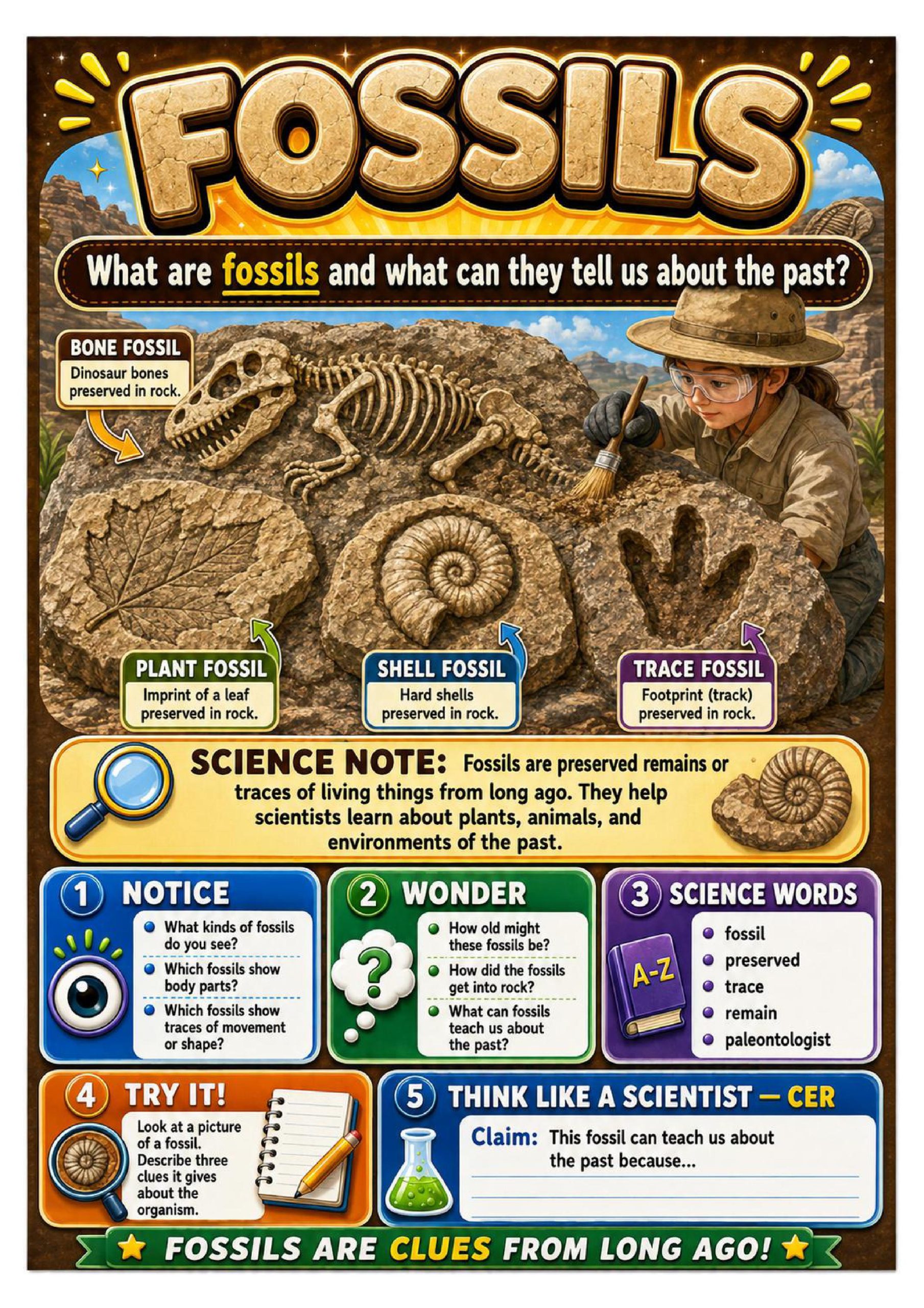
- Fossils — Introduce fossils as preserved remains or traces of living things and explore examples such as bone fossils, shell fossils, plant fossils, and trace fossils.
- How Fossils Form — Follow the step-by-step process of fossil formation, from an organism or trace being left behind to burial, sediment buildup, fossilization, and discovery.
- Types of Fossils — Compare body fossils, trace fossils, mold and cast fossils, and petrified wood.
- Fossils Are Evidence — Investigate how fossils give scientists clues about what organisms looked like, how they moved, what they may have eaten, and what past environments were like.
- Extinction — Explore what it means when a species becomes extinct and compare extinct species with endangered species that are still living but at risk.
- Be the Scientist! Fossils & Extinction — Students observe a mystery fossil, identify clues, compare evidence, and explain what the fossil suggests about the organism and the past.
Each poster includes a large Essential Question, vivid science illustrations, a concise Science Note, Notice & Wonder prompts, key Science Words, a Try It! activity, and a Think Like a Scientist — CER response prompt.
MORE THAN A POSTER — A TEACHING TOOL
These posters are designed to help students move beyond simply recognizing fossil pictures and begin understanding how fossils act as scientific evidence.
Students investigate questions such as:
What are fossils?
How do fossils form over time?
What different kinds of fossils can scientists find?
What clues can fossils give us about living things from long ago?
How do fossils help scientists infer habitats, movement, and diet?
What does it mean when a species becomes extinct?
How is endangered different from extinct?
How can scientists use fossil evidence to explain the past?
Use the posters to introduce a lesson, activate prior knowledge, guide whole-group conversations, reinforce vocabulary, support small-group instruction, review important concepts, or provide visual references throughout an Earth science, life science, or paleontology unit.
EXPLORE WHAT FOSSILS ARE
The introductory Fossils poster helps students understand that fossils are preserved remains or traces of living things from long ago.
Students examine examples such as:
- bone fossils
- plant fossils
- shell fossils
- trace fossils
This poster establishes the important idea that fossils are not only bones. Some fossils preserve body parts, while others preserve evidence of activity such as footprints or other traces.
HOW FOSSILS FORM
The How Fossils Form poster gives students a clear sequence for understanding fossil formation.
Students follow the process:
An organism or trace is left behind → quick burial by mud or sand → layers of sediment build up → remains are preserved and turned into fossil → the fossil is discovered later
This visual sequence helps students understand that fossil formation usually takes a very long time and often depends on quick burial and gradual change over time.
TYPES OF FOSSILS
The Types of Fossils poster helps students compare several major fossil categories.
Students investigate:
- body fossils — preserved remains such as bones or teeth
- trace fossils — evidence of activity such as footprints or burrows
- mold and cast fossils — impressions and filled-in shapes
- petrified wood — wood that has been replaced by minerals and turned to stone
This comparison helps students sort fossils by what kind of evidence each one preserves.
FOSSILS AS EVIDENCE
One of the strongest parts of the set is the Fossils Are Evidence poster, which shows students how fossils help scientists infer information about the past.
Examples in the poster show that fossils can provide clues about:
- body structure
- movement
- diet
- habitat
- plants and animals that once lived in an area
Students see that a sharp tooth fossil might suggest meat eating, a flat tooth fossil might suggest plant eating, a footprint or trackway can show movement, and fish, shell, or leaf fossils can suggest past environments.
This helps students understand that fossils are not just objects to name. They are evidence scientists can use to make explanations.
UNDERSTANDING EXTINCTION
The Extinction poster helps students understand an important distinction between extinct and endangered.
Students learn that:
- a species is extinct when no living members remain anywhere on Earth
- a species is endangered when it is still living but at risk of becoming extinct
The poster uses visual examples of extinct animals and endangered animals to support compare-and-contrast thinking while reinforcing that extinction means a species is gone forever.
INVESTIGATE LIKE A SCIENTIST
The culminating Be the Scientist! Fossils & Extinction poster turns these concepts into a simple scientific investigation.
Students follow a four-step process:
Observe → Identify Clues → Compare → Explain
They study a mystery fossil, identify important features such as bones, teeth, tracks, or shell shapes, compare it with known organisms, and explain what the evidence suggests.
This gives students meaningful practice with observation, comparison, inference, evidence-based explanation, and CER reasoning.
BUILDS SCIENCE THINKING
Rather than simply memorizing fossil vocabulary, students are encouraged to look for clues and make scientific inferences.
Throughout the set, students practice:
- observing carefully
- identifying fossil features
- comparing examples
- sorting fossil types
- sequencing fossil formation
- inferring information about the past
- distinguishing extinct from endangered
- using evidence to support claims
- explaining scientific ideas
The built-in CER prompts help students connect what they observe to larger conclusions about organisms, environments, and extinction.
KEY SCIENCE CONCEPTS
Students will explore concepts including:
- fossil
- preserved
- trace
- remain
- paleontologist
- sediment
- bury
- layer
- mineral
- fossilize
- body fossil
- trace fossil
- mold
- cast
- petrified
- evidence
- infer
- habitat
- organism
- environment
- extinct
- endangered
- species
- clue
- conclusion
- extinction
PERFECT FOR
Whole-group science instruction, Earth science units, life science units, fossil lessons, extinction lessons, paleontology studies, phenomenon-based learning, science anchor charts, classroom science walls, vocabulary reinforcement, morning review, small groups, science centers, CER practice, observation activities, compare-and-contrast lessons, science discussions, and unit review.
DESIGNED FOR STUDENT ENGAGEMENT
Bold headings, vivid colors, realistic fossil imagery, labeled examples, step-by-step sequences, comparison visuals, and easy-to-read information boxes help make ancient life and fossil evidence understandable and memorable for elementary learners.
The coordinated design allows all six posters to work together as a complete instructional sequence:
Introduce fossils → learn how fossils form → compare fossil types → use fossils as evidence → understand extinction → observe, compare, and explain with evidence
Display all six together for an engaging Fossils and Extinction science wall, or introduce them individually as students progress through the topic.
Turn your classroom walls into interactive science learning tools and help students discover how fossils preserve clues from long ago, how scientists use evidence to explain the past, and how extinction helps us understand changes in life on Earth.
- Grades K-5
- Instant digital download
- Print & reuse in class