Grade 7 Science Vocabulary Cards | Plate Motion | Plate Tectonics, Earthquakes & Landforms
$5.00
Help students build a strong understanding of plate tectonics, Earth’s internal layers, plate boundaries, earthquakes, mountain building, seafloor spreading, and subduction with this engaging Grade 7 Plate Motion Science Vocabulary Card Set.
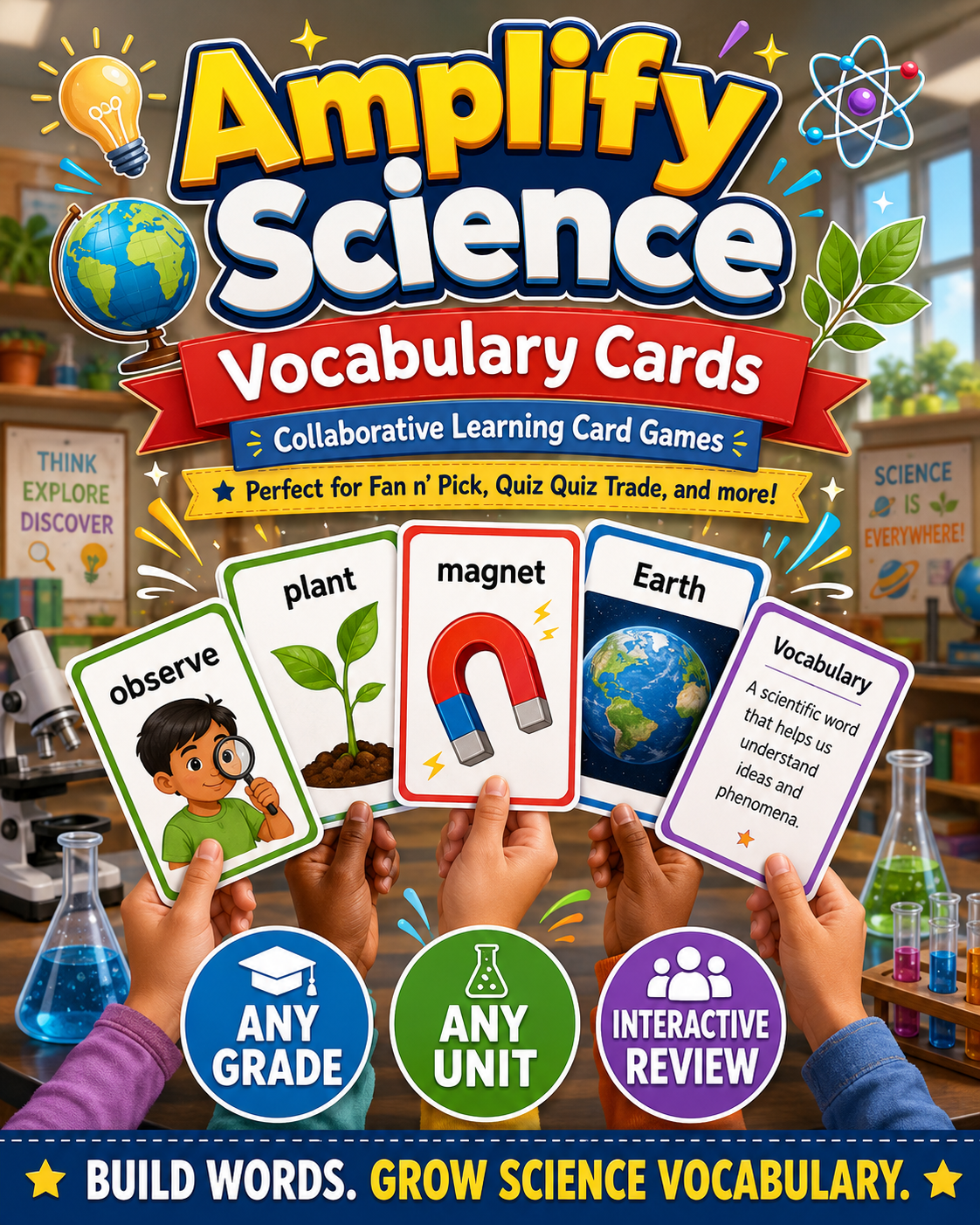
This resource includes 50 vocabulary cards designed to strengthen science language through repeated reading, speaking, and application. Each card includes a student-friendly meaning, a science-based example sentence, and three built-in prompts: How do you spell ___?, What is ___?, and Use ___ in a sentence.
Students work with essential plate tectonics concepts such as plate, plate motion, boundary, convergent, divergent, transform, subduction, seafloor spreading, rift, fault, earthquake, mountain range, ocean trench, and mid-ocean ridge. These terms help students explain how tectonic plates move and how their interactions reshape Earth’s surface.
The set also develops understanding of Earth’s internal structure with vocabulary such as crust, continental crust, oceanic crust, lithosphere, asthenosphere, mantle, core, inner core, outer core, and outer layer. Students can connect the structure of Earth to the processes that drive plate motion.
Each vocabulary card includes:
- Large, easy-to-read science vocabulary term
- Clear student-friendly definition
- Meaningful science example sentence
- Three reusable vocabulary and discussion prompts
- Colorful science-themed design
- Coordinating cover/backing pages for double-sided printing
Students also explore how convection and density contribute to plate movement. Terms such as convection, density, mantle, magma, exert, and asthenosphere help students explain how heat and slowly moving mantle material are connected to changes at Earth’s surface.
The cards also reinforce important evidence for plate motion and continental drift through vocabulary such as fossil, Mesosaurus, Pangea, GPS, hotspot, geologic time, pattern, data, and evidence. Students investigate how matching fossils, modern GPS measurements, and geologic patterns help scientists understand how continents have moved over time.
Students also build academic language for describing surface features created by plate interactions, including collision, mountain range, ocean trench, rift, hotspot, earthquake, fault, and tectonic. These terms help students connect plate movement to recognizable geologic features and events around the world.
Science practices are reinforced with vocabulary including analyze, claim, cross-section, data, evidence, explanation, inference, investigation, model, pattern, predict, rate, and reasoning. Students gain the language needed to interpret geological evidence, examine models, identify patterns, and construct explanations for plate movement and Earth’s changing surface.
Perfect for: Grade 7 science • Plate Motion • Plate tectonics • Earth’s layers • Convergent, divergent, and transform boundaries • Earthquakes • Subduction • Seafloor spreading • Continental drift • Landforms • Science centers • Vocabulary stations • Small groups • Partner practice • Intervention • Review
Use these cards for whole-class review, science centers, vocabulary games, partner questioning, word walls, morning work, early finishers, small-group instruction, intervention, or test preparation. They can also be placed on a ring to create a portable science vocabulary review deck.
Prep is simple: print, cut, laminate if desired, and begin using immediately.
This colorful, student-friendly resource makes Plate Motion vocabulary visual, interactive, and easy to reinforce throughout the unit.
- Grade 7
- Instant digital download
- Print & reuse in class