Grade 8 Phenomena Poster Bundle
Original price was: $45.00.$36.00Current price is: $36.00.
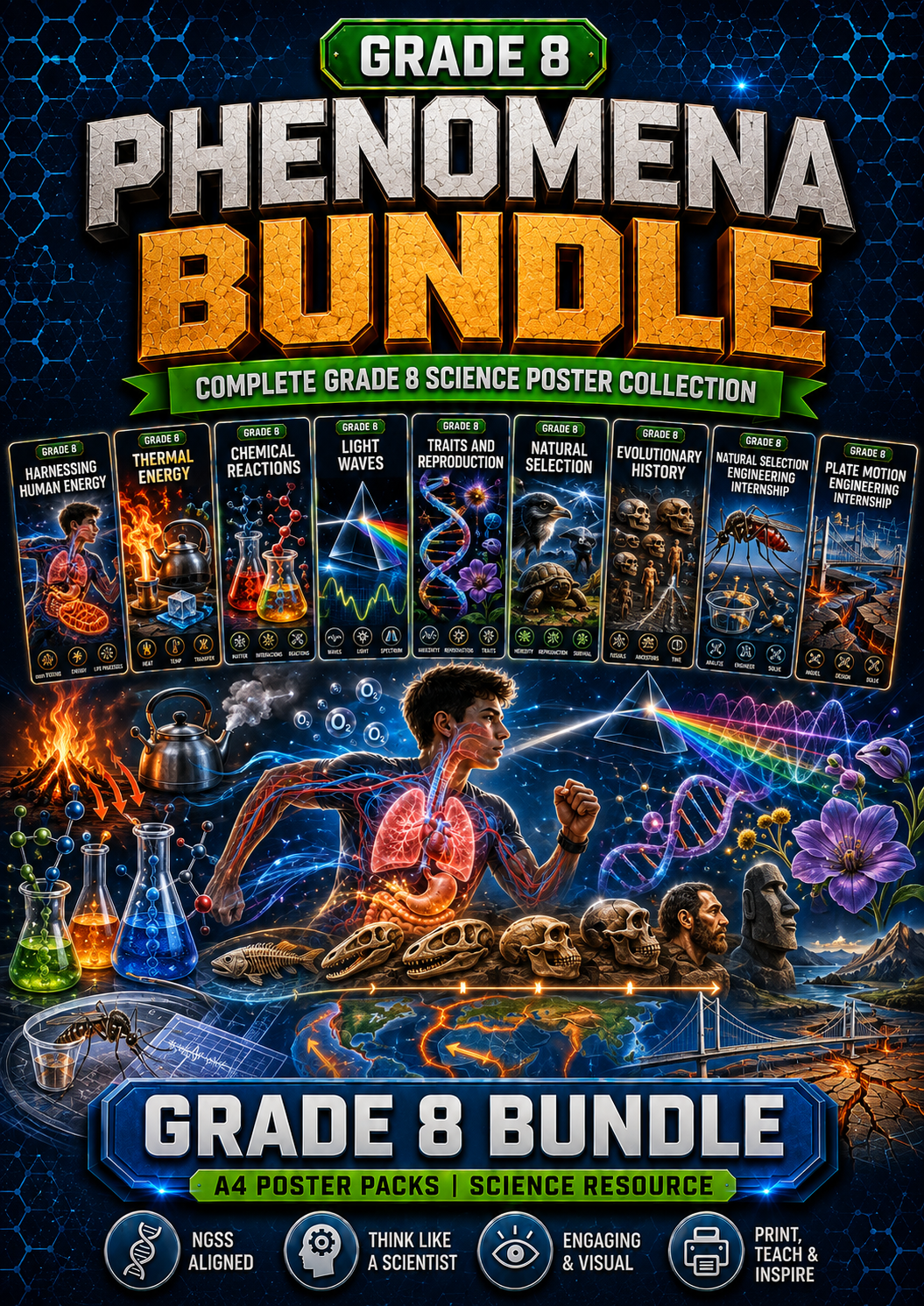
Bring phenomenon-based science instruction to life with this complete Grade 8 Phenomena Bundle.
This bundle includes all nine Grade 8 science units and provides 54 full-color phenomena posters designed to spark curiosity, strengthen academic vocabulary, encourage evidence-based discussion, and help students develop increasingly sophisticated scientific explanations.
Each unit includes six individual portrait phenomena posters centered around engaging science or engineering phenomena. Students observe carefully, ask questions, analyze models and evidence, identify patterns, make predictions, construct explanations, and revise their thinking as their scientific understanding develops.
These posters are designed to function as active instructional tools rather than simple classroom decorations. Use them to launch investigations, build interactive science focus walls, introduce challenging concepts, reinforce vocabulary, support scientific modeling, and provide repeated Claim-Evidence-Reasoning practice throughout the year.
Units Included
Harnessing Human Energy
Thermal Energy
Chemical Reactions
Light Waves
Traits and Reproduction
Natural Selection
Evolutionary History
Natural Selection Engineering Internship
Plate Motion Engineering Internship
Each unit includes six phenomena posters for a total of 54 posters in the complete Grade 8 bundle.
What’s Included on Each Phenomena Poster
Each poster includes:
A high-interest phenomenon question
A detailed science visual, model, diagram, graph, or real-world scenario
“What do you notice?” observation prompts
“What do you wonder?” discussion questions
Key science vocabulary
A “Try This Thinking” activity or challenge
A CER Starter for Claim, Evidence, and Reasoning practice
A concise science statement reinforcing the central concept
Harnessing Human Energy
Help students investigate how energy can be transferred, transformed, and harnessed to perform useful work.
Students explore energy systems, mechanical energy, electrical energy, energy transfer, transformation, efficiency, inputs, and outputs.
The phenomena encourage students to trace energy through real-world systems and consider how human movement can be converted into other useful forms of energy.
Students begin seeing energy as something that moves and changes throughout a system rather than something that simply appears or disappears.
Thermal Energy
Help students investigate how thermal energy moves between objects and throughout systems.
Students explore temperature, conduction, convection, radiation, insulation, particle motion, and thermal equilibrium.
The phenomena encourage students to connect observable temperature changes with energy transfer and particle-level processes.
Students can analyze why some materials transfer thermal energy more effectively than others and how engineers use these properties when designing products and systems.
Chemical Reactions
Help students investigate how substances interact and form new substances.
Students explore reactants, products, atoms, molecules, particle rearrangement, conservation of matter, and evidence of chemical reactions.
The phenomena encourage students to distinguish observations from explanations and use evidence such as gas production, temperature changes, color changes, or formation of new substances to determine whether a chemical reaction has occurred.
Particle models help students connect visible changes with processes occurring at the atomic and molecular level.
Light Waves
Help students investigate how light behaves as a wave.
Students explore wavelength, frequency, reflection, absorption, transmission, visible light, electromagnetic waves, and interactions between light and matter.
The phenomena encourage students to analyze wave models and connect them with observable light behaviors.
Students can investigate how different materials interact with light and how wave properties influence the way light behaves.
Traits and Reproduction
Help students investigate how genetic information is passed from parents to offspring.
Students explore genes, chromosomes, inherited traits, reproduction, genetic information, and variation among individuals.
The phenomena encourage students to compare organisms, identify inheritance patterns, analyze models, and explain why offspring can resemble their parents while still showing important differences.
Students begin connecting observable traits with processes occurring at the cellular and genetic levels.
Natural Selection
Help students investigate how populations change across generations.
Students explore variation, inherited traits, environmental pressures, adaptation, survival, reproduction, and changes in populations over time.
The phenomena encourage students to analyze how environmental conditions can influence which individuals survive and reproduce successfully.
Students use evidence to explain how advantageous inherited traits may become more common within a population over many generations.
Evolutionary History
Help students investigate how scientists reconstruct relationships among organisms from the past and present.
Students explore fossils, anatomical structures, common ancestry, evolutionary relationships, extinction, and evidence of change over time.
The phenomena encourage students to compare organisms, analyze fossil evidence, examine patterns, and develop explanations about how species may be related.
Students learn that scientists use multiple lines of evidence to reconstruct events that occurred millions of years ago.
Natural Selection Engineering Internship
Help students apply their understanding of natural selection, adaptation, and biological structures to authentic engineering challenges.
Students analyze useful structures and functions found in organisms and consider how those biological features can inspire engineered solutions.
The phenomena encourage students to define problems, establish criteria and constraints, evaluate evidence, compare possible designs, consider trade-offs, and justify recommendations.
Students experience how knowledge gained from life science can inform engineering and biomimicry.
Plate Motion Engineering Internship
Help students apply their understanding of tectonic processes and geologic hazards to engineering problems.
Students examine plate boundaries, faults, earthquakes, geological evidence, structural design, and possible hazard-reduction strategies.
The phenomena encourage students to consider how scientific knowledge about Earth processes can help engineers design safer structures and systems.
Students analyze criteria, constraints, test evidence, and trade-offs while comparing and improving possible solutions.
Build Strong Notice and Wonder Routines
Every poster provides a ready-to-use opportunity for students to investigate a phenomenon before being given an explanation.
Students examine the visual, model, graph, or scenario and begin by describing what they notice.
They then generate questions, identify patterns, make predictions, compare ideas with classmates, and begin developing possible explanations.
Using this consistent Notice and Wonder structure throughout all nine units creates a familiar instructional routine while allowing students to apply increasingly sophisticated scientific reasoning to new content.
Develop Advanced Middle School Scientific Reasoning
Grade 8 science requires students to move well beyond simple observation.
These posters encourage students to analyze evidence, interpret models, connect microscopic and macroscopic processes, identify cause-and-effect relationships, compare competing explanations, and justify conclusions.
Students can begin with an initial explanation, gather evidence through instruction and investigation, and return to the phenomenon later to revise their thinking.
This repeated process reinforces one of the most important ideas in science: explanations should change and improve when new evidence becomes available.
Build CER Skills Across 54 Phenomena
Every poster includes a student-friendly CER Starter.
Students practice making a Claim, selecting relevant Evidence, and using Reasoning to explain why the evidence supports their conclusion.
With 54 different phenomena spanning physical science, life science, evolutionary science, and engineering, students receive extensive opportunities to strengthen evidence-based speaking and writing.
The consistent structure also allows teachers to gradually increase expectations for the sophistication and depth of student reasoning.
Strengthen Science Vocabulary in Context
Important academic vocabulary is embedded directly within meaningful phenomena.
Students use new terminology while observing, modeling, analyzing evidence, comparing systems, discussing ideas, and constructing explanations.
Vocabulary is therefore connected to scientific thinking rather than presented as an isolated set of definitions.
Displaying the posters throughout each unit provides students with an ongoing visual reference for important concepts and terms.
Support Scientific Modeling
Many Grade 8 concepts involve processes students cannot directly observe.
Students cannot see atoms rearranging during a chemical reaction, directly observe thermal energy moving, watch genes pass from one generation to another, or observe natural selection unfolding across thousands of generations.
The posters provide visual models that help students represent these processes, identify relationships, make predictions, and revise explanations.
Students learn that models are tools scientists use to explain events occurring at scales that may be too small, too large, too fast, or too slow to observe directly.
Connect the Observable and Invisible
A major strength of the Grade 8 collection is the opportunity to connect visible evidence with processes that cannot be seen directly.
Students can observe temperature changes and connect them with particle motion.
They can observe evidence of a chemical reaction and connect it with atom rearrangement.
They can compare traits and connect those observations with genetic information.
They can study population patterns and connect them with natural selection over generations.
These connections help students move from surface-level descriptions toward deeper scientific explanations.
Develop Systems Thinking
Systems thinking appears throughout the Grade 8 collection.
Students trace energy through human-designed systems, investigate thermal energy systems, examine interactions among reactants and products, explore genetic systems, analyze changing populations, and evaluate engineered solutions.
Students identify system components, trace relationships, analyze inputs and outputs, and consider how changes in one part of a system can affect other parts.
These skills prepare students for increasingly complex high school science.
Connect Cause and Effect
Grade 8 phenomena provide repeated opportunities to investigate cause-and-effect relationships.
Students examine how energy transfer causes temperature changes, how atomic rearrangements produce new substances, how inherited variation and environmental conditions influence population change, and how geologic conditions influence engineering decisions.
Students move beyond describing what happened and begin explaining the mechanisms responsible for observed changes.
Connect Science and Engineering
The Natural Selection Engineering Internship and Plate Motion Engineering Internship provide meaningful opportunities for students to apply science to real-world design problems.
Students identify problems, establish criteria and constraints, analyze scientific evidence, compare possible solutions, evaluate trade-offs, test ideas, and revise designs.
These experiences reinforce the idea that science and engineering are deeply connected.
Scientific knowledge helps engineers understand a problem, while engineering provides opportunities to apply scientific knowledge to solutions.
Create an Interactive Science Focus Wall
Display the posters as part of your Grade 8 science focus wall and rotate them as your class progresses through each unit.
Introduce one phenomenon at a time or display several together so students can compare models, evidence, and scientific relationships.
Because each poster includes observations, questions, vocabulary, thinking challenges, and CER support, your focus wall becomes an active instructional resource students can return to throughout the learning process.
Flexible for Many Classroom Uses
Use this bundle for:
Whole-group science instruction
Phenomenon launches
Science focus walls
Notice and Wonder routines
Small-group instruction
Science centers
Science notebook responses
Vocabulary development
CER practice
Scientific modeling
Engineering design discussions
Evidence and data analysis
Partner conversations
Unit introductions
Review and reinforcement
Assessment discussions
Classroom displays
Use the Posters Before, During, and After Instruction
Before instruction, introduce a phenomenon and collect students’ initial observations, questions, and explanations.
During instruction, revisit the poster as students gather evidence, analyze models, develop vocabulary, and construct more complete scientific explanations.
After instruction, ask students to return to the original phenomenon and explain it again using what they now understand.
This provides students with a visible way to recognize how their scientific reasoning has become more detailed, precise, and evidence-based.
Save With the Complete Grade 8 Collection
Instead of purchasing each Grade 8 unit separately, this bundle provides the complete collection in one cohesive resource.
You receive:
9 complete science units
6 phenomena posters per unit
54 total phenomena posters
Consistent formatting across the complete collection
Repeated Notice and Wonder opportunities
Extensive CER practice
Integrated science vocabulary support
Scientific modeling opportunities
Systems-thinking practice
Engineering design connections
Evidence-analysis opportunities
A cohesive visual system for Grade 8 science instruction
The consistent format allows students to quickly become familiar with the instructional routine while each new unit introduces fresh phenomena and increasingly sophisticated scientific concepts.
A Yearlong Phenomenon-Based Science Resource
With 54 different phenomena spanning energy, thermal processes, chemical reactions, light waves, genetics, natural selection, evolutionary history, and engineering design, this bundle provides an extensive collection of instructional materials for the Grade 8 science classroom.
Whether you use the posters to launch investigations, build a science focus wall, support academic discussion, reinforce vocabulary, interpret models, practice CER, analyze evidence, or connect science with engineering, students receive repeated opportunities to observe, question, analyze, model, explain, and communicate like scientists.
Important Disclaimer
This resource is independently created and is not affiliated with, endorsed by, sponsored by, or produced by Amplify Education. The use of “Amplify” in the product title is intended only to help educators identify the curriculum topics with which this supplemental resource may be used. Amplify Education owns its respective trademarks and curriculum materials.
- Grade 8
- Instant digital download
- Print & reuse in class