Grade 8 Science Vocabulary Cards | Evolutionary History | Fossils, Common Ancestry & Evolution
$5.00
Help students build a strong understanding of evolutionary history, fossils, common ancestry, comparative anatomy, natural selection, extinction, speciation, and the evidence scientists use to reconstruct the history of life on Earth with this engaging Grade 8 Evolutionary History Science Vocabulary Card Set.
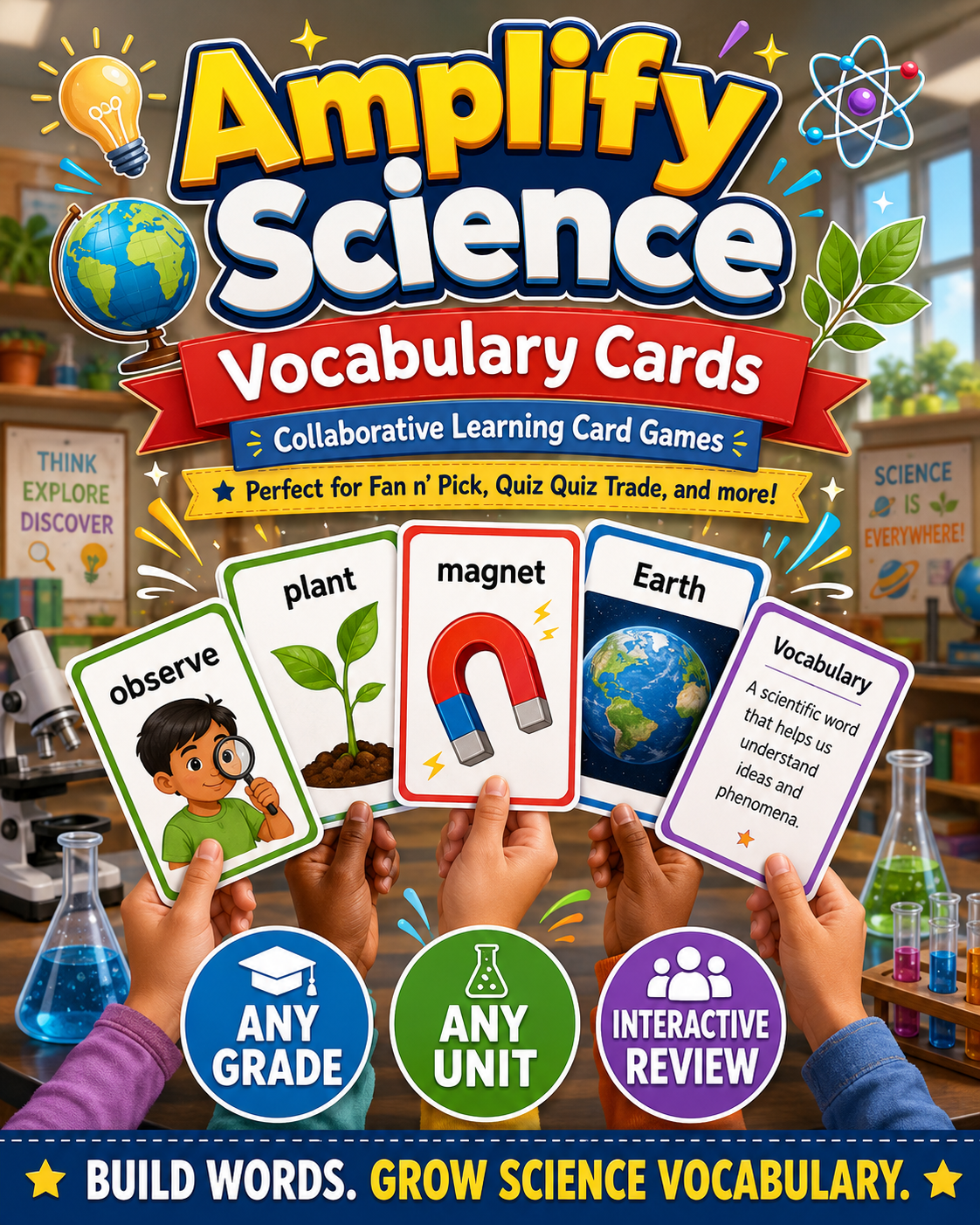
This resource includes 50 vocabulary cards designed to strengthen science language through repeated reading, speaking, and application. Each card includes a student-friendly meaning, a science-based example sentence, and three built-in prompts: How do you spell ___?, What is ___?, and Use ___ in a sentence.
Students work with essential evolutionary concepts such as ancestor, common ancestor, descendant, evolution, evolutionary tree, lineage, natural selection, mutation, inheritance, trait, species, speciation, divergence, convergence, and transition. These terms help students describe how populations and species change over long periods of time and how organisms can be related through shared ancestry.
The set places a strong emphasis on fossil evidence and the fossil record through vocabulary such as fossil, fossil record, ammonite, paleontologist, geologic time, extinct, extinction, mass extinction, observation, and diagnosis. Students can use these concepts to explain how fossils provide evidence about organisms that lived in the past and how scientists use rock layers and index fossils to investigate Earth’s biological history.
Each vocabulary card includes:
- Large, easy-to-read science vocabulary term
- Clear student-friendly definition
- Meaningful science example sentence
- Three reusable vocabulary and discussion prompts
- Colorful science-themed design
- Coordinating cover/backing pages for double-sided printing
Students also investigate comparative anatomy and structural evidence for common ancestry using terms such as anatomy, comparative anatomy, homologous, body plan, bone, limb, function, related, and common ancestor. These terms support students as they compare structures among organisms and use similarities and differences to infer evolutionary relationships.
The cards also help students connect genetics to evolutionary change through vocabulary such as DNA, mutation, inherit, generation, trait, environment, natural selection, and population. Students explore how inherited changes and environmental conditions can influence which traits become more common across generations.
Extinction and environmental change are reinforced through terms such as extinct, extinction, mass extinction, environment, cause, change, and geologic time. Students can examine how major environmental events may cause species to disappear and how those changes become part of the fossil record.
Science practices are reinforced with vocabulary including analyze, claim, data, evidence, explanation, inference, investigation, model, observation, pattern, reasoning, and diagnosis. Students gain academic language for comparing fossils, identifying structural patterns, interpreting evidence, constructing evolutionary relationships, and supporting scientific claims. olution…
Perfect for: Grade 8 science • Evolutionary History • Evolution • Fossil record • Common ancestry • Comparative anatomy • Natural selection • Speciation • Extinction • Geologic time • Paleontology • Science centers • Vocabulary stations • Small groups • Partner practice • Intervention • Review
Use these cards for whole-class review, science centers, vocabulary games, partner questioning, word walls, morning work, early finishers, small-group instruction, intervention, or test preparation. They can also be placed on a ring to create a portable science vocabulary review deck.
Prep is simple: print, cut, laminate if desired, and begin using immediately.
This colorful, student-friendly resource makes Evolutionary History vocabulary visual, interactive, and easy to reinforce throughout the unit.
- Grade 8
- Instant digital download
- Print & reuse in class