Natural Disasters Science Concept Posters
$5.00
6-Piece Visual Science Poster Set | Earthquakes | Volcanoes | Floods | Wildfires | Hurricanes | Tornadoes | CER
Bring Natural Disasters to life with this bold, colorful, and highly visual 6-poster Science Concept Set!
Designed to do much more than simply decorate your science wall, these posters help students identify natural hazards, understand how disasters affect people and environments, compare different types of natural disasters, analyze evidence, explore preparedness, and think like scientists.
Each poster combines large, engaging science visuals with clear student-friendly explanations, discussion prompts, vocabulary, simple observation activities, and Claim-Evidence-Reasoning (CER) opportunities. Students explore earthquakes, volcanoes, hurricanes, tornadoes, floods, and wildfires while learning how scientists gather evidence and how communities can prepare for dangerous natural events.
WHAT’S INCLUDED
This set includes 6 full-color, print-ready science posters:
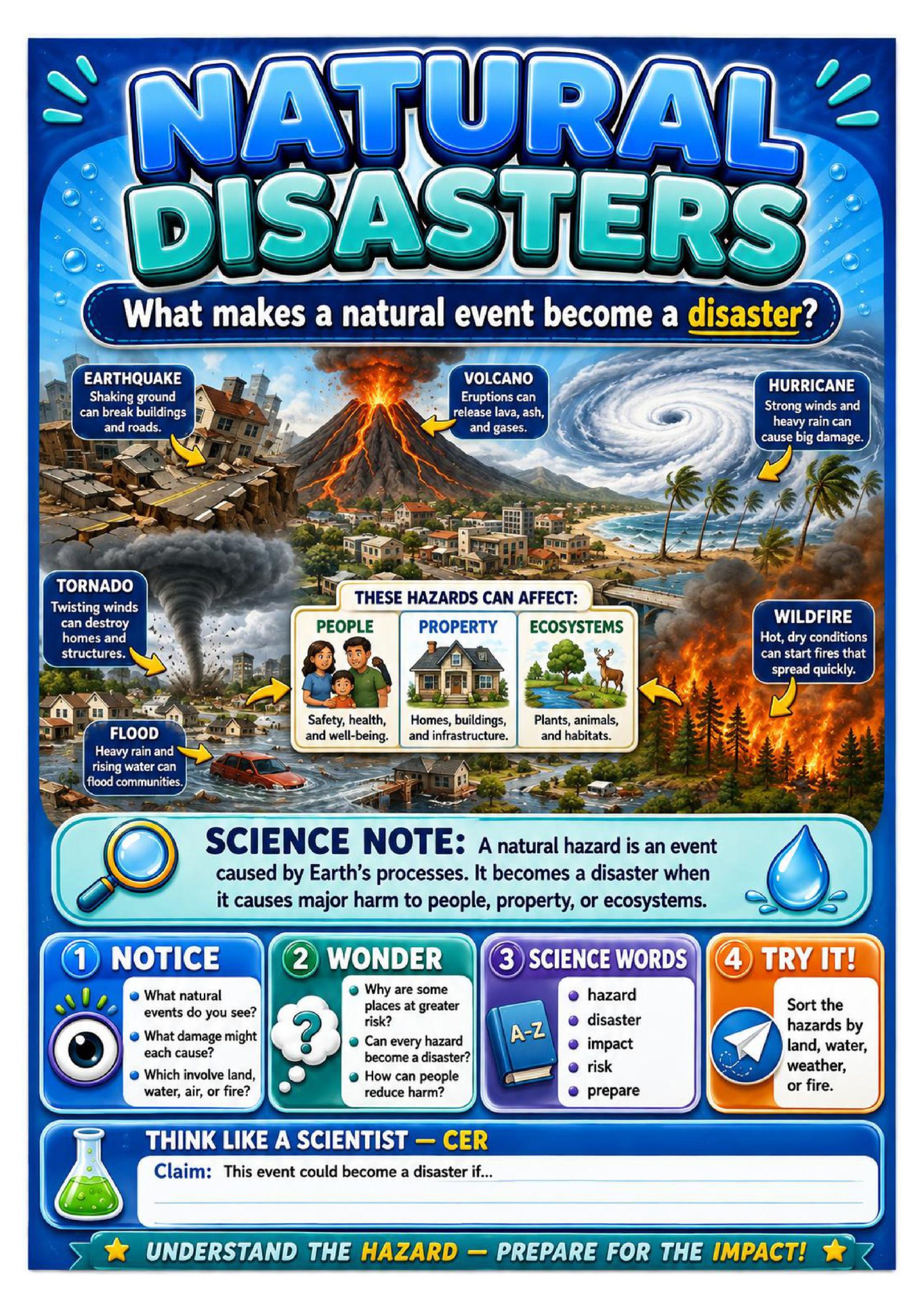
- Natural Disasters — Introduce major natural hazards including earthquakes, volcanoes, hurricanes, tornadoes, floods, and wildfires while exploring how these events can affect people, property, and ecosystems.
- Be the Scientist! Natural Disasters — Students observe evidence, collect data, analyze patterns, and explain what happened during a natural disaster.
- Earthquakes & Volcanoes — Explore how processes inside Earth can produce earthquakes and volcanic eruptions and change Earth’s surface.
- Predict, Prepare & Stay Safe — Examine how scientists monitor natural hazards and how planning, emergency supplies, alerts, evacuation routes, and safety procedures can reduce risk.
- Floods & Wildfires — Compare how water and fire can quickly change environments, damage communities, and affect habitats.
- Hurricanes & Tornadoes — Compare two powerful rotating storms and investigate how they are alike and different in size, location, formation, and effects.
Each poster includes a large Essential Question, vivid science illustrations, a concise Science Note, Notice & Wonder prompts, key Science Words, a Try It! activity, and a Think Like a Scientist — CER response prompt.
MORE THAN A POSTER — A TEACHING TOOL
These posters are designed to help students understand that a natural hazard and a natural disaster are related but not exactly the same thing.
Students learn that natural hazards are events caused by Earth’s processes and that these events can become disasters when they cause major harm to people, property, or ecosystems.
Students investigate questions such as:
What makes a natural event become a disaster?
How can earthquakes and volcanoes change Earth’s surface?
How do floods and wildfires affect environments?
How are hurricanes and tornadoes alike and different?
What kinds of evidence help scientists understand natural disasters?
How can scientists and communities prepare for future hazards?
How can preparation reduce disaster risk?
Use the posters to introduce a lesson, activate prior knowledge, guide whole-group conversations, reinforce vocabulary, support small-group instruction, review important concepts, or provide visual references throughout an Earth science, weather, or natural hazards unit.
EXPLORE MAJOR TYPES OF NATURAL DISASTERS
The set provides students with visually rich examples of several major natural hazards.
Students examine:
- earthquakes
- volcanoes
- hurricanes
- tornadoes
- floods
- wildfires
Each visual emphasizes observable evidence and the effects these events can have on communities and environments.
Students can compare the ways different hazards involve land, water, weather, air, or fire while recognizing that each type of event can create different risks.
EARTHQUAKES AND VOLCANOES
The Earthquakes & Volcanoes poster helps students connect dramatic changes at Earth’s surface to processes occurring inside the planet.
Students examine earthquake features such as:
- shaking buildings
- cracked ground
- fault lines
- seismic waves
They also investigate volcanic features such as:
- magma
- lava
- ash and gases
- eruptions
- magma chambers
The poster reinforces the idea that both earthquakes and volcanoes result from processes within Earth and can rapidly change the surface.
FLOODS AND WILDFIRES
The Floods & Wildfires poster compares two very different hazards that can both quickly transform environments.
Students explore how heavy rain, overflowing rivers, rising floodwaters, and runoff can affect communities.
They also examine how sparks, heat, dry vegetation, and wind can contribute to the spread of wildfires.
This comparison encourages students to consider how conditions in the environment influence the development and effects of natural hazards.
HURRICANES AND TORNADOES
The Hurricanes & Tornadoes poster provides a clear side-by-side comparison of two powerful storms.
Students learn that hurricanes are very large rotating storms that form over warm ocean water, while tornadoes are smaller spinning columns of air associated with powerful thunderstorms.
The visual comparison helps students examine differences in:
- size
- location
- formation
- wind
- rainfall
- structure
This gives students a strong foundation for explaining similarities and differences using scientific evidence.
SCIENCE, EVIDENCE, AND NATURAL DISASTERS
The Be the Scientist! Natural Disasters poster shows students how scientists investigate these events.
Students follow a simple scientific process:
Observe → Collect Data → Analyze → Explain
They examine photographs, maps, measurements, weather information, and other evidence to identify patterns and develop explanations.
This encourages students to see natural disasters as phenomena that scientists can study using observations, data, and evidence.
PREPARE AND REDUCE RISK
The Predict, Prepare & Stay Safe poster connects science learning with the important concept of disaster preparedness.
Students see how scientists monitor weather, water, and Earth patterns to identify potential danger.
They also explore preparedness strategies such as:
- making an emergency plan
- gathering supplies
- staying informed
- knowing local risks
- following emergency alerts
- using evacuation routes
- going to safe locations
The emphasis is on helping students understand that while not every natural disaster can be predicted exactly, scientific monitoring and thoughtful preparation can help reduce harm.
KEY SCIENCE CONCEPTS
Students will explore concepts including:
- natural hazard
- natural disaster
- impact
- risk
- earthquake
- fault
- seismic waves
- volcano
- magma
- lava
- eruption
- flood
- runoff
- wildfire
- hurricane
- tornado
- wind
- rotate
- warning
- prepare
- evacuation
- evidence
- data
- pattern
- observation
PERFECT FOR
Whole-group science instruction, Earth science units, weather units, natural hazards lessons, disaster preparedness lessons, phenomenon-based learning, science anchor charts, classroom science walls, vocabulary reinforcement, morning review, small groups, science centers, CER practice, compare-and-contrast activities, science discussions, and unit review.
DESIGNED FOR STUDENT ENGAGEMENT
Bold headings, vivid colors, dramatic natural-disaster scenes, labeled features, comparison diagrams, real-world safety examples, and easy-to-read information boxes help make complex Earth science concepts accessible and memorable for elementary learners.
The coordinated design allows all six posters to work together as a complete instructional sequence:
Understand natural disasters → investigate evidence → explore earthquakes and volcanoes → connect science to preparedness → compare floods and wildfires → compare hurricanes and tornadoes
Display all six together for an engaging Natural Disasters science wall, or introduce them individually as students progress through the topic.
Turn your classroom walls into interactive science learning tools and help students understand how natural hazards affect Earth and its communities, how scientists study these events, and how knowledge and preparation can help reduce risk.
- Grades K-5
- Instant digital download
- Print & reuse in class