Parts of a Plant Science Concept Posters
$5.00
6-Piece Visual Science Poster Set | Roots | Stem | Leaves | Flower | Fruit | Seeds | CER
Bring Parts of a Plant to life with this bold, colorful, and highly visual 6-poster Science Concept Set!
Designed to do much more than simply decorate your science wall, these posters help students identify the main parts of a plant, understand the job of each part, connect plant structures to plant needs, compare how parts work together, build science vocabulary, use clues as evidence, and think like scientists.
Each poster combines large, engaging plant visuals with clear student-friendly explanations, discussion prompts, vocabulary, simple observation activities, and introductory Claim-Evidence-Reasoning (CER) opportunities. Students explore how roots, stems, leaves, flowers, fruits, and seeds each have a special job that helps plants live, grow, and make new plants.
WHAT’S INCLUDED
This set includes 6 full-color, print-ready science posters:
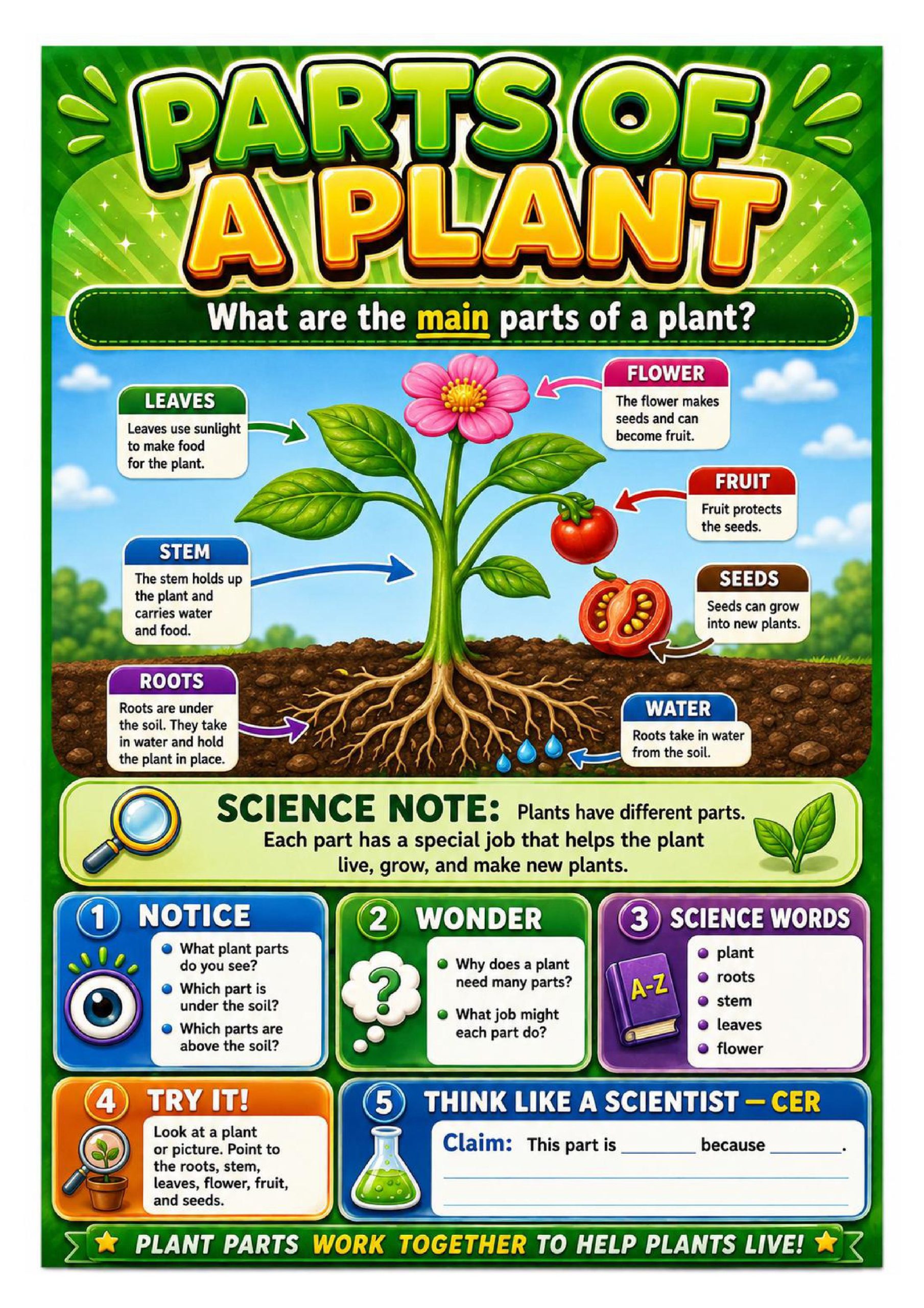
- Parts of a Plant — Introduce the main plant parts and explore how roots, stems, leaves, flowers, fruits, and seeds each help the plant.
- Roots Help Plants — Investigate how roots grow under the soil, take in water, and help hold the plant in place.
- Stems and Leaves Help Plants — Explore how stems support the plant and move water, while leaves take in sunlight and help make food.
- Flowers, Fruits, and Seeds — Discover how flowers help make seeds, fruits protect seeds, and seeds can grow into new plants.
- What Part Does What? — Match each plant part to its special job and compare how different parts help the plant live and grow.
- Be the Scientist! — Students use clues to label plant parts and explain what each part does.
Each poster includes a large guiding question, vivid science illustrations, a concise Science Note, Notice & Wonder prompts, key Science Words, a Try It! activity, and a Think Like a Scientist — CER response opportunity.
MORE THAN A POSTER — A TEACHING TOOL
These posters are designed to help students move beyond simply naming plant parts and begin understanding what each part does and why it matters.
Students investigate questions such as:
What are the main parts of a plant?
What do roots do?
How do stems help a plant?
How do leaves help a plant live?
What do flowers, fruits, and seeds do?
How do all the plant parts work together?
How can scientists use clues to figure out what a plant part does?
Use the posters to introduce a plant unit, activate prior knowledge, guide whole-group conversations, reinforce vocabulary, support small-group instruction, provide science-center references, or create an engaging classroom life science display.
INTRODUCING THE MAIN PARTS OF A PLANT
The introductory Parts of a Plant poster gives students a strong visual overview of the main plant structures.
Students identify:
- roots
- stem
- leaves
- flower
- fruit
- seeds
The poster also introduces the idea that each part has a special job. For example, roots are under the soil, stems help hold the plant up, leaves help the plant make food, flowers help make seeds, fruit protects seeds, and seeds can grow into new plants.
This creates a strong foundation for the more focused posters that follow.
ROOTS HELP PLANTS
The Roots Help Plants poster focuses on the work done underground.
Students learn that roots:
- grow under the soil
- take in water from the soil
- help hold the plant in place
The poster also compares plants with strong roots and weak roots so students can see how roots help plants stay standing and healthy.
This makes it easier for young learners to understand that roots do important work even though they are not always visible.
STEMS AND LEAVES HELP PLANTS
The Stems and Leaves Help Plants poster helps students understand how these two parts work together.
Students discover that:
- the stem holds the plant upright
- water moves up the stem
- leaves take in sunlight
- leaves help the plant make food
- plants may grow toward sunlight
The clear diagram showing water moving upward and sunlight reaching the leaves helps students connect structure with function.
This poster is especially helpful for showing that plants need support, water movement, and sunlight collection in order to grow well.
FLOWERS, FRUITS, AND SEEDS
The Flowers, Fruits, and Seeds poster focuses on how plants make new plants.
Students explore how:
- flowers help plants make seeds
- fruit protects the seeds
- seeds can grow into new plants
- a sprout begins the growth of a new plant
This poster supports early understanding of plant reproduction in a very accessible, primary-friendly way.
Students also begin to see that plant parts do more than just help one plant survive. Some parts also help the plant species continue.
WHAT PART DOES WHAT?
The What Part Does What? poster provides a strong review and comparison opportunity.
Students match each part with its job:
- roots — take in water
- stem — holds up the plant
- leaves — make food
- flower — makes seeds
- fruit — protects seeds
- seeds — grow into a new plant
This matching format helps students organize their understanding and makes the “part-to-job” relationship very clear.
It is especially useful for review, discussion, sorting activities, and assessment preparation.
BE THE SCIENTIST
The culminating Be the Scientist! poster invites students to apply what they have learned.
Students use clues to label plant parts and match them to descriptions such as:
- the part under the soil that drinks water
- the part that holds the plant up
- the part that makes food using sunlight
- the part that helps make seeds
- the part that protects seeds
- the part that can grow into a new plant
The poster reinforces an important early science practice:
Scientists observe plant parts and use clues to figure out what each part does.
This helps students move from memorization to evidence-based reasoning.
BUILDS SCIENCE THINKING
Rather than simply reciting plant-part names, students are encouraged to observe, compare, match, and explain.
Throughout the set, students practice:
- identifying plant parts
- connecting parts to jobs
- observing plants closely
- comparing above-ground and below-ground parts
- recognizing how parts work together
- using clues
- matching structures to functions
- explaining how a plant lives and grows
- supporting ideas with evidence
The recurring CER prompts help students connect what they observe to scientific explanations.
INTRODUCES CER IN A STUDENT-FRIENDLY WAY
Each poster includes a simple Think Like a Scientist — CER component.
Students complete sentence frames such as:
“This part is ___ because ___.”
“Roots help a plant because I observed ___.”
“Stems and leaves help plants because ___.”
“Seeds can grow into new plants because ___.”
“The ___ helps the plant by ___.”
“Part ___ is the ___ because ___.”
These prompts provide an age-appropriate introduction to using observations as evidence and explaining scientific thinking.
KEY SCIENCE CONCEPTS
Students will explore concepts including:
plant, part, roots, stem, leaves, flower, fruit, seeds, sprout, water, sunlight, soil, job, support, protect, grow, observe, compare, clue, evidence, claim, and reasoning.
PERFECT FOR
Kindergarten science, first grade science, early elementary life science, plant units, plant structure lessons, plant needs lessons, living things units, classroom plant investigations, science anchor charts, classroom science walls, vocabulary reinforcement, morning review, small groups, science centers, CER introductions, observation activities, and hands-on plant science.
DESIGNED FOR YOUNG SCIENTISTS
Bold headings, vivid colors, clear plant diagrams, labeled structures, simple job-to-part comparisons, healthy plant visuals, and easy-to-read information boxes make plant structures understandable and memorable for younger elementary learners.
The coordinated design allows all six posters to work together as a complete instructional sequence:
Introduce the main parts of a plant → explore roots → investigate stems and leaves → discover flowers, fruits, and seeds → match parts to jobs → use clues and evidence to explain plant parts
Display all six together for an engaging Parts of a Plant science wall, or introduce them individually as students progress through the topic.
Turn your classroom walls into interactive science learning tools and help students discover that every plant part has an important job—and that all of those parts work together to help plants live, grow, and make new plants.
- Grades K-5
- Instant digital download
- Print & reuse in class