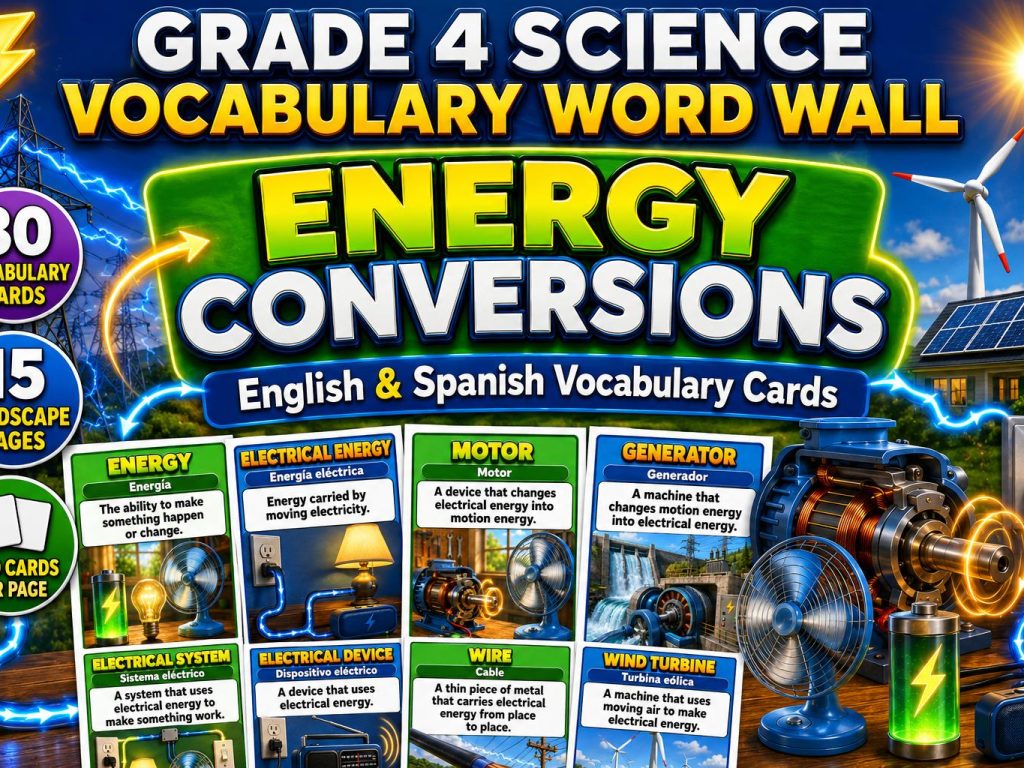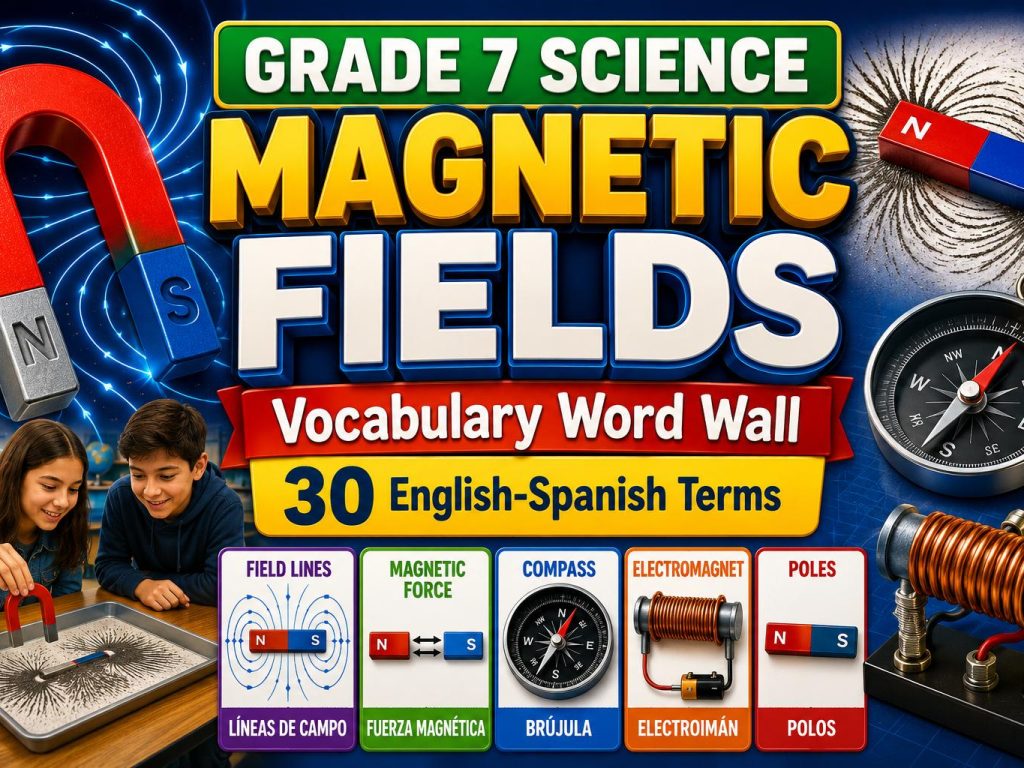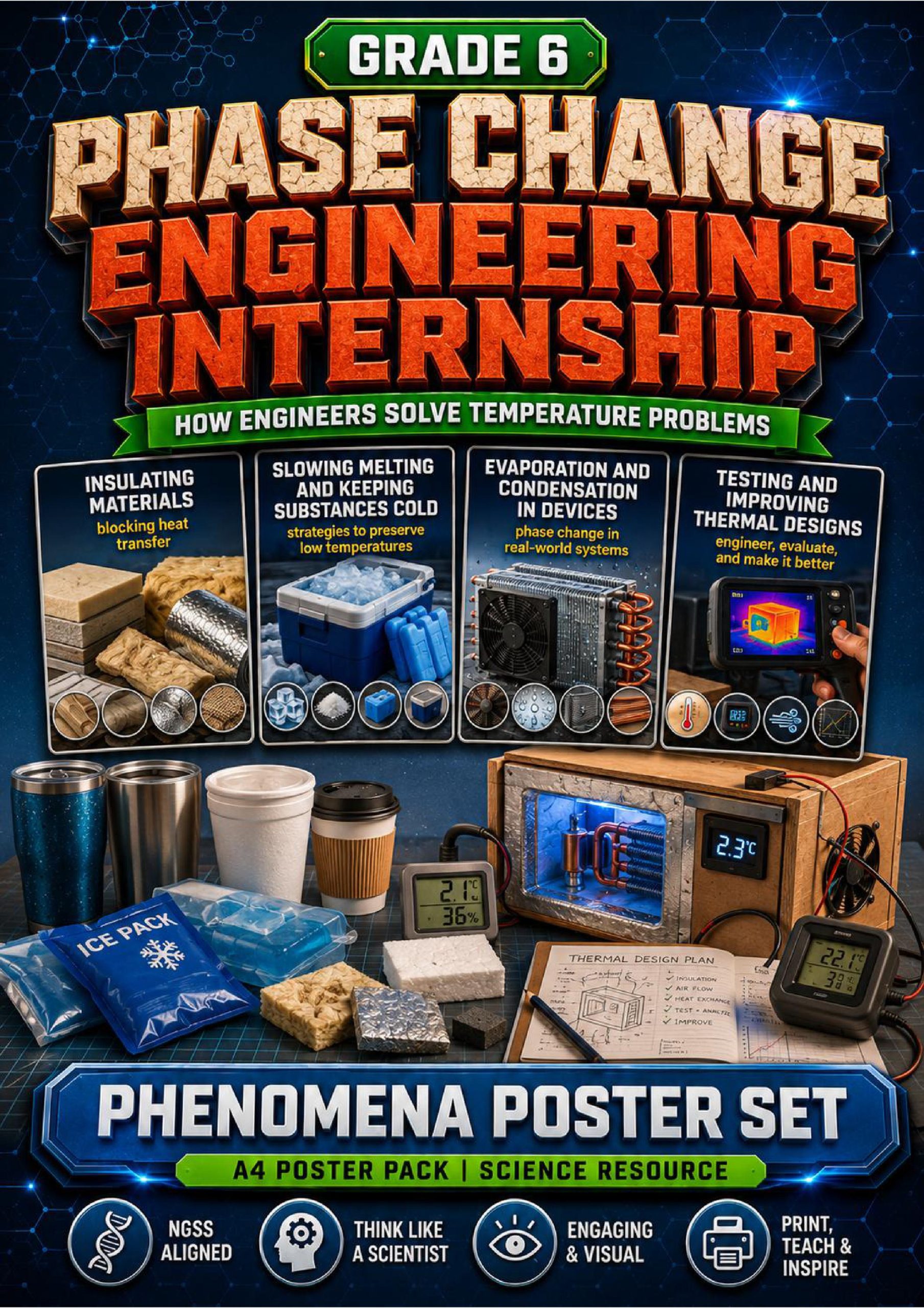
Phase Change Engineering Internship Phenomena Poster Set
$5.00
Help students apply their understanding of phase change, thermal energy, and particle motion to an engineering challenge with this engaging Phase Change Engineering Internship phenomena resource.
This six-poster collection uses visually rich science and engineering phenomena to encourage students to observe, analyze evidence, develop models, evaluate designs, and explain how energy transfer and phase change can be used to solve real-world problems.
Students move from understanding the science of phase change to applying that knowledge as engineers who must consider evidence, constraints, materials, and design choices.
What’s Included
This resource includes six individual full-color portrait phenomena posters.
Each poster includes:
A high-interest science or engineering phenomenon question
A detailed visual, model, or engineering scenario
“What do you notice?” observation prompts
“What do you wonder?” discussion questions
Key science and engineering vocabulary
A “Try This Thinking” activity or challenge
A CER Starter for Claim, Evidence, and Reasoning practice
A concise science statement reinforcing the main concept
Apply Phase Change Science to Engineering
Students use what they know about solids, liquids, gases, thermal energy, and particle motion to think about practical engineering problems.
The phenomena encourage students to consider how controlling energy transfer can affect whether a material melts, freezes, evaporates, or condenses.
Students begin seeing phase change as more than a classroom concept. It becomes scientific knowledge that can inform design decisions.
Investigate Energy Transfer
Students examine how energy entering or leaving a system can affect matter.
They can consider questions such as:
Where is thermal energy moving?
What evidence shows that energy has been transferred?
How could reducing energy transfer affect a material?
How could increasing energy transfer change the system?
What phase change might occur under different conditions?
How could an engineer control these changes?
These questions help students connect scientific explanations with engineering solutions.
Use Particle Models to Support Design Decisions
Particle models help students explain why materials behave differently when thermal energy is added or removed.
Students can use these models to predict what may happen under different conditions and then apply those predictions when considering possible designs.
This reinforces the connection between scientific modeling and engineering decision-making.
Evaluate Engineering Solutions
Students are encouraged to compare possible solutions rather than assuming there is only one correct design.
They can consider:
How well does the design solve the problem?
What scientific evidence supports the design?
What are the design criteria?
What constraints must be considered?
What could be improved?
How might a change in materials or structure affect performance?
These discussions help students understand engineering as an iterative process of testing and improvement.
Build Evidence-Based Reasoning
The posters encourage students to support engineering recommendations with science rather than personal preference.
Students can analyze evidence, make a claim about which solution may work best, and explain how their knowledge of thermal energy and phase change supports their choice.
This provides an authentic context for scientific argumentation.
Strengthen Science and Engineering Vocabulary
Important vocabulary is embedded directly within meaningful phenomena and design challenges.
Students encounter concepts related to phase change, thermal energy, temperature, particles, energy transfer, criteria, constraints, design, model, evidence, testing, and optimization while actively applying those terms.
Support CER Practice
Each poster includes a student-friendly CER Starter.
Students practice making a Claim, identifying Evidence from the phenomenon or engineering scenario, and using Reasoning to connect the evidence with principles of phase change and thermal energy.
CER practice helps students justify why a particular design or explanation is supported by scientific evidence.
Connect Science and Engineering Practices
This resource provides opportunities for students to combine multiple science and engineering practices.
Students can:
Observe phenomena
Ask questions
Develop and use models
Analyze evidence
Make predictions
Compare possible solutions
Apply scientific principles
Construct explanations
Evaluate designs
Revise ideas based on evidence
This makes the posters especially useful for connecting science content with authentic problem solving.
Great for Classroom Use
Use these posters for:
Engineering internship instruction
Phenomenon launches
Science focus walls
Whole-group discussions
Small-group engineering teams
Notice and Wonder routines
Science notebook responses
Vocabulary development
CER practice
Design challenges
Particle modeling
Evidence analysis
Engineering discussions
Review and reinforcement
Classroom displays
Revisit the Phenomena Throughout the Internship
Introduce each phenomenon before students have developed a complete solution.
As students learn more about phase change, thermal energy, materials, and engineering design, return to the posters and ask them to revise their ideas.
Students can use new evidence to improve their explanations, reconsider design choices, and justify modifications to proposed solutions.
Turn Science Knowledge Into Problem Solving
Engineering internships give students an opportunity to use science for a purpose.
These posters help students connect particle-level explanations of phase change with real-world design decisions. By combining visual phenomena, engineering challenges, structured questioning, vocabulary development, modeling, and CER practice, this resource supports meaningful application of phase change science.
Important Disclaimer
This resource is independently created and is not affiliated with, endorsed by, sponsored by, or produced by Amplify Education. The use of “Amplify” in the product title is intended only to help educators identify the curriculum topic with which this supplemental resource may be used. Amplify Education owns its respective trademarks and curriculum materials.
- Grade 6
- Instant digital download
- Print & reuse in class