Plate Motion Engineering Internship Phenomena Poster Set
$5.00
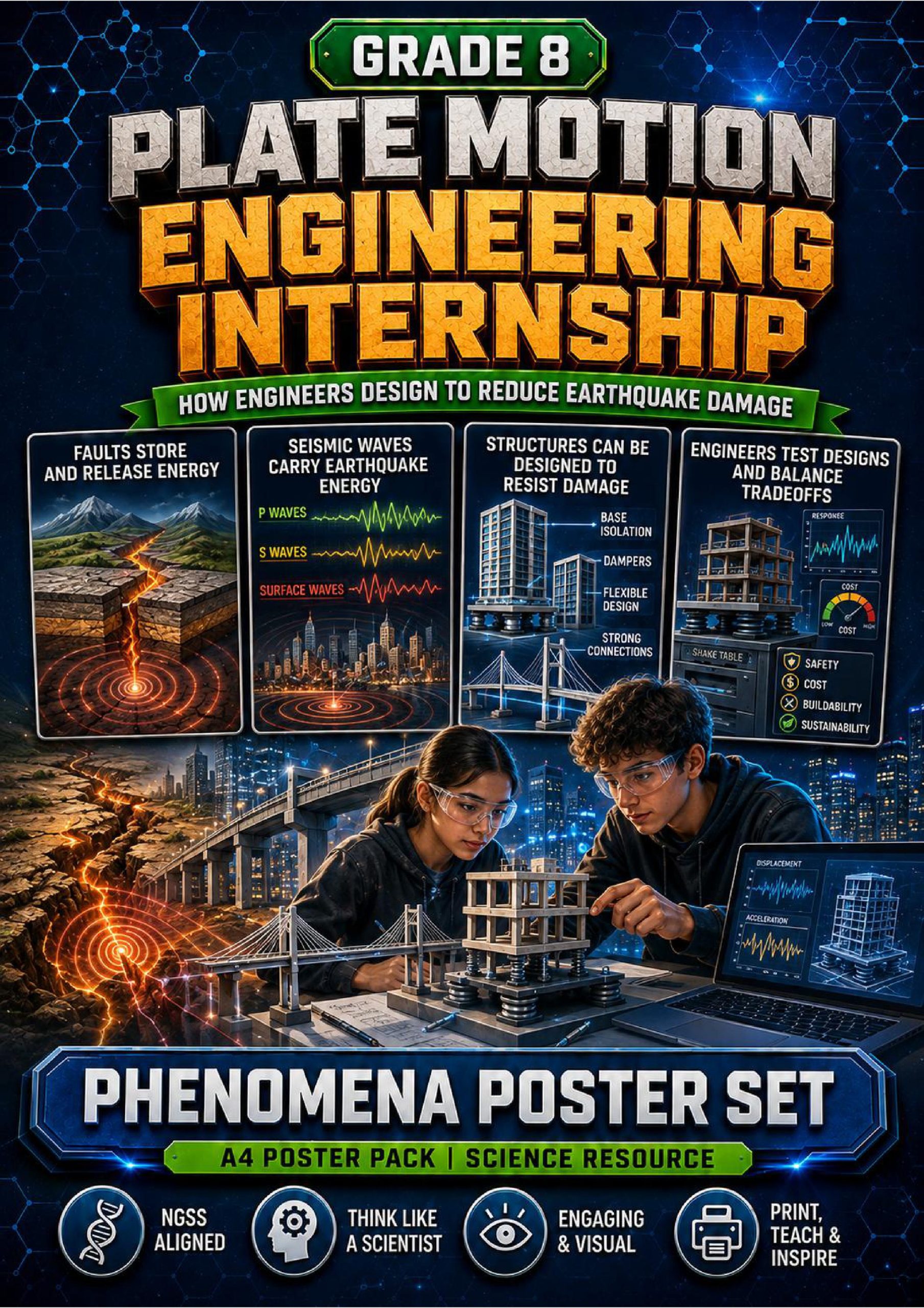
Help students apply their understanding of plate motion, Earth’s crust, geological processes, and evidence to an authentic engineering challenge with this engaging Plate Motion Engineering Internship phenomena resource.
This six-poster collection uses visually rich science and engineering phenomena to encourage students to analyze geologic evidence, interpret models, evaluate possible solutions, and explain how an understanding of tectonic processes can inform engineering decisions.
Students move from investigating why tectonic plates move and how plate interactions affect Earth’s surface to applying that knowledge in a problem-solving context where evidence, criteria, constraints, safety, and design choices matter.
What’s Included
This resource includes six individual full-color portrait phenomena posters.
Each poster includes:
A high-interest science or engineering phenomenon question
A detailed science visual, model, map, or engineering scenario
“What do you notice?” observation prompts
“What do you wonder?” discussion questions
Key science and engineering vocabulary
A “Try This Thinking” activity or challenge
A CER Starter for Claim, Evidence, and Reasoning practice
A concise science statement reinforcing the main concept
Apply Plate Motion Science to Engineering
Students use their understanding of tectonic plates, plate boundaries, earthquakes, geological structures, and Earth processes to investigate engineering problems.
The phenomena encourage students to consider how knowledge about plate motion can help engineers make informed decisions when designing structures and systems in areas affected by geologic hazards.
Students begin seeing Earth science as knowledge that can be directly applied to protecting people, structures, and communities.
Analyze Geological Evidence
Before engineers can design effective solutions, they must understand the geological conditions of an area.
Students can examine maps, models, landforms, and other evidence while considering questions such as:
Where are plate boundaries located?
What evidence indicates tectonic activity?
What geological hazards may affect this location?
How could plate movement influence structures built in the area?
What evidence should engineers consider before designing a solution?
How can scientific models help predict possible risks?
These questions help students connect geological investigation with engineering decision-making.
Connect Plate Motion to Earthquake Hazards
Plate movement can cause stress to build within Earth’s crust.
When that stress is released, earthquakes can occur.
Students can investigate how earthquake hazards affect buildings and infrastructure and consider how engineers use scientific knowledge about forces, motion, materials, and structural design to reduce potential damage.
Investigate Engineering Solutions
Students are encouraged to explore how structures can be designed to better withstand geologic hazards.
They can consider how features such as flexible materials, reinforced structures, strong foundations, structural supports, and other design strategies may affect performance.
The phenomena create opportunities for students to connect Earth science with practical engineering solutions.
Evaluate Multiple Designs
Engineering problems rarely have one perfect solution.
Students can compare possible designs and consider:
How well does each design address the problem?
What scientific evidence supports the solution?
How might the structure respond during an earthquake?
Does the design meet the required criteria?
What limitations or constraints must be considered?
What improvements could make the design more effective?
These discussions encourage students to evaluate solutions based on evidence rather than personal preference.
Consider Criteria, Constraints, and Trade-Offs
Real-world engineering involves limitations.
Students can consider criteria for success as well as constraints involving materials, cost, safety, location, construction requirements, environmental conditions, and other factors.
They can also investigate trade-offs and recognize that a solution that performs extremely well in one area may create challenges in another.
Use Models to Understand Geological Processes
Plate motion and earthquakes involve processes that occur beneath Earth’s surface and cannot be directly observed.
Visual models help students represent plate boundaries, faults, stress, movement, and other geological interactions.
Students can use these models to explain hazards and justify engineering recommendations.
Build Evidence-Based Reasoning
Students are encouraged to support engineering decisions with geological and scientific evidence.
Rather than simply stating which design they prefer, students can explain why a particular solution is appropriate based on the conditions of the location and the forces the structure may experience.
This makes scientific reasoning an important part of the engineering design process.
Strengthen Science and Engineering Vocabulary
Important vocabulary is embedded within meaningful phenomena and engineering challenges.
Students encounter concepts related to tectonic plates, plate boundaries, faults, earthquakes, stress, crust, geological hazards, criteria, constraints, design, evidence, testing, structure, and optimization while actively applying those terms.
Support CER Practice
Each poster includes a student-friendly CER Starter.
Students practice making a Claim about a geological phenomenon or engineering solution, identifying Evidence from maps, models, test results, or scenarios, and using Reasoning to explain why that evidence supports their conclusion.
CER practice becomes especially meaningful when students must justify an engineering recommendation using scientific evidence.
Connect Science and Engineering Practices
This resource provides opportunities for students to:
Observe geological phenomena
Ask questions
Analyze maps and evidence
Develop and use models
Identify engineering problems
Define criteria and constraints
Apply plate motion concepts
Compare possible solutions
Test designs
Analyze results
Evaluate trade-offs
Revise solutions
Justify recommendations
These practices help students experience Earth science and engineering as interconnected ways of understanding and solving real-world problems.
Great for Classroom Use
Use these posters for:
Engineering internship instruction
Phenomenon launches
Science focus walls
Whole-group discussions
Small-group engineering teams
Notice and Wonder routines
Science notebook responses
Vocabulary development
CER practice
Plate boundary modeling
Earthquake investigations
Engineering design challenges
Geologic hazard discussions
Evidence analysis
Solution comparisons
Review and reinforcement
Classroom displays
Revisit the Phenomena Throughout the Internship
Introduce each phenomenon before students have developed a complete engineering solution.
As students gather geological evidence and deepen their understanding of plate motion and structural design, return to the posters and ask them to reconsider their ideas.
Students can strengthen their claims, revise models, improve designs, and justify modifications using new scientific evidence.
Turn Earth Science Into Real-World Problem Solving
The Plate Motion Engineering Internship gives students an opportunity to apply their knowledge of tectonic processes to meaningful engineering challenges.
These posters help students connect geological evidence, plate movement, earthquake hazards, scientific models, and engineering design.
By combining engaging phenomena with structured questioning, modeling, evidence analysis, vocabulary development, and CER practice, this resource provides meaningful support throughout a Plate Motion Engineering Internship.
Important Disclaimer
This resource is independently created and is not affiliated with, endorsed by, sponsored by, or produced by Amplify Education. The use of “Amplify” in the product title is intended only to help educators identify the curriculum topic with which this supplemental resource may be used. Amplify Education owns its respective trademarks and curriculum materials.
- Grade 8
- Instant digital download
- Print & reuse in class