Pushes and Pulls Science Concept Posters
$5.00
6-Piece Visual Science Poster Set | Forces | Motion | Push | Pull | Stronger & Weaker Forces | CER
Bring Pushes and Pulls to life with this bold, colorful, and highly visual 6-poster Science Concept Set!
Designed to do much more than simply decorate your science wall, these posters help students understand pushes and pulls as forces, observe changes in motion, compare stronger and weaker forces, identify direction, investigate how objects move, build science vocabulary, and think like scientists.
Each poster combines large, engaging science visuals with clear student-friendly explanations, discussion prompts, vocabulary, simple hands-on activities, and introductory Claim-Evidence-Reasoning (CER) opportunities. Students explore how pushes and pulls can start motion, stop motion, speed objects up, slow them down, bring objects closer, move them away, and change their direction.
WHAT’S INCLUDED
This set includes 6 full-color, print-ready science posters:
- Pushes and Pulls — Introduce pushes and pulls as forces and explore how they can start, stop, speed up, slow down, or change the direction of moving objects.
- Pushes — Investigate how a push moves an object away and can start motion, speed it up, slow it down, stop it, or change its direction.
- Pulls — Explore how a pull moves an object toward you and can start motion, bring an object closer, slow or stop motion, or change direction.
- Stronger or Weaker? — Compare gentle and strong pushes and pulls and examine how the amount of force can change motion.
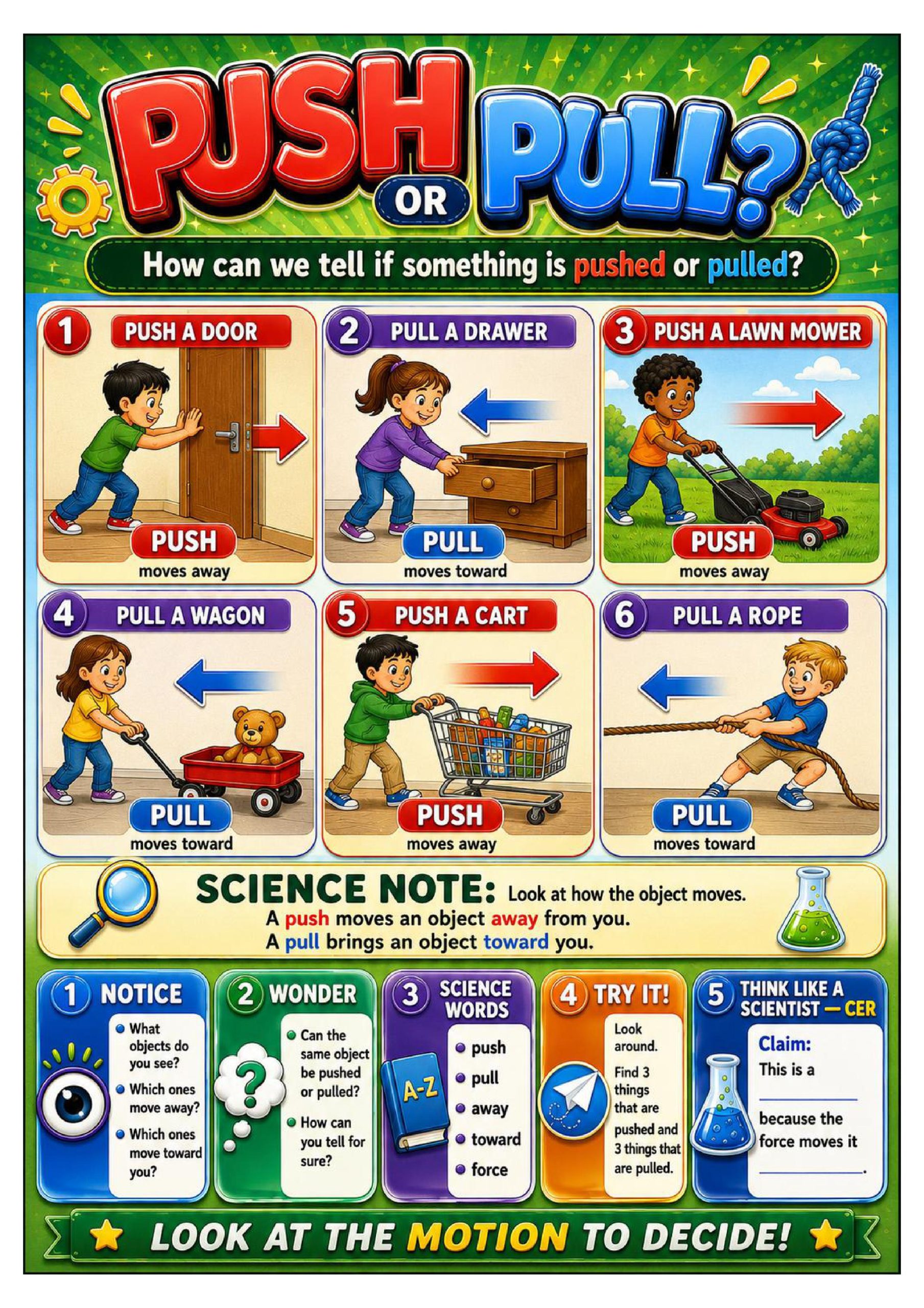
- Push or Pull? — Classify familiar actions such as opening a drawer, moving a lawn mower, pulling a wagon, pushing a cart, and tugging on a rope.
- Be the Scientist! Push or Pull? — Students ask questions, make a plan, test pushes and pulls, observe motion, measure results, and use evidence to explain what happened.
Each poster includes a large guiding question, vivid science illustrations, a concise Science Note, Notice & Wonder prompts, key Science Words, a Try It! activity, and a Think Like a Scientist — CER response opportunity. Science Concept Poster Set_Push…
MORE THAN A POSTER — A TEACHING TOOL
These posters are designed to help students move beyond simply naming something as a push or a pull and begin understanding how forces change motion.
Students investigate questions such as:
What is a force?
How is a push different from a pull?
What happens when you push something harder?
How can a pull bring an object closer?
Can pushes and pulls change an object’s direction?
Why do heavier objects sometimes need more force?
How can we tell whether an action is a push or a pull?
How can scientists test the effects of forces?
Use the posters to introduce a lesson, activate prior knowledge, guide whole-group conversations, reinforce vocabulary, support small-group instruction, provide science-center references, or create an engaging forces-and-motion display.
INTRODUCING PUSHES AND PULLS
The introductory Pushes and Pulls poster establishes the central idea that a push or pull is a force.
Students compare:
Push — moves an object away
Pull — moves an object toward
The poster also shows that pushes and pulls can cause several different changes in motion:
- start moving
- stop moving
- speed up
- slow down
- change direction
These familiar examples give young learners a clear visual connection between force and motion.
EXPLORE PUSHES
The Pushes poster focuses specifically on how pushing affects objects.
Students examine examples showing how a push can:
- start a soccer ball moving
- speed up a cart or toy car
- change the direction of an object
The Science Note expands this understanding by explaining that a push can also slow or stop motion.
Students are encouraged to observe what changed because of the push, which helps them begin thinking about cause and effect.
EXPLORE PULLS
The Pulls poster gives students the same focused treatment for pulling forces.
Students examine examples such as:
- pulling a wagon to start motion
- pulling a backpack closer
- pulling a sled to change its direction
Students learn that a pull is a force that moves an object toward you and can also start, slow, stop, or redirect motion.
The visual comparison between pushing away and pulling toward helps students form a strong conceptual distinction between the two forces.
STRONGER OR WEAKER?
The Stronger or Weaker? poster extends student thinking by exploring how the amount of force matters.
Students compare:
- a gentle push with a stronger push
- a gentle pull with a stronger pull
- moving a light object with moving a heavier object
- moving a light load with moving a heavier load
Students see that a stronger force can often create a bigger change in motion, such as making an object move farther or faster.
The poster also introduces the idea that heavier objects may require more force to move.
This provides an important early foundation for later learning about force, mass, and motion.
PUSH OR PULL?
The Push or Pull? poster gives students multiple everyday examples to classify.
Students examine actions such as:
- pushing a door
- pulling a drawer
- pushing a lawn mower
- pulling a wagon
- pushing a shopping cart
- pulling a rope
The central strategy is simple:
Look at how the object moves.
If it moves away from the person applying the force, it is a push.
If it moves toward the person applying the force, it is a pull.
This poster works especially well as a classroom reference because students can use the same reasoning with new examples they encounter.
CONNECT FORCE TO MOTION
Across the set, students repeatedly see that forces affect motion.
Rather than treating “push” and “pull” as isolated vocabulary words, the posters show students how force can change:
- whether an object is moving
- how fast it moves
- how far it moves
- which direction it moves
This helps students understand force as something that causes changes they can observe.
Large arrows throughout the set provide visual clues about the direction and relative strength of pushes and pulls.
INVESTIGATE LIKE A SCIENTIST
The culminating Be the Scientist! Push or Pull? poster turns the topic into a simple hands-on investigation.
Students follow a science mission that includes:
Ask a Question → Make a Plan → Test Your Idea → Observe → Record Results → Use Evidence
Students can test toy cars on a ramp or flat surface using pushes and pulls.
They observe whether the object:
- starts moving
- stops moving
- speeds up
- slows down
- changes direction
Scientist tools such as a magnifier, ruler, and notebook reinforce the importance of observing, measuring, and recording.
Students then use CER to communicate what they discovered through a claim, evidence, and reasoning.
BUILDS SCIENCE THINKING
Rather than simply memorizing definitions, students are encouraged to observe how objects respond to forces.
Throughout the set, students practice:
- identifying pushes and pulls
- observing motion
- identifying direction
- comparing force strength
- predicting what might happen
- testing objects
- comparing gentle and strong forces
- observing changes in speed and distance
- measuring motion
- recording results
- using evidence to explain what happened
The recurring CER prompts help students connect what they observe to scientific explanations.
KEY SCIENCE CONCEPTS
Students will explore concepts including:
force, push, pull, motion, direction, away, toward, start, stop, speed up, slow down, strong, weak, heavy, move, test, observe, measure, evidence, claim, and reasoning.
PERFECT FOR
Kindergarten science, first grade science, early elementary physical science, forces and motion units, pushes and pulls lessons, STEM instruction, phenomenon-based learning, science anchor charts, classroom science walls, vocabulary reinforcement, morning review, small groups, science centers, toy-car investigations, CER introductions, observation activities, and hands-on science lessons.
DESIGNED FOR YOUNG SCIENTISTS
Bold headings, vivid colors, familiar everyday examples, large directional arrows, diverse student models, simple investigations, clear comparisons, and easy-to-read information boxes help make force and motion understandable and memorable for younger elementary learners.
The coordinated design allows all six posters to work together as a complete instructional sequence:
Introduce pushes and pulls → investigate pushes → investigate pulls → compare stronger and weaker forces → classify pushes and pulls → test motion and explain with evidence
Display all six together for an engaging Pushes and Pulls science wall, or introduce them individually as students progress through the topic.
Turn your classroom walls into interactive science learning tools and help students discover that every push and pull is a force—and those forces can change how objects start, stop, speed up, slow down, and move in different directions.
- Grades K-5
- Instant digital download
- Print & reuse in class