Renewable and Nonrenewable Resources Science Concept Posters
$5.00
6-Piece Visual Science Poster Set | Natural Resources | Conservation | Sustainability | CER
Bring Renewable and Nonrenewable Resources to life with this bold, colorful, and highly visual 6-poster Science Concept Set!
Designed to do much more than simply decorate your science wall, these posters help students identify natural resources, compare renewable and nonrenewable resources, understand how resources are used, explore conservation, analyze evidence, and think like scientists.
Each poster combines large, engaging science visuals with clear student-friendly explanations, discussion prompts, vocabulary, simple investigation activities, and Claim-Evidence-Reasoning (CER) opportunities. Students explore where natural resources come from, how quickly they can be replaced, why some resources are limited, and how people can make responsible choices about resource use.
WHAT’S INCLUDED
This set includes 6 full-color, print-ready science posters:
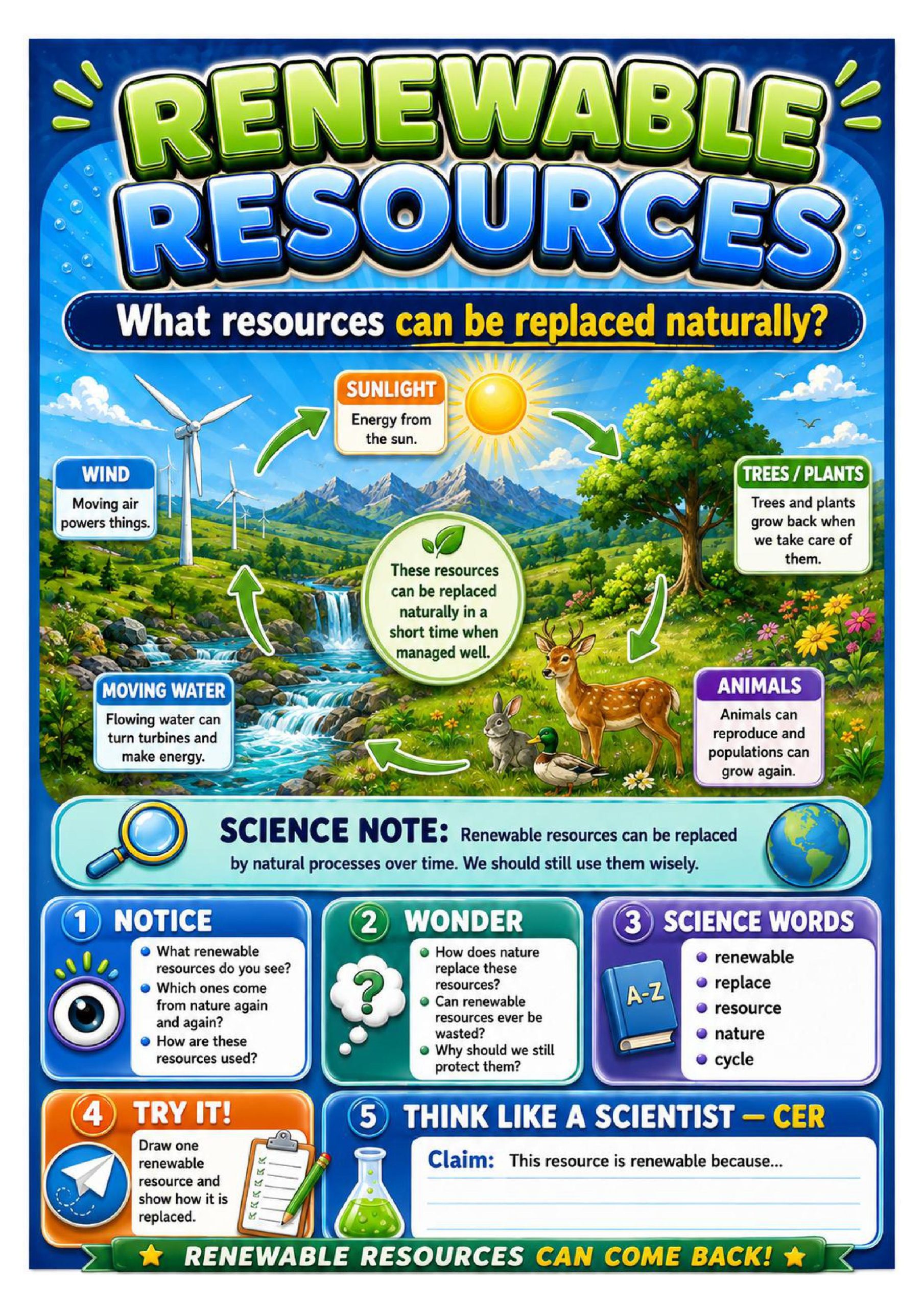
- Renewable Resources — Explore resources that can be replaced naturally over time, including sunlight, wind, moving water, plants, and animals.
- Nonrenewable Resources — Investigate resources such as coal, oil, natural gas, minerals, and metals that take extremely long periods of time to form and cannot be replaced quickly.
- Our Earth’s Resources — Introduce natural resources and examine examples such as sunlight, air, water, wood, rocks, and minerals.
- Be the Scientist: Resource Investigation — Students observe resource use in their school, home, or community, collect data, analyze examples, and share ideas for responsible resource use.
- Renewable vs. Nonrenewable — Compare the two major resource groups and examine how they differ in the amount of time nature needs to replace them.
- Using Resources Wisely — Explore practical ways to conserve resources through reducing, reusing, recycling, saving water and electricity, using less fuel, and protecting habitats.
Each poster includes a large Essential Question, vivid science illustrations, a concise Science Note, Notice & Wonder prompts, key Science Words, a Try It! activity, and a Think Like a Scientist — CER response prompt.
MORE THAN A POSTER — A TEACHING TOOL
These posters are designed to help students move beyond memorizing lists of renewable and nonrenewable resources and begin thinking about where resources come from, how they are used, and why responsible resource use matters.
Students investigate questions such as:
What are natural resources?
Which resources can be replaced naturally?
Which resources take a very long time to form?
How are renewable and nonrenewable resources different?
How do people use resources in their everyday lives?
What happens when limited resources are used too quickly?
How can individuals and communities conserve resources?
Use the posters to introduce a lesson, activate prior knowledge, guide whole-group conversations, reinforce vocabulary, support small-group instruction, review important concepts, or provide visual references throughout an Earth science, environmental science, or natural resources unit.
BUILDS SCIENCE THINKING
Rather than simply sorting resources into two categories, this set helps students understand why a resource is considered renewable or nonrenewable.
Students learn that renewable resources can be replaced through natural processes over relatively short periods of time when managed well. Examples in the set include sunlight, wind, moving water, trees and plants, and animals.
Students also learn that nonrenewable resources form much more slowly. Coal, petroleum, natural gas, minerals, and metals may take extremely long periods of time to form, which means these resources cannot be replaced quickly once they are used.
The comparison poster helps students directly examine the difference between these two groups and reinforces the important idea that both renewable and nonrenewable resources come from Earth, but they differ in how quickly nature can replace them.
CONNECT SCIENCE TO EVERYDAY LIFE
The set also encourages students to connect science concepts to the choices people make every day.
The Using Resources Wisely poster introduces practical conservation strategies such as:
- reducing unnecessary resource use
- reusing materials
- recycling
- saving water
- saving electricity
- using less fuel
- protecting trees
- caring for habitats and wildlife
These examples help students understand that conservation is not simply a science vocabulary word. It involves making thoughtful choices about how resources are used now so they remain available in the future.
INVESTIGATE RESOURCE USE
The Be the Scientist: Resource Investigation poster extends learning beyond the classroom wall by inviting students to investigate how resources are used in their own school, home, or community.
Students follow a simple scientific process:
Observe → Collect Data → Analyze → Share
They identify examples of resource use, record information with notes, charts, or surveys, classify examples as renewable or nonrenewable, and communicate ideas for conserving resources.
This provides a natural opportunity to practice data collection, classification, comparison, evidence-based reasoning, and real-world problem solving.
KEY SCIENCE CONCEPTS
Students will explore concepts including:
- natural resources
- renewable resources
- nonrenewable resources
- sunlight
- wind
- water
- plants
- animals
- coal
- oil
- petroleum
- natural gas
- minerals
- metals
- fossil fuels
- energy
- limited resources
- conservation
- reduce
- reuse
- recycle
- sustainability
- evidence
- data
PERFECT FOR
Whole-group science instruction, Earth science units, environmental science lessons, natural resources units, renewable and nonrenewable resource lessons, conservation activities, phenomenon-based learning, science anchor charts, classroom science walls, vocabulary reinforcement, morning review, small groups, science centers, CER practice, community investigations, science discussions, and unit review.
DESIGNED FOR STUDENT ENGAGEMENT
Bold headings, vivid landscapes, labeled resource examples, clear comparisons, realistic energy and mining scenes, community examples, and easy-to-read information boxes help make natural resource concepts understandable and meaningful for elementary learners.
The coordinated design allows all six posters to work together as a complete instructional sequence:
Explore renewable resources → investigate nonrenewable resources → identify Earth’s natural resources → investigate resource use → compare resource types → apply conservation strategies
Display all six together for an engaging Natural Resources science wall, or introduce them individually as students progress through the topic.
Turn your classroom walls into interactive science learning tools and help students understand where Earth’s resources come from, how renewable and nonrenewable resources differ, and why using resources wisely matters for both people and the planet.
- Grades K-5
- Instant digital download
- Print & reuse in class