Spin the Deck – Grade 4 Amplify Science: Waves, Energy, and Information
$5.00
Spin the Deck – Grade 4 Amplify Science: Waves, Energy, and Information
100 Interactive Science Review Cards | Cooperative Learning | Whole-Group & Small-Group Activities
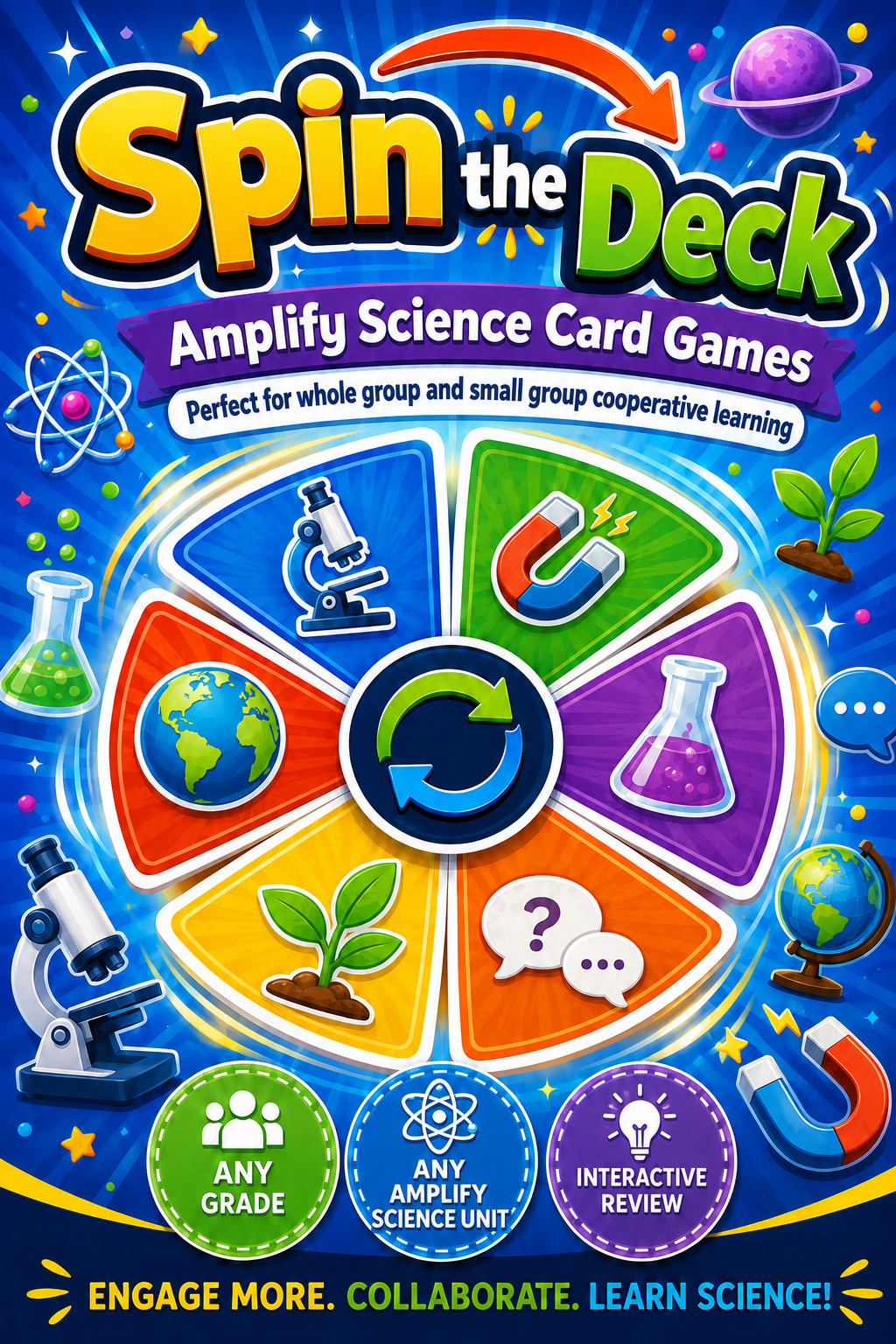
SPIN THE DECK! ENGAGE MORE. COLLABORATE. LEARN SCIENCE!
Make Waves in Your Classroom with an Exciting, Hands-On Science Review Experience!
How do waves transfer energy? Why can dolphins communicate underwater? What makes one sound louder than another? How do cell phones, computers, and satellites send information across long distances?
Bring these fascinating scientific questions to life with Spin the Deck: Waves, Energy, and Information!
Designed to complement the Grade 4 Amplify Science Waves, Energy, and Information unit, this interactive collection of 100 multiple-choice science review cards helps students investigate wave properties, energy transfer, sound and light waves, digital communication, and the ways information travels from one place to another.
Students explore how waves move energy, how vibrations produce sound, how wave properties affect what we hear, and how modern technology uses patterns and signals to communicate.
From investigating dolphins and bats using sound waves to exploring Morse code, binary numbers, cell phones, satellites, and digital signals, this resource connects essential scientific concepts to the technology and natural phenomena students encounter every day.
Perfect for whole-group review, cooperative learning, small-group instruction, science centers, partner activities, intervention, enrichment, and unit assessment preparation, Spin the Deck encourages students to communicate, collaborate, and think like scientists.
Move beyond traditional worksheets and transform your science review into an interactive adventure filled with discovery, discussion, and teamwork!
What's Included?
- 100 numbered multiple-choice science review cards covering Grade 4 Waves, Energy, and Information concepts
- Four answer choices per question to encourage careful reading, critical thinking, and scientific reasoning
- Answers printed on the reverse side for immediate feedback and self-checking
- 50 printable PDF pages designed for double-sided printing
- 25 double-sided sheets when printed back-to-back
- Four cards per sheet, creating 100 double-sided review cards
- Colorful science-themed card designs featuring laboratory equipment, scientific instruments, atoms, lightbulbs, and vibrant science imagery
- Questions covering wave properties, sound, light, energy transfer, digital information, communication technology, and scientific models
- Reusable review cards for cooperative learning games and interactive classroom activities
Easy Preparation: Print the PDF double-sided, cut apart the four cards on each sheet, and laminate for durability. Your interactive science review deck is ready to use!
Science Concepts & Skills Covered
Understanding Waves & Wave Properties
Help students investigate what waves are and how their properties affect the transfer of energy.
Topics include:
- Waves as patterns of motion
- Wave energy
- Energy transfer
- Amplitude
- Wavelength
- Frequency
- Wave crests and troughs
- High-frequency and low-frequency waves
- Wave sources
- Wave models
- Predicting wave behavior
- Energy dissipation
Students practice identifying important wave structures and explaining how changes in amplitude, wavelength, and frequency affect wave behavior.
Sound Waves, Vibrations & Energy Transfer
Discover how sound waves are produced, how they travel, and how their properties influence what we hear.
Topics include:
- Sound waves
- Vibrations
- Sound traveling through matter
- Sound traveling through solids, liquids, and gases
- Why sound cannot travel through a vacuum
- Sound amplitude and volume
- Sound wavelength and pitch
- High-pitched and low-pitched sounds
- Reflection of sound
- Echoes
- Energy transfer through sound waves
- Sound becoming weaker over distance
Students explore the relationship between vibrations and sound, investigate why some sounds are louder or higher-pitched than others, and examine how sound waves transfer energy.
Light Waves & How Light Interacts with Matter
Explore how light travels and what happens when light encounters different materials.
Topics include:
- Light waves
- Light traveling in straight lines
- Reflection
- Absorption
- Refraction
- Transparent materials
- Translucent materials
- Opaque materials
- Light and color
- Sunlight containing different colors
- Rainbows
- Light wavelengths
- How materials reflect or absorb light
Students investigate how light interacts with objects and why materials can appear different based on the light they reflect or absorb.
Digital Information, Patterns & Codes
Help students understand how information can be represented, transmitted, received, and decoded.
Topics include:
- Information transfer
- Patterns and codes
- Signals
- Binary code
- Zeros and ones
- Morse code
- Dots and dashes
- Digital information
- Analog signals
- Digital signals
- Encoding and decoding messages
- Digital images and pixels
- Information storage
- Reliable communication
Students explore how simple patterns can represent information and how digital systems use codes to communicate.
Communication Technology & Information Transfer
Connect science learning to real-world technology students use every day.
Topics include:
- Cell phones
- Radio waves
- Satellites
- Computers
- Microphones
- Speakers
- Electrical signals
- Digital communication
- Transmitters and receivers
- Sending information over long distances
- Converting sound into electrical signals
- Converting electrical signals back into sound
- Digital communication systems
Students examine how different devices send and receive information and investigate why digital communication is useful for transmitting messages across long distances.
Animal Communication & Echolocation
Explore how animals use waves and sound to communicate, locate objects, and survive.
Topics include:
- Dolphin communication
- Sound waves underwater
- Bat echolocation
- Echoes
- Reflected sound
- Using sound to locate food
- Animal communication
- Wave-based information transfer
Students connect scientific ideas about sound waves to animal behaviors and investigate how sound can carry useful information.
Wave Models, Investigations & Scientific Reasoning
Strengthen the scientific thinking skills students need to understand wave behavior and communication systems.
Topics include:
- Scientific models
- Predicting wave behavior
- Identifying wave properties
- Comparing wave types
- Transverse waves
- Longitudinal waves
- Slinky wave models
- Wave mediums
- Seismic waves
- Seismographs
- Recognizing patterns
- Explaining cause-and-effect relationships
- Applying scientific vocabulary
Students practice identifying scientific concepts, interpreting wave behavior, and connecting observations to explanations.
Perfect for Whole-Group & Small-Group Cooperative Learning!
Whole-Group Interactive Science Review
Bring students together to answer questions, compare responses, and discuss wave properties, energy transfer, sound, light, and communication technology.
Fan-N-Pick
Students work in cooperative groups, taking turns selecting cards, reading questions, answering, and checking responses. This activity promotes participation, active listening, and teamwork.
Quiz-Quiz-Trade
Students pair up, quiz one another, check answers, exchange cards, and find new partners. This movement-based activity provides repeated opportunities to review essential science vocabulary.
Science Centers & Stations
Create engaging review stations focused on wave properties, sound, light, digital communication, and scientific models.
Partner Review
Students take turns reading questions, selecting answers, and explaining their scientific reasoning before checking the answer on the reverse side.
Small-Group Wave Challenges
Organize students into teams to discuss questions, defend answers, and strengthen their understanding of how waves transfer energy and information.
Spin & Answer Review Games
Combine the cards with a classroom spinner or teacher-created game structure to make review sessions even more exciting.
Science Test Preparation
Help students revisit important vocabulary, scientific concepts, and explanations before unit assessments.
Warm-Ups & Exit Tickets
Select a few cards to activate prior knowledge, spark scientific discussions, or check student understanding at the end of a lesson.
Science Intervention & Enrichment
Target specific concepts for additional practice or challenge advanced learners to explain the scientific reasoning behind their answers.
Early Finishers & Substitute Plans
Provide meaningful, low-preparation science activities that keep students engaged and learning.
Why Teachers Will Love Spin the Deck!
Low-Prep and Ready to Use!
Simply print, cut, and laminate to create a reusable science review resource.
Designed for Cooperative Learning!
Encourage students to communicate, collaborate, listen respectfully, and participate in meaningful scientific discussions.
Promotes Active Student Engagement!
Turn traditional science review into an interactive experience involving discussion, movement, teamwork, and problem-solving.
Reinforces Amplify Science Concepts!
Review essential vocabulary and scientific ideas connected to the Grade 4 Waves, Energy, and Information unit.
Builds Scientific Reasoning!
Students strengthen their ability to identify wave properties, explain energy transfer, describe sound and light behavior, and understand how information travels through communication systems.
Provides Immediate Feedback!
Answers on the reverse side allow students to check their understanding during independent, partner, and group activities.
Supports Differentiated Instruction!
Select questions based on student readiness, target specific concepts, or extend discussions with additional scientific reasoning challenges.
Connects Learning to Real-World Science!
Examples involving dolphins, bats, cell phones, satellites, computers, microphones, speakers, rainbows, and sound waves help students recognize how waves and information affect everyday life.
Reusable Year After Year!
Laminate the cards for a durable classroom resource that supports repeated review and cooperative learning.
Sample Spin the Deck Questions
Here are examples of actual questions included in this collection:
Question 1: What is a wave?
Answer: A pattern of motion.
Question 2: The distance from the top of one wave to the top of the next is:
Answer: Wavelength.
Question 3: The height of a wave from its center to its peak is called:
Answer: Amplitude.
Question 4: Sound is a type of wave that travels through:
Answer: Matter (solids, liquids, gases).
Question 9: Information can be sent over long distances using:
Answer: Patterns and codes.
Question 10: In the unit, dolphins communicate using:
Answer: Sound waves.
Question 17: A "binary" code uses how many symbols?
Answer: Two.
Question 20: Why can't sound travel in outer space?
Answer: There is no matter to vibrate.
Question 23: Which device converts sound into electrical signals?
Answer: A microphone.
Question 26: When you increase the amplitude of a sound, it gets:
Answer: Louder.
Question 34: How do computers "talk" to each other?
Answer: Exchanging digital patterns.
Question 42: Which animal uses echolocation to find food?
Answer: Bat.
Question 47: A "Morse Code" signal uses:
Answer: Dots and dashes.
Question 51: What do we call the number of waves that pass in a certain time?
Answer: Frequency.
Question 54: How does a cell phone send a message?
Answer: Using radio waves.
Question 56: A "wave model" helps scientists:
Answer: Predict how waves behave.
Question 65: If you push a slinky back and forth, you make a:
Answer: Longitudinal wave.
Question 75: How do satellites send information?
Answer: Using waves through space.
These questions reinforce essential scientific vocabulary while encouraging students to explain wave properties, understand energy transfer, recognize communication patterns, and connect scientific ideas to real-world technology.
Make Waves with an Unforgettable Science Review!
Waves are all around us! From the sounds we hear to the light we see and the digital messages we send, waves play an important role in transferring energy and information.
With 100 Spin the Deck Waves, Energy, and Information review cards, students can investigate wave properties, explore sound and light, discover how communication systems work, and strengthen their understanding of scientific patterns and models.
Imagine students enthusiastically selecting cards, explaining the difference between amplitude and wavelength, investigating how dolphins communicate, identifying how microphones and speakers work, and collaborating to solve questions about digital signals and information transfer.
Whether you're reviewing lessons, preparing for assessments, reinforcing vocabulary, or building collaborative learning opportunities, Spin the Deck helps transform science review into an engaging classroom experience.
One deck. 100 questions. Multiple ways to learn!
SPIN THE DECK! ENGAGE MORE. COLLABORATE. LEARN SCIENCE!
Add Spin the Deck: Waves, Energy, and Information to your classroom toolkit and inspire confident, curious, and collaborative young scientists!
Important Curriculum Disclaimer
This independently created resource is designed to supplement the Amplify Science curriculum. It is not affiliated with, sponsored by, authorized by, or endorsed by Amplify Education, Inc. Amplify and Amplify Science are trademarks of their respective owner. No affiliation or endorsement is implied.
This product is a supplemental classroom review activity and is not a replacement for official Amplify Science curriculum materials, lessons, assessments, or instructional resources.
- Grade 4
- Instant digital download
- Print & reuse in class