Spin the Deck – Grade 5 Amplify Science: Ecosystem Restoration
$5.00
Spin the Deck – Grade 5 Amplify Science: Ecosystem Restoration
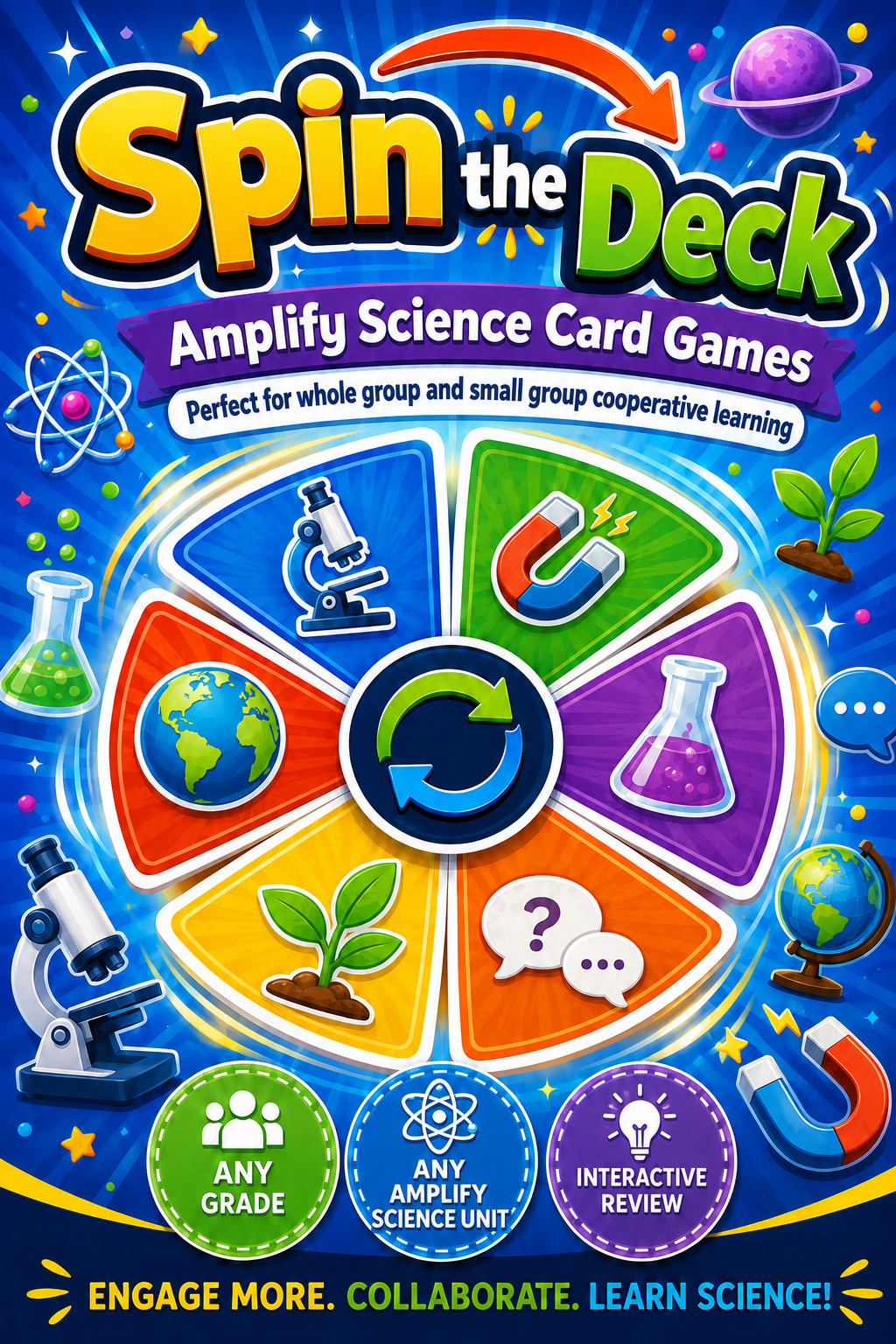
100 Interactive Science Review Cards | Cooperative Learning | Whole-Group & Small-Group Activities
SPIN THE DECK! ENGAGE MORE. COLLABORATE. LEARN SCIENCE!
Restore the Excitement of Science Learning with an Interactive Ecosystem Adventure!
What makes an ecosystem healthy? How do plants and animals depend on one another? Where does the matter in a growing plant come from? What happens when an ecosystem loses important organisms or nutrients?
Bring these essential scientific questions to life with Spin the Deck: Ecosystem Restoration!
Designed to complement the Grade 5 Amplify Science Ecosystem Restoration unit, this interactive collection of 100 multiple-choice science review cards helps students explore ecosystems, food webs, producers, consumers, decomposers, photosynthesis, matter cycling, energy flow, and the important relationships that keep ecosystems functioning.
Students investigate how living and nonliving components interact, why organisms depend on one another for survival, how matter moves through ecosystems, and why restoring a damaged environment requires scientific understanding.
From investigating why a rainforest is struggling to grow to exploring how decomposers recycle nutrients, how plants build their structures, and how energy moves through food chains, this resource connects essential scientific concepts to meaningful environmental challenges.
Perfect for whole-group review, cooperative learning, small-group instruction, science centers, partner activities, intervention, enrichment, and unit assessment preparation, Spin the Deck encourages students to communicate, collaborate, and think like environmental scientists.
Move beyond traditional worksheets and transform your ecosystem review into an exciting learning adventure filled with discovery, discussion, and teamwork!
What's Included?
- 100 numbered multiple-choice science review cards covering Grade 5 Ecosystem Restoration concepts
- Four answer choices per question to encourage careful reading, critical thinking, and scientific reasoning
- Answers printed on the reverse side for immediate feedback and self-checking
- 50 printable PDF pages designed for double-sided printing
- 25 double-sided sheets when printed back-to-back
- Four cards per sheet, creating 100 double-sided review cards
- Colorful science-themed card designs featuring laboratory equipment, scientific instruments, atoms, lightbulbs, and vibrant science imagery
- Questions covering ecosystems, food webs, photosynthesis, nutrient cycling, energy flow, organism interactions, ecosystem health, restoration, and scientific reasoning
- Reusable review cards for cooperative learning games and interactive classroom activities
Easy Preparation: Print the PDF double-sided, cut apart the four cards on each sheet, and laminate for durability. Your interactive ecosystem review deck is ready to use!
Science Concepts & Skills Covered
Ecosystems & Organism Interactions
Help students understand what makes an ecosystem and how living and nonliving components work together.
Topics include:
- Ecosystems
- Living and nonliving components
- Biotic factors
- Abiotic factors
- Habitats
- Ecology
- Organism interactions
- Interdependence
- Ecosystem balance
- Healthy ecosystems
- Environmental conditions
- Population relationships
Students practice identifying ecosystem components and explaining how changes to one part of an ecosystem can affect other organisms.
Producers, Consumers & Decomposers
Explore the important roles organisms play in maintaining healthy ecosystems.
Topics include:
- Producers
- Consumers
- Decomposers
- Herbivores
- Carnivores
- Omnivores
- Predators
- Scavengers
- Primary consumers
- Secondary consumers
- Apex predators
- Fungi and bacteria
- Organism relationships
Students learn how organisms obtain matter and energy and investigate why producers, consumers, and decomposers are essential to ecosystem survival.
Photosynthesis & Plant Growth
Discover how plants obtain the matter and energy needed to grow and survive.
Topics include:
- Photosynthesis
- Sunlight and solar energy
- Carbon dioxide
- Water
- Oxygen
- Glucose and sugar production
- Chloroplasts
- Plant structures
- Leaves and roots
- Plant growth
- Matter from air and water
- Nutrients
- Plant energy storage
Students investigate where plants obtain the materials needed to build roots, stems, and leaves while exploring the role of photosynthesis in ecosystems.
Food Chains, Food Webs & Energy Flow
Help students understand how energy moves through an ecosystem and how organisms depend on food sources.
Topics include:
- Food chains
- Food webs
- Energy flow
- Energy from the Sun
- Producer-consumer relationships
- Predator-prey relationships
- Primary and secondary consumers
- Energy transfer
- Food web arrows
- Energy use and heat
- Changes in food availability
- Effects of removing producers
Students explore how food webs represent feeding relationships and explain why disruptions to one population can affect other organisms.
Matter Cycling & Nutrient Recycling
Investigate how matter moves through ecosystems and why decomposers are important.
Topics include:
- Matter
- Conservation of matter
- Matter cycling
- Nutrients
- Decomposition
- Nutrient recycling
- Soil
- Dead organic matter
- Matter transfer
- Animal growth
- Plant building materials
- Carbon movement
- Recycling matter through ecosystems
Students examine how matter moves between organisms and their environments, how decomposers return nutrients to the soil, and why matter is essential for growth and survival.
Ecosystem Health & Restoration
Explore how scientists investigate damaged ecosystems and develop ways to restore environmental balance.
Topics include:
- Ecosystem restoration
- Healthy ecosystems
- Habitat restoration
- Rainforest ecosystems
- Nutrient availability
- Environmental balance
- Ecosystem disruption
- Population changes
- Restoration projects
- Interdependence
- Ecosystem recovery
- Identifying environmental problems
Students connect scientific knowledge to environmental challenges, including investigating why a rainforest may struggle to grow and how restoring important ecosystem resources can support recovery.
Scientific Investigation, Evidence & Reasoning
Strengthen the scientific practices students need to investigate ecosystems and explain their findings.
Topics include:
- Scientific questions
- Claims
- Evidence
- Observations
- Inferences
- Scientific models
- Analyzing data
- Identifying patterns
- Using evidence to support conclusions
- Investigating cause-and-effect relationships
- Evaluating scientific explanations
- Communicating scientific ideas
Students practice using scientific reasoning to interpret ecosystem relationships, explain observations, and support conclusions with evidence.
Perfect for Whole-Group & Small-Group Cooperative Learning!
Whole-Group Interactive Science Review
Bring students together to answer questions, compare responses, and discuss ecosystem relationships, food webs, matter cycling, energy flow, and environmental restoration.
Fan-N-Pick
Students work in cooperative groups, taking turns selecting cards, reading questions, answering, and checking responses. This activity promotes participation, active listening, and teamwork.
Quiz-Quiz-Trade
Students pair up, quiz one another, check answers, exchange cards, and find new partners. This movement-based activity provides repeated opportunities to review essential ecosystem vocabulary.
Science Centers & Stations
Create engaging review stations focused on ecosystem components, food webs, photosynthesis, matter cycling, decomposers, and restoration.
Partner Review
Students take turns reading questions, selecting answers, and explaining their scientific reasoning before checking the answer on the reverse side.
Small-Group Ecosystem Challenges
Organize students into teams to discuss questions, defend answers, and strengthen their understanding of how organisms interact and ecosystems function.
Spin & Answer Review Games
Combine the cards with a classroom spinner or teacher-created game structure to make review sessions even more exciting.
Science Test Preparation
Help students revisit important vocabulary, scientific concepts, and explanations before unit assessments.
Warm-Ups & Exit Tickets
Select a few cards to activate prior knowledge, spark scientific discussions, or check student understanding at the end of a lesson.
Science Intervention & Enrichment
Target specific concepts for additional practice or challenge advanced learners to explain the scientific reasoning behind their answers.
Early Finishers & Substitute Plans
Provide meaningful, low-preparation science activities that keep students engaged and learning.
Why Teachers Will Love Spin the Deck!
Low-Prep and Ready to Use!
Simply print, cut, and laminate to create a reusable science review resource.
Designed for Cooperative Learning!
Encourage students to communicate, collaborate, listen respectfully, and participate in meaningful scientific discussions.
Promotes Active Student Engagement!
Turn traditional science review into an interactive experience involving discussion, movement, teamwork, and problem-solving.
Reinforces Amplify Science Concepts!
Review essential vocabulary and scientific ideas connected to the Grade 5 Ecosystem Restoration unit.
Builds Scientific Reasoning!
Students strengthen their ability to identify ecosystem components, explain matter and energy transfer, interpret food webs, describe photosynthesis, and investigate ecosystem restoration.
Provides Immediate Feedback!
Answers on the reverse side allow students to check their understanding during independent, partner, and group activities.
Supports Differentiated Instruction!
Select questions based on student readiness, target specific concepts, or extend discussions with additional scientific reasoning challenges.
Connects Learning to Real-World Environmental Science!
Examples involving rainforests, plants, animals, soil, decomposers, food webs, and ecosystem restoration help students recognize how scientific concepts apply to the natural world.
Reusable Year After Year!
Laminate the cards for a durable classroom resource that supports repeated review and cooperative learning.
Sample Spin the Deck Questions
Here are examples of actual questions included in this collection:
Question 1: What is an ecosystem?
Answer: Living and nonliving things interacting.
Question 2: Where do producers get their energy?
Answer: From the Sun.
Question 3: Which of these is a producer?
Answer: Grass.
Question 5: What process do plants use to make food?
Answer: Photosynthesis.
Question 8: What do decomposers do in an ecosystem?
Answer: Break down dead matter.
Question 11: In the unit, why was the rainforest not growing?
Answer: Not enough nutrients.
Question 14: Which group "recycles" matter back into the soil?
Answer: Decomposers.
Question 18: A food web shows how _____ moves in an ecosystem.
Answer: Matter and energy.
Question 20: Restoration means the process of:
Answer: Repairing an ecosystem.
Question 26: Matter _____ through an ecosystem.
Answer: Cycles.
Question 27: Energy _____ through an ecosystem.
Answer: Flows in one direction.
Question 30: What happens to an animal's matter after it dies?
Answer: It is recycled by decomposers.
Question 36: Where do most of a plant's solid building materials come from?
Answer: The air.
Question 42: What is a secondary consumer?
Answer: An animal that eats herbivores.
Question 48: Which is the primary consumer in: Grass → Cricket → Frog?
Answer: Cricket.
Question 55: What happens to energy as it moves up a food chain?
Answer: Most is used or lost as heat.
Question 61: What is the "Restoration Project" goal?
Answer: To return a habitat to health.
Question 66: In a food web, the arrows show:
Answer: The direction of energy flow.
These questions reinforce essential scientific vocabulary while encouraging students to explain ecosystem relationships, identify how matter and energy move through food webs, investigate organism interactions, and connect scientific ideas to environmental restoration.
Restore Excitement to Your Science Classroom!
Healthy ecosystems depend on countless interactions between plants, animals, decomposers, and the nonliving environment. Understanding these relationships helps students recognize why protecting and restoring ecosystems matters.
With 100 Spin the Deck Ecosystem Restoration review cards, students can explore food webs, investigate matter and energy transfer, discover the importance of photosynthesis and decomposition, and strengthen their understanding of how ecosystems function.
Imagine students enthusiastically selecting cards, explaining how matter cycles through an ecosystem, identifying the roles of producers and consumers, investigating why rainforests need nutrients, and collaborating to solve questions about ecosystem health and restoration.
Whether you're reviewing lessons, preparing for assessments, reinforcing vocabulary, or building collaborative learning opportunities, Spin the Deck helps transform science review into an engaging classroom experience.
One deck. 100 questions. Multiple ways to learn!
SPIN THE DECK! ENGAGE MORE. COLLABORATE. LEARN SCIENCE!
Add Spin the Deck: Ecosystem Restoration to your classroom toolkit and inspire confident, curious, and environmentally aware young scientists!
Important Curriculum Disclaimer
This independently created resource is designed to supplement the Amplify Science curriculum. It is not affiliated with, sponsored by, authorized by, or endorsed by Amplify Education, Inc. Amplify and Amplify Science are trademarks of their respective owner. No affiliation or endorsement is implied.
This product is a supplemental classroom review activity and is not a replacement for official Amplify Science curriculum materials, lessons, assessments, or instructional resources.
- Grade 5
- Instant digital download
- Print & reuse in class