Spin the Deck – Grade 5 Amplify Science: Modeling Matter
$5.00
Spin the Deck – Grade 5 Amplify Science: Modeling Matter
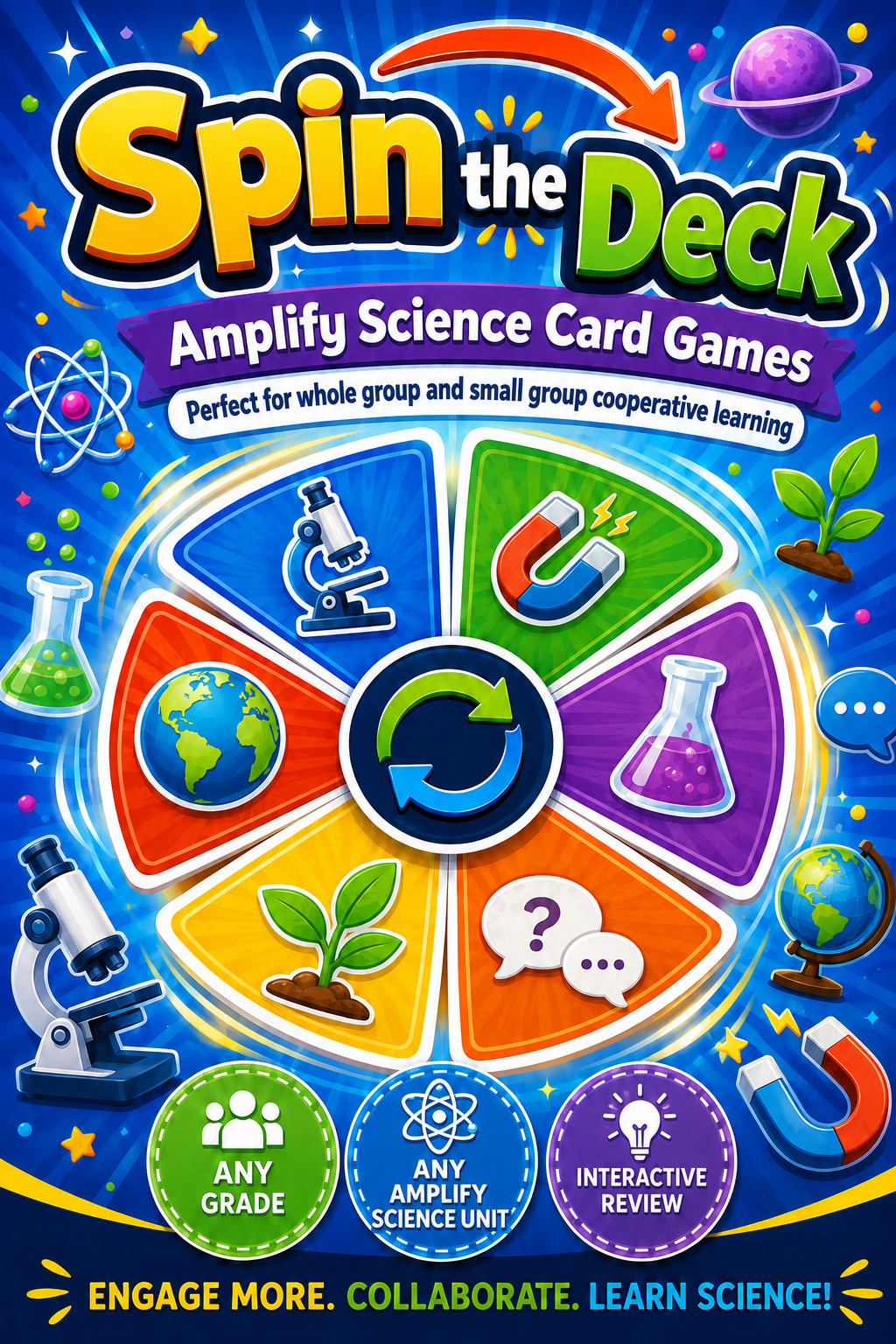
100 Interactive Science Review Cards | Cooperative Learning | Whole-Group & Small-Group Activities
SPIN THE DECK! ENGAGE MORE. COLLABORATE. LEARN SCIENCE!
Make Matter Come Alive with an Interactive Science Review Adventure!
What is matter made of? Why do some substances dissolve while others separate? What happens to molecules when substances are heated or cooled? How can scientists use models to explain things too small to see?
Bring these fascinating science questions to life with Spin the Deck: Modeling Matter!
Designed to complement the Grade 5 Amplify Science Modeling Matter unit, this engaging collection of 100 multiple-choice science review cards helps students investigate the properties of matter, atoms and molecules, mixtures and solutions, molecular attraction, states of matter, physical and chemical changes, and scientific modeling.
Students explore how tiny particles make up everything around them, why different substances have different properties, how molecules interact, and how scientists use evidence and models to explain what happens at the molecular level.
From solving the mystery of separating salad dressing to investigating how emulsifiers help ingredients stay mixed, why oil floats on water, how substances dissolve, and how heating and cooling affect molecular movement, this resource connects essential scientific concepts to meaningful, real-world experiences.
Perfect for whole-group review, cooperative learning, small-group instruction, science centers, partner activities, intervention, enrichment, and unit assessment preparation, Spin the Deck transforms traditional science review into an interactive experience that promotes collaboration, scientific reasoning, and active participation.
Move beyond ordinary worksheets and give students an exciting opportunity to think, discuss, investigate, and learn like real scientists!
What's Included?
- 100 numbered multiple-choice science review cards covering Grade 5 Modeling Matter concepts
- Four answer choices per question to encourage careful reading and scientific reasoning
- Answers printed on the reverse side for immediate feedback and self-checking
- 50 printable PDF pages designed for double-sided printing
- 25 double-sided sheets when printed back-to-back
- Four cards per sheet, creating 100 double-sided review cards
- Vibrant science-themed card designs featuring atoms, laboratory equipment, test tubes, scientific instruments, and colorful science imagery
- Questions covering matter, molecular structure, states of matter, physical properties, solutions, mixtures, dissolving, density, molecular attraction, chemical reactions, and scientific investigation
- Reusable review cards for cooperative learning games, science stations, and classroom review activities
Easy Preparation: Print the PDF double-sided, cut apart the four cards on each sheet, and laminate for durability. Your interactive Modeling Matter review deck is ready to use!
Science Concepts & Skills Covered
Matter, Atoms & Molecules
Help students understand the fundamental building blocks of matter and how tiny particles make up everything around them.
Topics include:
- Matter
- Mass
- Volume
- Atoms
- Molecules
- Molecular structure
- Particle models
- Atomic scale
- Microscopic scale
- Macroscopic observations
- Nanoscience vocabulary
- Molecular movement
- Properties of substances
- Conservation of matter
Students practice identifying what makes something matter and explaining how particles too small to see help determine the properties of everyday materials.
States of Matter & Molecular Movement
Explore how particles behave in solids, liquids, and gases.
Topics include:
- Solids
- Liquids
- Gases
- Particle arrangement
- Molecular attraction
- Molecular motion
- Fixed shape and volume
- Changes in temperature
- Heating and cooling
- Compressibility
- Molecular spacing
- Changes of state
Students investigate how the movement and arrangement of molecules help explain why solids maintain their shape, liquids flow, and gases spread to fill their containers.
Physical Properties of Matter
Strengthen students' understanding of the characteristics scientists use to describe and identify substances.
Topics include:
- Physical properties
- Color
- Mass
- Volume
- Density
- Solubility
- Molecular structure
- Surface area
- Observing matter
- Measuring matter
- Comparing substances
- Scientific measurement tools
Students explore how scientists observe and measure matter to identify differences between substances and explain their behavior.
Mixtures, Solutions & Dissolving
Help students understand what happens when substances are combined and why some mixtures behave differently from others.
Topics include:
- Mixtures
- Solutions
- Solutes
- Solvents
- Dissolving
- Solubility
- Insoluble substances
- Saturated solutions
- Suspensions
- Molecular mixing
- Separating mixtures
- Filtration
- Evaporation
- Chromatography
Students investigate why salt dissolves in water, how substances mix at the molecular level, and how different methods can separate mixtures.
Density, Molecular Attraction & Emulsifiers
Connect science concepts to the real-world mystery of separating ingredients.
Topics include:
- Density
- Floating and sinking
- Oil and water
- Molecular attraction
- Molecular interactions
- Emulsifiers
- Ingredient separation
- Mixture stability
- Salad dressing investigations
- Properties of liquids
Students explore the Modeling Matter salad dressing mystery, investigating why ingredients separate and how emulsifiers can help them remain mixed together.
Thermal Energy & Changes of State
Investigate how heating and cooling affect matter and molecular motion.
Topics include:
- Thermal energy
- Heat transfer
- Melting
- Freezing
- Evaporation
- Condensation
- Boiling
- Water vapor
- Phase changes
- Particle movement
- Temperature changes
- Conservation of mass during changes of state
Students explain how changes in thermal energy affect molecular motion and how matter can change states without disappearing.
Physical & Chemical Changes
Help students recognize differences between changes in a substance's physical appearance and changes that produce new substances.
Topics include:
- Physical changes
- Chemical changes
- Chemical reactions
- Evidence of chemical reactions
- Formation of new substances
- Precipitates
- Temperature changes
- Color changes
- Gas formation
- Endothermic reactions
- Exothermic reactions
- Conservation of matter
Students practice identifying changes in matter and examining evidence that a chemical reaction may have occurred.
Scientific Models, Investigation & Evidence
Develop the scientific practices students need to explain observations and investigate matter.
Topics include:
- Scientific models
- Visualizations
- Observations
- Inferences
- Evidence
- Molecular representations
- Scientific tools
- Mass measurement
- Volume measurement
- Investigating mixtures
- Analyzing results
- Scientific explanations
- Food science investigations
Students explore how scientists use models to represent particles too small to observe directly and use evidence to explain how matter behaves.
Perfect for Whole-Group & Small-Group Cooperative Learning!
Whole-Group Interactive Science Review
Engage the entire class in meaningful discussions about molecular structure, states of matter, mixtures, solutions, density, and scientific modeling.
Fan-N-Pick
Students work in cooperative groups, taking turns selecting cards, reading questions, answering, and checking responses. This structure encourages participation, teamwork, and active listening.
Quiz-Quiz-Trade
Students pair up, quiz one another, check answers, exchange cards, and find new partners. This movement-based activity provides repeated opportunities to practice science vocabulary and concepts.
Science Centers & Stations
Create engaging review stations focused on matter, molecules, mixtures, solutions, density, thermal energy, and physical and chemical changes.
Partner Review
Students take turns reading questions, choosing answers, explaining their reasoning, and checking responses on the reverse side.
Small-Group Science Challenges
Organize students into teams to discuss scientific questions, defend their answers, and strengthen their understanding of molecular interactions.
Spin & Answer Review Games
Combine the cards with a classroom spinner or teacher-created game structure to add excitement to science review.
Science Test Preparation
Help students revisit important vocabulary, scientific concepts, and explanations before unit assessments.
Warm-Ups & Exit Tickets
Use selected cards to activate prior knowledge, introduce scientific discussions, or quickly assess understanding.
Science Intervention & Enrichment
Target specific concepts for additional practice or challenge students to provide more detailed scientific explanations.
Early Finishers & Substitute Plans
Provide meaningful, low-preparation science activities that reinforce essential learning.
Why Teachers Will Love Spin the Deck!
Low-Prep and Ready to Use!
Simply print, cut, and laminate to create a reusable science review resource.
Designed for Cooperative Learning!
Encourage students to communicate, collaborate, listen respectfully, and explain their scientific thinking.
Promotes Active Student Engagement!
Turn traditional science review into an interactive experience involving discussion, movement, teamwork, and problem-solving.
Reinforces Amplify Science Concepts!
Review important vocabulary and scientific ideas connected to the Grade 5 Modeling Matter unit.
Builds Scientific Reasoning!
Students strengthen their ability to explain molecular behavior, compare substances, identify physical properties, investigate mixtures, and use models to support scientific explanations.
Provides Immediate Feedback!
Answers on the reverse side allow students to check their understanding during independent, partner, and group activities.
Supports Differentiated Instruction!
Select questions based on student readiness, target specific concepts, or extend learning through additional scientific discussions.
Connects Learning to Real-World Science!
Examples involving salad dressing, oil and water, saltwater, food coloring, balloons, sugar cubes, and everyday materials help students recognize science in their daily lives.
Reusable Year After Year!
Laminate the cards for a durable classroom resource that supports repeated review and cooperative learning.
Sample Spin the Deck Questions
Here are examples of actual questions included in this collection:
Question 1: What is everything in the universe made of?
Answer: Matter.
Question 2: Matter is anything that has mass and:
Answer: Takes up space.
Question 3: The tiny pieces that make up all matter are called:
Answer: Atoms/Molecules.
Question 5: In which state do molecules move most freely?
Answer: Gas.
Question 7: A mixture where one substance dissolves into another is a:
Answer: Solution.
Question 8: What happens to molecules when they are heated?
Answer: They move faster.
Question 15: If a substance "dissolves," it means it:
Answer: Mixes evenly at a molecular level.
Question 20: What happens to the mass of matter during a change of state?
Answer: It stays the same.
Question 27: What is the "solute" in a saltwater solution?
Answer: The salt.
Question 35: A "chromatography" test is used to:
Answer: Separate mixtures.
Question 38: What happens when you add food coloring to water?
Answer: Molecules mix and spread.
Question 41: The total mass of a mixture is the _____ of its parts.
Answer: Sum.
Question 48: To separate salt from water, you could use:
Answer: Evaporation.
Question 52: Why does ice float in water?
Answer: It is less dense.
Question 56: In Modeling Matter, we acted as:
Answer: Food Scientists.
Question 57: The "salad dressing" mystery involved:
Answer: Why ingredients separated.
Question 58: Emulsifiers help ingredients:
Answer: Stay mixed together.
Question 59: What property allows oil to float on water?
Answer: Density.
Question 61: A "saturated" solution means:
Answer: No more solute can dissolve.
Question 67: When water boils, the bubbles are:
Answer: Water vapor gas.
Question 72: If you crush a sugar cube, you change its:
Answer: Surface area.
These questions reinforce essential scientific vocabulary while encouraging students to explain molecular interactions, investigate the properties of substances, identify changes in matter, and connect scientific models to everyday experiences.
Make Every Science Review a Matter of Discovery!
Everything around us is made of matter, and understanding how matter behaves helps students make sense of the world.
With 100 Spin the Deck Modeling Matter review cards, students can explore atoms and molecules, investigate mixtures and solutions, discover why substances dissolve or separate, and strengthen their understanding of how scientists use evidence and models.
Imagine students enthusiastically selecting cards, explaining why oil floats on water, investigating how emulsifiers work, describing molecular movement, identifying changes of state, and collaborating to solve scientific questions.
Whether you're reviewing lessons, preparing for assessments, reinforcing vocabulary, or creating collaborative learning opportunities, Spin the Deck helps transform science review into an engaging classroom experience.
One deck. 100 questions. Multiple ways to learn!
SPIN THE DECK! ENGAGE MORE. COLLABORATE. LEARN SCIENCE!
Add Spin the Deck: Modeling Matter to your classroom toolkit and inspire confident, curious, and scientifically minded young learners!
Important Curriculum Disclaimer
This independently created resource is designed to supplement the Amplify Science curriculum. It is not affiliated with, sponsored by, authorized by, or endorsed by Amplify Education, Inc. Amplify and Amplify Science are trademarks of their respective owner. No affiliation or endorsement is implied.
This product is a supplemental classroom review activity and is not a replacement for official Amplify Science curriculum materials, lessons, assessments, or instructional resources.
- Grade 5
- Instant digital download
- Print & reuse in class