Spin the Deck – Grade 5 Amplify Science: The Earth System
$5.00
Spin the Deck – Grade 5 Amplify Science: The Earth System
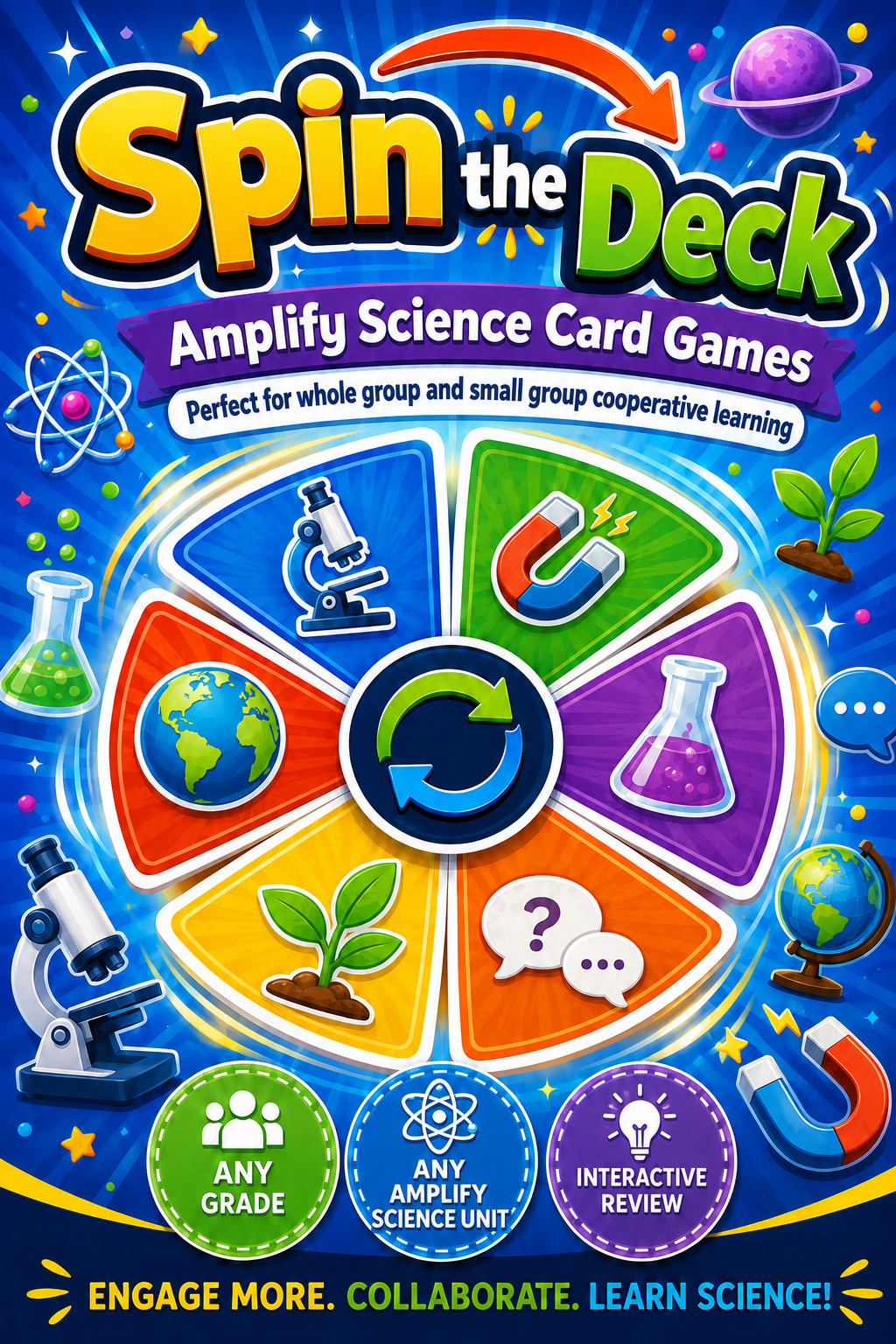
100 Interactive Science Review Cards | Cooperative Learning | Whole-Group & Small-Group Activities
SPIN THE DECK! ENGAGE MORE. COLLABORATE. DISCOVER HOW EARTH WORKS!
Turn Your Science Classroom into an Exciting Earth Systems Investigation!
Where does Earth's water come from? Why do some places experience drought while others receive abundant rainfall? How do Earth's land, water, air, and living things interact? What happens when one part of Earth's system changes?
Bring these fascinating questions to life with Spin the Deck: The Earth System!
Designed to complement the Grade 5 Amplify Science The Earth System unit, this engaging collection of 100 multiple-choice science review cards helps students investigate Earth's interconnected systems, the water cycle, freshwater distribution, weather patterns, natural resources, and the relationships between the geosphere, hydrosphere, atmosphere, and biosphere.
Students explore how water moves through Earth's systems, why freshwater is a limited resource, how mountains influence precipitation, and how changes in one Earth system can affect others.
From investigating the East Ferris water mystery to understanding groundwater, aquifers, evaporation, condensation, and precipitation, students develop a deeper understanding of the processes that shape our planet.
Perfect for whole-group science review, cooperative learning, small-group instruction, science centers, partner activities, intervention, enrichment, and unit assessment preparation, Spin the Deck transforms traditional review into an exciting, collaborative learning experience.
Students don't just memorize science vocabulary—they practice recognizing patterns, identifying cause-and-effect relationships, explaining interactions, and applying scientific knowledge to real-world environmental challenges.
Help your students become confident Earth scientists, critical thinkers, and responsible stewards of our planet!
What's Included?
- 100 numbered multiple-choice science review cards covering Grade 5 Earth System concepts
- Four answer choices per question to encourage careful reading and scientific reasoning
- Answers printed on the reverse side for immediate feedback and student self-checking
- 50 printable PDF pages designed for double-sided printing
- 25 double-sided sheets when printed back-to-back
- Four cards per sheet, creating 100 interactive review cards
- Colorful science-themed card designs featuring laboratory equipment, scientific instruments, and engaging science imagery
- Questions addressing Earth's four spheres, the water cycle, freshwater distribution, groundwater, precipitation, landforms, climate, and human impacts
- Reusable review cards for cooperative learning games, science stations, and classroom activities
Easy Preparation: Print the PDF double-sided, cut apart the four cards on each sheet, and laminate for durability. Your interactive Earth System review deck is ready to use!
Science Concepts & Skills Covered
Earth's Four Interconnected Spheres
Help students identify and understand the major components of Earth's system.
Topics include:
- Geosphere
- Hydrosphere
- Atmosphere
- Biosphere
- Earth's crust and mantle
- Rocks, mountains, and landforms
- Oceans, rivers, and lakes
- Atmospheric gases
- Living organisms
- Interactions between Earth's spheres
Students investigate how Earth's land, water, air, and living things form an interconnected system and how changes in one sphere can affect another.
The Water Cycle & Movement of Water
Explore the continuous movement of water through Earth's environment.
Topics include:
- Evaporation
- Condensation
- Precipitation
- Transpiration
- Runoff
- Infiltration
- Collection
- Water vapor
- The Sun as an energy source
- Gravity's role in the water cycle
- Water changing states
- Movement of water between reservoirs
Students learn how water moves through the atmosphere, across Earth's surface, underground, and through living organisms.
Earth's Water Distribution & Freshwater Resources
Help students understand where Earth's water is located and why accessible freshwater is so valuable.
Topics include:
- Saltwater and freshwater
- Oceans
- Glaciers and ice caps
- Groundwater
- Rivers and lakes
- Freshwater reservoirs
- Earth's water distribution
- Limited freshwater supplies
- Potable water
- Freshwater conservation
- Desalination
Students explore why approximately 97% of Earth's water is saltwater and why most freshwater is stored in ice caps and glaciers.
Groundwater, Aquifers & Water Storage
Investigate the important role of underground water in Earth's system.
Topics include:
- Groundwater
- Aquifers
- Infiltration
- Water stored in soil and rock
- Underground water reservoirs
- Freshwater availability
- Water movement through the geosphere
- Water storage and distribution
Students develop an understanding of how water enters the ground, where groundwater is stored, and why underground freshwater resources are important.
Weather, Climate & Precipitation Patterns
Explore the relationship between Earth's atmosphere, landforms, and water distribution.
Topics include:
- Rain and snow
- Sleet and hail
- Air temperature
- Humidity
- Water vapor
- Cloud formation
- Mountain precipitation
- Rain shadows
- Windward and leeward mountain slopes
- Drought
- Uneven precipitation
- Landforms and climate
Students investigate why some regions receive more precipitation than others and how mountains influence local weather patterns.
Interactions Between Earth's Systems
Help students recognize how Earth's spheres influence one another.
Topics include:
- Rain falling on soil
- Wind moving sand
- Erosion
- Flooding
- Animals drinking water
- Plants releasing water vapor
- Living organisms using atmospheric gases
- Water shaping landforms
- Soil containing components of multiple spheres
- Changes affecting interconnected systems
Students identify real-world examples of interactions between the atmosphere, biosphere, hydrosphere, and geosphere.
The East Ferris Water Mystery
Connect review activities to the investigation featured in the Amplify Science Earth System unit.
Topics include:
- Changes in water distribution
- Water availability
- Earth's interconnected systems
- The hydrosphere
- Freshwater resources
- Evidence-based explanations
- Investigating environmental changes
Students revisit important concepts connected to the East Ferris mystery and consider how changes in water distribution can affect communities and the environment.
Human Impacts & Water Conservation
Encourage students to think critically about the relationship between people and Earth's natural resources.
Topics include:
- Water pollution
- Overuse of freshwater
- Water conservation
- Limited natural resources
- Potable water
- Desalination
- Human impacts on the hydrosphere
- Environmental responsibility
- Freshwater availability
- Effects of drought on living organisms
Students explore why freshwater conservation matters and how human activities can influence Earth's water systems.
Scientific Tools, Models & Earth System Investigations
Strengthen students' understanding of how scientists investigate Earth.
Topics include:
- Scientific models
- Systems and their components
- Closed systems
- Scientific observations
- Rain gauges
- Measuring precipitation
- Geologists
- Evidence
- Cause-and-effect relationships
- Water molecules
- States of matter
- Scientific explanations
Students practice recognizing how scientists use models, tools, and observations to investigate systems and explain natural processes.
Perfect for Whole-Group & Small-Group Cooperative Learning!
Whole-Group Interactive Science Review
Engage your entire class in discussions about Earth's four spheres, the water cycle, freshwater distribution, and interactions between land, water, air, and living things.
Fan-N-Pick
Students work in cooperative groups, taking turns selecting cards, reading questions, answering, and checking responses. This structure promotes participation, teamwork, and active listening.
Quiz-Quiz-Trade
Students pair up, quiz one another, check answers, exchange cards, and find new partners. This movement-based activity reinforces Earth science vocabulary and concepts through repeated practice.
Science Centers & Stations
Create engaging review stations focused on Earth's spheres, the water cycle, groundwater, freshwater resources, weather patterns, and environmental interactions.
Partner Review
Students take turns reading questions, selecting answers, explaining their reasoning, and checking responses on the reverse side.
Small-Group Earth Science Challenges
Organize students into teams to investigate Earth system questions, discuss cause-and-effect relationships, and defend answers using scientific reasoning.
Spin & Answer Review Games
Combine the cards with a classroom spinner or teacher-created game structure to add excitement and friendly competition to science review.
Science Test Preparation
Help students revisit essential vocabulary, important scientific processes, and key Earth System concepts before unit assessments.
Warm-Ups & Exit Tickets
Use selected cards to activate prior knowledge, encourage scientific discussions, or quickly assess student understanding.
Science Intervention & Enrichment
Target specific concepts for additional practice or challenge students to explain how multiple Earth systems interact.
Early Finishers & Substitute Plans
Provide meaningful, low-preparation science activities that reinforce important Earth science concepts.
Why Teachers Will Love Spin the Deck!
Low-Prep and Ready to Use!
Simply print, cut, and laminate to create a reusable classroom resource.
Designed for Cooperative Learning!
Encourage students to communicate, collaborate, listen respectfully, and explain their scientific thinking.
Promotes Active Student Engagement!
Transform traditional science review into an interactive experience involving discussion, movement, teamwork, and problem-solving.
Reinforces Amplify Science Concepts!
Review important vocabulary and scientific ideas connected to the Grade 5 The Earth System unit.
Builds Scientific Reasoning!
Students strengthen their ability to recognize patterns, explain water movement, identify Earth system interactions, and connect causes with effects.
Provides Immediate Feedback!
Answers on the reverse side allow students to check their understanding during independent, partner, and group activities.
Supports Differentiated Instruction!
Select questions based on student readiness, target specific concepts, or extend learning through additional scientific discussions.
Connects Learning to Real-World Environmental Issues!
Examples involving drought, groundwater, freshwater conservation, rain shadows, and human impacts help students recognize the importance of Earth's systems in everyday life.
Reusable Year After Year!
Laminate the cards for a durable classroom resource that supports repeated review and cooperative learning.
Sample Spin the Deck Questions
Here are examples of actual questions included in this collection:
Question 1: Which sphere includes all humans, animals, and plants?
Answer: Biosphere.
Question 2: The layer of gases surrounding Earth is the:
Answer: Atmosphere.
Question 3: Most of Earth's total water is found in:
Answer: Oceans.
Question 5: What is the primary energy source for the water cycle?
Answer: The Sun.
Question 6: Which process turns liquid water into water vapor?
Answer: Evaporation.
Question 7: Water vapor cooling to form liquid droplets is:
Answer: Condensation.
Question 9: What percentage of Earth's water is salt water?
Answer: 97%.
Question 10: Most of Earth's fresh water is located in:
Answer: Ice caps and glaciers.
Question 11: Plants releasing water vapor into the air is:
Answer: Transpiration.
Question 13: Which is an example of an interaction between spheres?
Answer: Rain falling on soil.
Question 14: Freshwater that is found under Earth's surface is:
Answer: Groundwater.
Question 15: The East Ferris mystery was caused by a change in:
Answer: Water distribution.
Question 16: When water moves over land into a lake or river, it is:
Answer: Runoff.
Question 22: Wind blowing sand to create dunes is an interaction of:
Answer: Atmosphere and Geosphere.
Question 24: Water that is safe for humans to drink is called:
Answer: Potable water.
Question 28: An underground layer of rock or sediment that holds water is an:
Answer: Aquifer.
Question 32: Desalination is the process of removing:
Answer: Salt from water.
Question 33: On a rain shadow mountain, the leeward side is:
Answer: Dry and desert-like.
Question 47: When a bird drinks from a puddle, which spheres interact?
Answer: Biosphere and Hydrosphere.
Question 50: How do scientists study systems they cannot see easily?
Answer: They use models.
Question 58: What defines a "closed system" regarding matter?
Answer: Matter stays inside.
Question 72: An example of the Hydrosphere interacting with the Geosphere is:
Answer: A flood carving a valley.
These questions reinforce essential Earth science vocabulary while encouraging students to identify patterns, recognize interactions, explain scientific processes, and understand the relationships between Earth's interconnected systems.
Make Every Science Review an Earth-Shaking Learning Experience!
Earth is an incredible system where land, water, air, and living things constantly interact. Understanding these relationships helps students explain natural processes, investigate environmental changes, and recognize the importance of Earth's resources.
With 100 Spin the Deck Earth System review cards, students can investigate Earth's four spheres, trace water through the water cycle, explore groundwater and freshwater distribution, examine precipitation patterns, and discover how changes in one system can affect others.
Imagine students enthusiastically selecting cards, explaining evaporation and condensation, identifying interactions between Earth's spheres, investigating groundwater, discussing freshwater conservation, and collaborating to solve Earth science questions.
Whether you're reviewing lessons, preparing for assessments, reinforcing vocabulary, or creating collaborative learning opportunities, Spin the Deck helps transform science review into an exciting classroom experience.
One deck. 100 questions. Endless opportunities to explore our amazing planet!
SPIN THE DECK! ENGAGE MORE. COLLABORATE. DISCOVER HOW EARTH WORKS!
Add Spin the Deck: The Earth System to your classroom toolkit and inspire confident, curious, and scientifically minded young Earth scientists!
Important Curriculum Disclaimer
This independently created resource is designed to supplement the Amplify Science curriculum. It is not affiliated with, sponsored by, authorized by, or endorsed by Amplify Education, Inc. Amplify and Amplify Science are trademarks of their respective owner. No affiliation or endorsement is implied.
This product is a supplemental classroom review activity and is not a replacement for official Amplify Science curriculum materials, lessons, assessments, or instructional resources.
- Grade 5
- Instant digital download
- Print & reuse in class