Spin the Deck – Grade 6 Amplify Science: Earth, Moon, and Sun
$5.00
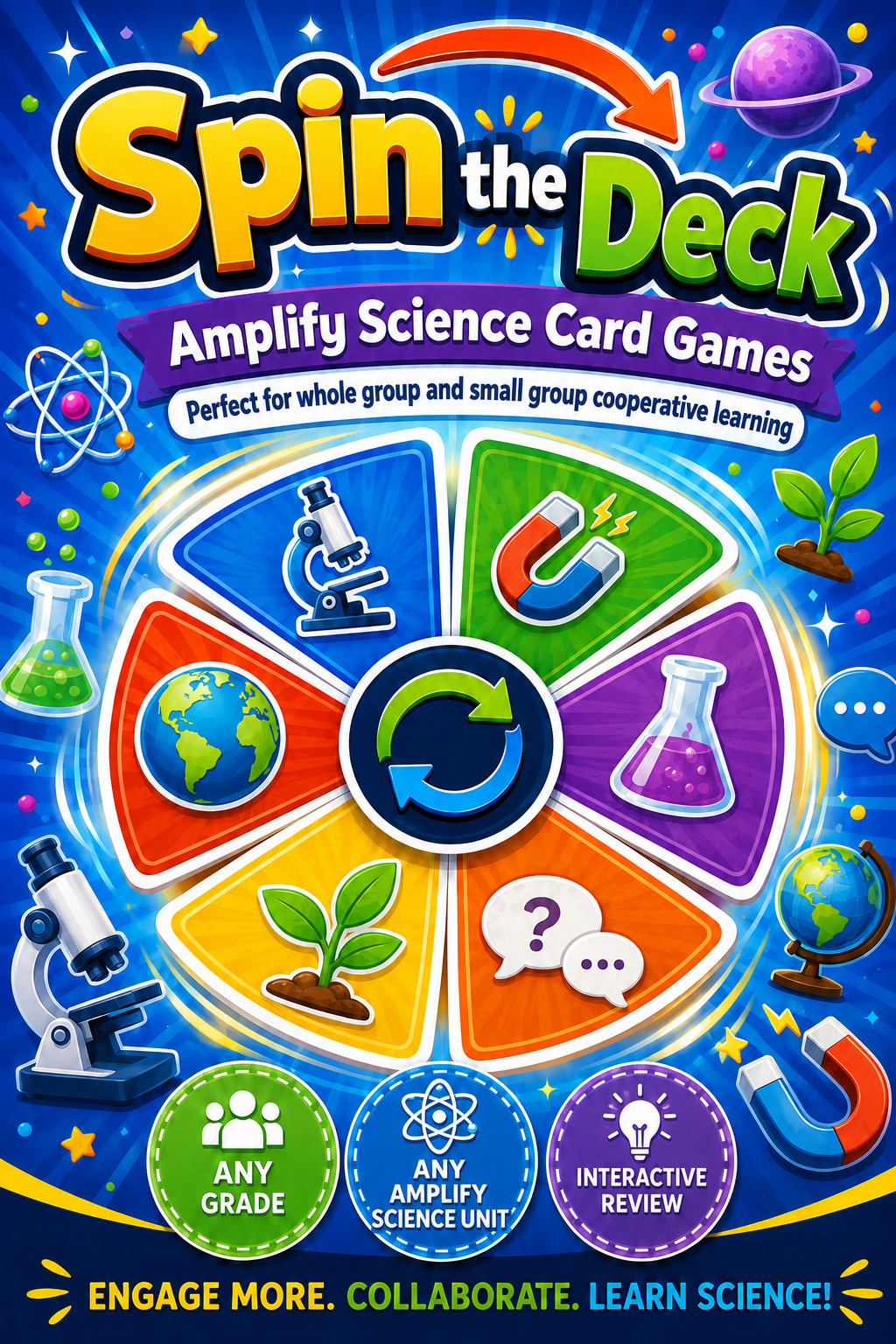
Spin the Deck – Grade 6 Amplify Science: Earth, Moon, and Sun
100 Interactive Science Review Cards | Cooperative Learning | Whole-Group & Small-Group Activities
SPIN THE DECK! ENGAGE MORE. COLLABORATE. EXPLORE THE WONDERS OF SPACE!
Bring the Wonders of the Solar System into Your Science Classroom!
Why does the Moon appear to change shape throughout the month? What causes solar and lunar eclipses? Why do we experience different seasons? How do the movements of Earth, the Moon, and the Sun create predictable patterns that scientists can observe and explain?
Launch your students into an exciting astronomy adventure with Spin the Deck: Earth, Moon, and Sun!
Designed to complement the Grade 6 Amplify Science Earth, Moon, and Sun unit, this engaging collection of 100 multiple-choice science review cards helps students explore the fascinating relationships between Earth, the Moon, and the Sun.
Students investigate how the Moon's position changes as it orbits Earth, why we observe different lunar phases, how sunlight illuminates celestial objects, and how the alignment of Earth, the Moon, and the Sun produces eclipses.
From exploring Earth's rotation and revolution to understanding gravity, seasonal changes, astronomical distances, and scale models, students strengthen their understanding of the patterns and processes that shape our solar system.
Move beyond traditional worksheets and transform science review into an exciting cooperative learning experience where students answer questions, explain their thinking, discuss scientific ideas, and collaborate with classmates!
Perfect for whole-group science review, small-group cooperative learning, science centers, partner activities, intervention, enrichment, and unit assessment preparation, this versatile resource helps students build astronomy knowledge through active participation and repeated practice.
Help your students become confident astronomers, curious investigators, and enthusiastic scientific thinkers!
What's Included?
- 100 numbered multiple-choice science review cards covering Grade 6 Earth, Moon, and Sun concepts
- Four answer choices per question to encourage careful reading and scientific reasoning
- Answers printed on the reverse side for immediate feedback and student self-checking
- 50 printable PDF pages designed for double-sided printing
- 25 double-sided sheets when printed back-to-back
- Four cards per sheet, creating 100 interactive review cards
- Colorful, science-themed card designs featuring space and laboratory imagery
- Questions exploring lunar phases, eclipses, Earth's movements, gravity, sunlight, seasons, and astronomical models
- Reusable review cards compatible with multiple cooperative learning games and classroom activities
Easy Preparation: Print the PDF double-sided, cut apart the four cards on each sheet, and laminate for durability. Your interactive astronomy review deck is ready to use!
Science Concepts & Skills Covered
The Earth, Moon, and Sun System
Help students understand the relationships between the three celestial bodies and how their movements create observable patterns.
Topics include:
- Earth, Moon, and Sun relationships
- Celestial objects
- Relative positions in space
- Orbits and orbital motion
- Predictable astronomical patterns
- The Sun as a source of light
- The Moon as a reflector of sunlight
- Celestial cycles
Students review how the positions and movements of celestial objects help explain what we observe from Earth.
Moon Phases & the Lunar Cycle
Explore why the Moon appears to change shape throughout the month.
Topics include:
- New Moon
- Full Moon
- Crescent Moon
- Gibbous Moon
- Quarter Moon
- Waxing phases
- Waning phases
- Illuminated portions of the Moon
- The lunar cycle
- The Moon's orbital movement
- The approximately 29.5-day lunar phase cycle
Students investigate how the changing position of the Moon relative to Earth and the Sun affects the portion of its illuminated surface visible from Earth.
Solar & Lunar Eclipses
Help students distinguish between two of the most fascinating astronomical events.
Topics include:
- Solar eclipses
- Lunar eclipses
- Earth's shadow
- The Moon's shadow
- Alignment of celestial objects
- The Moon blocking sunlight
- Earth's shadow falling on the Moon
- The Moon's tilted orbit
- Why eclipses do not occur every month
Students explore how the positions of Earth, the Moon, and the Sun determine when eclipses can occur.
Light, Shadows & Illumination
Investigate how light travels through space and interacts with celestial objects.
Topics include:
- Light sources
- Reflected sunlight
- Illumination
- Light and dark regions
- Shadows
- Straight-line travel of light
- The lunar terminator
- The illuminated half of the Moon
- Observing celestial objects
Students develop a better understanding of how sunlight and shadows contribute to the patterns visible in the sky.
Earth's Rotation & Revolution
Strengthen students' understanding of the movements responsible for important astronomical cycles.
Topics include:
- Earth's rotation
- Earth's revolution
- Day and night
- Earth's approximately 24-hour rotation
- Earth's orbit around the Sun
- The length of a year
- Orbital motion
- Rotation versus revolution
- Predictable celestial patterns
Students learn to distinguish between spinning on an axis and orbiting another celestial body.
Seasons, Solstices & Equinoxes
Explore why Earth experiences seasonal changes throughout the year.
Topics include:
- Earth's tilted axis
- Seasonal changes
- Summer and winter
- Northern Hemisphere seasons
- Direct and indirect sunlight
- Solstices
- Equinoxes
- Daylight patterns
- Earth's position during its orbit
- The relationship between axial tilt and seasons
Students investigate why the Northern Hemisphere experiences summer when tilted toward the Sun and winter when tilted away.
Gravity & Orbital Motion
Discover how gravitational forces influence the movement of objects in space.
Topics include:
- Gravity
- Earth's gravitational pull
- The Moon's gravity
- Gravitational attraction
- The Moon's orbit
- Planetary motion
- Orbital relationships
- The connection between gravity and celestial movement
Students reinforce their understanding of why the Moon remains in orbit around Earth.
Astronomical Distance, Size & Scale Models
Help students visualize the enormous differences in size and distance within the solar system.
Topics include:
- Scale models
- Relative size
- Relative distance
- Earth-Moon distance
- Sun-Earth size comparisons
- Proportional relationships
- Astronomical models
- Representing large distances
- Scientific model accuracy
Students investigate how scientists use scaled representations to communicate relationships that are difficult to observe directly.
Moon Rotation & Synchronous Motion
Explore why observers on Earth generally see the same side of the Moon.
Topics include:
- The Moon's rotation
- The Moon's revolution
- Synchronous rotation
- Orbital periods
- The near and far sides of the Moon
- Lunar movement
- The relationship between rotation and orbital motion
Students review how the Moon's rotation period matches its orbital period, resulting in nearly the same lunar hemisphere facing Earth.
Scientific Models, Observations & Reasoning
Strengthen the scientific practices used throughout middle school Earth and space science.
Topics include:
- Scientific observations
- Identifying patterns
- Predicting lunar phases
- Interpreting astronomical models
- Top-down representations
- Using evidence
- Comparing celestial positions
- Scientific explanations
- Cause-and-effect relationships
- Understanding predictable cycles
Students practice using scientific concepts to explain observations and recognize relationships within the Earth-Moon-Sun system.
Perfect for Whole-Group & Small-Group Cooperative Learning!
Whole-Group Interactive Science Review
Engage your entire class in meaningful discussions about lunar phases, eclipses, seasons, Earth's rotation, and the relationships between celestial objects.
Fan-N-Pick
Students work in cooperative groups, taking turns selecting cards, reading questions, answering, and checking responses. This activity encourages participation, teamwork, and active listening.
Quiz-Quiz-Trade
Students pair up, quiz one another, check answers, exchange cards, and find new partners. This movement-based activity reinforces astronomy vocabulary and concepts through repeated practice.
Science Centers & Stations
Create review stations focusing on lunar phases, eclipses, Earth's movements, gravity, seasons, and scale models.
Partner Review
Students take turns reading questions, selecting answers, explaining their reasoning, and checking responses on the reverse side.
Small-Group Astronomy Challenges
Organize students into teams to investigate scientific questions, compare explanations, and discuss observable patterns in the sky.
Spin & Answer Review Games
Combine the cards with a classroom spinner or teacher-created game structure to add excitement and friendly competition to astronomy review.
Science Test Preparation
Help students revisit important vocabulary, celestial relationships, and key scientific concepts before unit assessments.
Warm-Ups & Exit Tickets
Use selected cards to activate prior knowledge, encourage scientific discussions, or quickly check understanding.
Science Intervention & Enrichment
Target specific concepts for additional practice or challenge students to explain more complex astronomical relationships.
Early Finishers & Substitute Plans
Provide meaningful, low-preparation science activities that reinforce important Earth and space science concepts.
Why Teachers Will Love Spin the Deck!
Low-Prep and Ready to Use!
Simply print, cut, and laminate to create a reusable classroom resource.
Designed for Cooperative Learning!
Encourage students to communicate, collaborate, listen respectfully, and explain scientific ideas to their classmates.
Promotes Active Student Engagement!
Transform traditional science review into an interactive experience involving discussion, movement, teamwork, and problem-solving.
Reinforces Amplify Science Concepts!
Review essential vocabulary and scientific ideas connected to the Grade 6 Earth, Moon, and Sun unit.
Builds Scientific Reasoning!
Students strengthen their ability to identify patterns, explain celestial movements, compare astronomical events, and connect scientific concepts to observations.
Provides Immediate Feedback!
Answers on the reverse side allow students to check their understanding during independent, partner, and group activities.
Supports Differentiated Instruction!
Select questions based on student readiness, target specific concepts, or extend learning through additional scientific discussions.
Connects Science to Everyday Observations!
Students explore familiar phenomena such as changing Moon phases, day and night, seasonal differences, and eclipses while learning the scientific explanations behind them.
Reusable Year After Year!
Laminate the cards to create a durable classroom resource that supports repeated review and cooperative learning.
Sample Spin the Deck Questions
Here are eight examples of actual questions included in this collection:
Question 1: Why does the Moon appear to change shape?
Answer: We see different amounts of the illuminated half.
Question 2: How much of the Moon is always lit by the Sun?
Answer: Exactly half.
Question 4: How long does it take for the Moon to orbit Earth?
Answer: About one month (28 days).
Question 8: A "Lunar Eclipse" happens when:
Answer: Earth's shadow falls on the Moon.
Question 10: Why don't eclipses happen every month?
Answer: The Moon's orbit is slightly tilted.
Question 15: "Waxing" means the illuminated part we see is:
Answer: Growing.
Question 21: Which force keeps the Moon in orbit?
Answer: Gravity.
Question 29: Seasons are caused by:
Answer: Earth's tilted axis.
These questions reinforce important astronomical vocabulary while encouraging students to explain lunar phases, celestial movements, gravity, eclipses, and seasonal changes.
Launch Your Students into an Exciting Astronomy Review!
The Earth, Moon, and Sun form an interconnected system whose movements create many of the predictable patterns we observe in the sky.
With 100 Spin the Deck Earth, Moon, and Sun review cards, students can investigate why the Moon changes appearance, how eclipses occur, what causes Earth's seasons, and how rotation, revolution, gravity, and sunlight influence celestial patterns.
Imagine students enthusiastically selecting cards, explaining the difference between solar and lunar eclipses, identifying waxing and waning Moon phases, discussing why we experience day and night, and collaborating to understand the movements of celestial objects.
Whether you're reviewing lessons, preparing for assessments, reinforcing vocabulary, or creating collaborative learning opportunities, Spin the Deck transforms astronomy review into an exciting, student-centered learning experience.
One deck. 100 questions. Endless opportunities to explore the universe!
SPIN THE DECK! ENGAGE MORE. COLLABORATE. LEARN SCIENCE!
Add Spin the Deck: Earth, Moon, and Sun to your classroom toolkit and inspire confident, curious, and collaborative young astronomers!
Important Curriculum Disclaimer
This independently created resource is designed to supplement the Amplify Science curriculum. It is not affiliated with, sponsored by, authorized by, or endorsed by Amplify Education, Inc. Amplify and Amplify Science are trademarks of their respective owner. No affiliation or endorsement is implied.
This product is a supplemental classroom review activity and is not a replacement for official Amplify Science curriculum materials, lessons, assessments, or instructional resources.
- Grade 6
- Instant digital download
- Print & reuse in class