Spin the Deck – Grade 6 Amplify Science: Geology on Mars
$5.00
Spin the Deck – Grade 6 Amplify Science: Geology on Mars
100 Interactive Science Review Cards | Cooperative Learning | Whole-Group & Small-Group Activities
SPIN THE DECK! ENGAGE MORE. COLLABORATE. EXPLORE THE RED PLANET!
Take Your Students on an Exciting Scientific Mission to Mars!
Was Mars once a planet with flowing rivers and lakes? What can ancient channels, craters, and rock formations reveal about its history? How do scientists investigate a planet millions of miles away, and what evidence might suggest that Mars was once capable of supporting life?
Launch your students into an extraordinary planetary investigation with Spin the Deck: Geology on Mars!
Designed to complement the Grade 6 Amplify Science Geology on Mars unit, this exciting collection of 100 multiple-choice science review cards helps students investigate the geological history of Mars while developing essential scientific reasoning and evidence-based argumentation skills.
Students explore how scientists examine Martian landforms, compare geological features on Mars and Earth, investigate the processes that shape planetary surfaces, and use evidence to determine whether liquid water may have existed on Mars in the past.
From exploring the enormous Olympus Mons volcano and the spectacular Valles Marineris canyon system to investigating ancient water channels, impact craters, sedimentary rocks, and the discoveries of Mars rovers, students gain a deeper understanding of how scientists reconstruct a planet's geological history.
Move beyond traditional worksheets and transform science review into an exciting cooperative learning experience where students answer questions, explain their thinking, evaluate evidence, and collaborate with classmates!
Perfect for whole-group science review, small-group cooperative learning, science centers, partner activities, intervention, enrichment, and unit assessment preparation, this versatile resource makes planetary geology accessible, engaging, and memorable.
Help your students become confident planetary scientists, curious investigators, and enthusiastic scientific thinkers!
What's Included?
- 100 numbered multiple-choice science review cards covering Grade 6 Geology on Mars concepts
- Four answer choices per question to encourage scientific thinking and careful analysis
- Answers printed on the reverse side for immediate feedback and self-checking
- 50 printable PDF pages designed for double-sided printing
- 25 double-sided sheets when printed back-to-back
- Four cards per sheet, creating 100 interactive review cards
- Colorful, science-themed card designs featuring planets, scientific equipment, and laboratory imagery
- Questions exploring Mars, planetary geology, landforms, water, lava, erosion, scientific evidence, and habitability
- Reusable review cards compatible with multiple cooperative learning games and classroom activities
Easy Preparation: Print the PDF double-sided, cut apart the four cards on each sheet, and laminate for durability. Your interactive planetary geology review deck is ready for classroom exploration!
Science Concepts & Skills Covered
Exploring Mars & Planetary Habitability
Introduce students to one of the most fascinating scientific questions about our neighboring planet: Could Mars have once supported life?
Topics include:
- Mars as Earth's planetary neighbor
- Rocky planets
- Planetary habitability
- Requirements for life as we know it
- The importance of liquid water
- Ancient Martian environments
- The geological history of Mars
- Comparing Mars and Earth
- The investigation of past habitability
Students explore how scientists use evidence about a planet's environment and geological history to investigate whether conditions may once have been suitable for life.
Martian Landforms & Surface Features
Discover the remarkable geological features found across the surface of Mars.
Topics include:
- Landforms
- Impact craters
- Channels
- Valleys and canyons
- Mountains and volcanoes
- Slopes
- Topography
- Geological surface patterns
- Gusev Crater
- Olympus Mons
- Valles Marineris
Students identify different landforms and consider what their shapes, locations, and characteristics reveal about the processes that created them.
Water, Lava & Channel Formation
Investigate how different geological processes can produce similar features on a planet's surface.
Topics include:
- Flowing liquid water
- Flowing lava
- Channel formation
- Meandering channels
- Ancient waterways
- Volcanic channels
- Water erosion
- Lava flows
- Comparing water-formed and lava-formed features
- Evidence of past surface water
Students strengthen their understanding of how scientists use landform evidence to investigate whether water or lava shaped portions of the Martian surface.
Geological Processes & Surface Changes
Explore the natural processes responsible for changing planetary landscapes over time.
Topics include:
- Weathering
- Erosion
- Sediment movement
- Deposition
- Volcanic activity
- Impact events
- Landform formation
- Surface changes over time
- Geological processes on Earth and Mars
Students examine how geological processes shape planetary surfaces and leave behind clues about a planet's past.
Volcanoes, Magma & Igneous Rocks
Investigate the role of volcanic activity in shaping the Red Planet.
Topics include:
- Volcanoes
- Olympus Mons
- Magma
- Lava
- Molten rock
- Cooling and solidification
- Basalt
- Volcanic channels
- Internal planetary heat
- Volcanic landform formation
- The relationship between gravity and volcanic mountain size
Students explore how volcanic processes create new rock and produce some of the largest landforms in the solar system.
Sediment, Deltas & Evidence of Ancient Water
Help students understand how sedimentary features provide clues about past environmental conditions.
Topics include:
- Sediment
- Sediment transport
- Rounded pebbles
- Conglomerate rocks
- Deltas
- Water-formed landforms
- Stream processes
- Rock formation
- Ancient lakes
- Gusev Crater
- Evidence of flowing water on Mars
Students investigate how rounded pebbles, sediment deposits, and delta-shaped features can provide evidence about water movement in a planet's past.
Earth's Systems & Martian Environments
Explore the major planetary systems that interact to influence environmental conditions.
Topics include:
- Geosphere
- Hydrosphere
- Atmosphere
- Biosphere
- Planetary systems
- Interacting components
- Mars's thin atmosphere
- Present-day surface conditions
- The availability of liquid water
- Planetary environmental differences
Students compare planetary systems and explore how conditions on Mars differ from those on Earth.
Scientific Evidence, Claims & Reasoning
Develop essential scientific argumentation skills through planetary investigations.
Topics include:
- Scientific claims
- Evidence
- Reasoning
- Supporting a claim
- Refuting a claim
- Evaluating scientific explanations
- Interpreting observations
- Comparing competing explanations
- Drawing conclusions from evidence
- Communicating scientific ideas
Students practice connecting observations and geological evidence to scientific claims about Mars's past.
Scientific Models, Simulations & Comparisons
Explore how scientists investigate distant planets using tools, models, and evidence from Earth.
Topics include:
- Scientific models
- The Active Model
- Simulations
- Manipulating variables
- Geological analogues
- Comparative investigations
- The Rocky Planet Dataset
- Cross-section models
- Landform comparisons
- Scientific predictions
Students learn why scientists use models and simulations to investigate geological processes that cannot easily be observed directly on Mars.
Mars Exploration & Remote Sensing
Discover how modern technology helps scientists study the Martian surface.
Topics include:
- Mars rovers
- Curiosity
- Orbiters
- Cameras and scientific instruments
- Remote sensing
- Satellite observations
- Martian surface imagery
- Regolith
- Geological data collection
- Planetary exploration
Students investigate how scientists collect information about Mars and use observations to develop explanations about its geological history.
Planetary Forces, Energy & Environmental Conditions
Strengthen understanding of the forces and energy sources that influence geological processes.
Topics include:
- Gravity on Mars
- Internal planetary heat
- Solar energy
- Volcanic eruptions
- Wind erosion
- Martian dust devils
- Surface changes
- Planetary atmosphere
- Martian seasons
- Differences between Earth and Mars
Students explore how gravity, internal heat, sunlight, and atmospheric conditions influence the development of planetary landforms.
Perfect for Whole-Group & Small-Group Cooperative Learning!
Whole-Group Interactive Science Review
Engage the entire class in discussions about ancient Martian waterways, volcanic activity, geological evidence, planetary habitability, and the scientific investigation of Mars.
Fan-N-Pick
Students work in cooperative groups, taking turns selecting cards, reading questions, answering, and checking responses. This activity encourages participation, collaboration, and scientific discussion.
Quiz-Quiz-Trade
Students pair up, quiz one another, check answers, exchange cards, and find new partners. This movement-based activity reinforces planetary geology vocabulary through repeated practice.
Science Centers & Stations
Create stations focused on Martian landforms, water and lava processes, geological evidence, planetary systems, and scientific reasoning.
Partner Review
Students take turns reading questions, choosing answers, explaining their reasoning, and checking responses on the reverse side.
Mars Investigation Challenges
Organize students into teams to evaluate geological clues, compare explanations, and discuss what landforms reveal about the history of Mars.
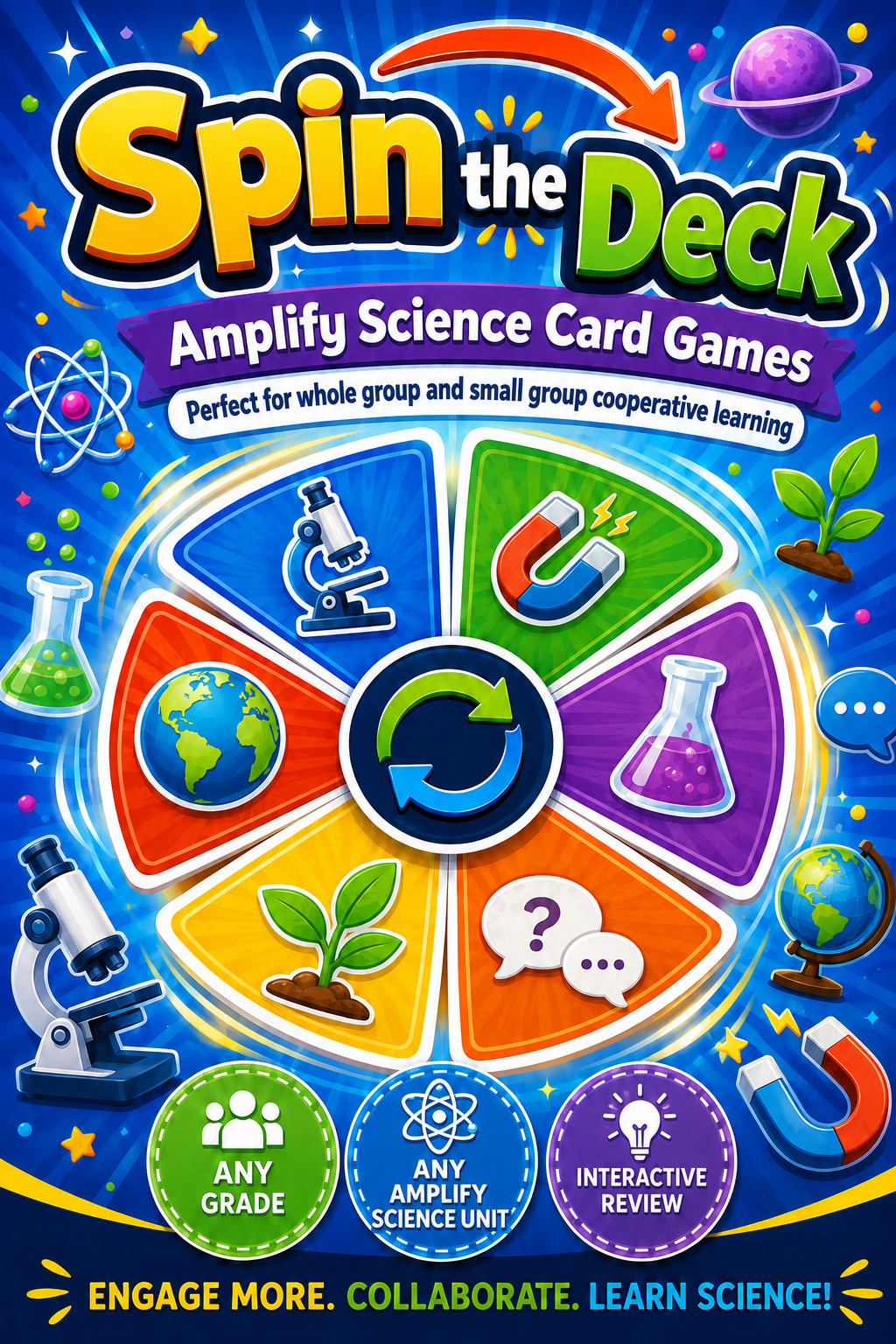
Spin & Answer Review Games
Combine the cards with a classroom spinner or teacher-created game structure to introduce excitement and friendly competition into science review.
Science Test Preparation
Reinforce important concepts, vocabulary, and scientific practices before Geology on Mars unit assessments.
Warm-Ups & Exit Tickets
Use selected cards to activate prior knowledge, review important ideas, or quickly assess understanding.
Science Intervention & Enrichment
Target specific topics for additional support or challenge students to explain the evidence behind geological conclusions.
Early Finishers & Substitute Plans
Provide meaningful, low-preparation science activities that reinforce important Earth and space science concepts.
Why Teachers Will Love Spin the Deck!
Low-Prep and Ready to Use!
Simply print, cut, and laminate to create a reusable classroom resource.
Designed for Cooperative Learning!
Encourage students to communicate, collaborate, listen respectfully, and explain scientific ideas to classmates.
Promotes Active Student Engagement!
Transform traditional review into an interactive experience involving discussion, movement, teamwork, and problem-solving.
Reinforces Amplify Science Concepts!
Review important vocabulary and scientific ideas connected to the Grade 6 Geology on Mars unit.
Builds Evidence-Based Reasoning!
Students strengthen their ability to use geological observations, scientific models, and evidence to support explanations about Mars.
Provides Immediate Feedback!
Answers on the reverse side allow students to check their understanding during independent, partner, and group activities.
Supports Differentiated Instruction!
Select cards based on student readiness, target specific concepts, or extend learning through deeper scientific discussions.
Connects Earth Science to Space Exploration!
Students discover how processes familiar on Earth help scientists investigate the geological history of distant planets.
Reusable Year After Year!
Laminate the cards to create a durable classroom resource that supports repeated review and cooperative learning.
Sample Spin the Deck Questions
Here are eight actual questions included in this collection:
Question 1: What is the main goal of the Geology on Mars unit?
Answer: To see if Mars was once habitable.
Question 4: What is a "geologic process"?
Answer: An event that shapes the surface of a planet.
Question 13: What process forms a channel?
Answer: Flowing water or lava.
Question 17: "Evidence" is information that:
Answer: Supports or refutes a claim.
Question 21: Olympus Mons is a giant:
Answer: Volcano.
Question 26: Why is the "Gusev Crater" important?
Answer: It may have once held a lake.
Question 34: A "triangular" landform at the end of a channel is a:
Answer: Delta.
Question 42: If we find rounded pebbles on Mars, what can we infer?
Answer: Water once flowed there.
These questions reinforce essential planetary geology concepts while encouraging students to think about the evidence scientists use to reconstruct Mars's geological past.
Launch Your Students on a Mission to Discover Mars's Past!
Mars is a planet filled with remarkable geological mysteries. Its towering volcanoes, enormous canyons, ancient channels, and unusual rock formations provide scientists with important clues about the planet's history.
With 100 Spin the Deck Geology on Mars review cards, students can investigate how geological processes shape planetary surfaces, why scientists compare Mars with Earth, and how evidence can help determine whether liquid water once existed on the Red Planet.
Imagine students enthusiastically selecting cards, identifying geological landforms, comparing lava and water processes, explaining the significance of rounded pebbles, and collaborating to evaluate scientific claims about ancient Martian environments.
Whether you're reviewing lessons, preparing for assessments, reinforcing scientific vocabulary, or creating collaborative learning opportunities, Spin the Deck transforms planetary geology review into an exciting, student-centered learning experience.
One deck. 100 questions. Endless opportunities to investigate the Red Planet!
SPIN THE DECK! ENGAGE MORE. COLLABORATE. LEARN SCIENCE!
Add Spin the Deck: Geology on Mars to your classroom toolkit and inspire confident, curious, and collaborative young planetary scientists!
Important Curriculum Disclaimer
This independently created resource is designed to supplement the Amplify Science curriculum. It is not affiliated with, sponsored by, authorized by, or endorsed by Amplify Education, Inc. Amplify and Amplify Science are trademarks of their respective owner. No affiliation or endorsement is implied.
This product is a supplemental classroom review activity and is not a replacement for official Amplify Science curriculum materials, lessons, assessments, or instructional resources.
- Grade 6
- Instant digital download
- Print & reuse in class