Spin the Deck – Grade 6 Amplify Science: Matter and Energy in Ecosystems
$5.00
Spin the Deck – Grade 6 Amplify Science: Matter and Energy in Ecosystems
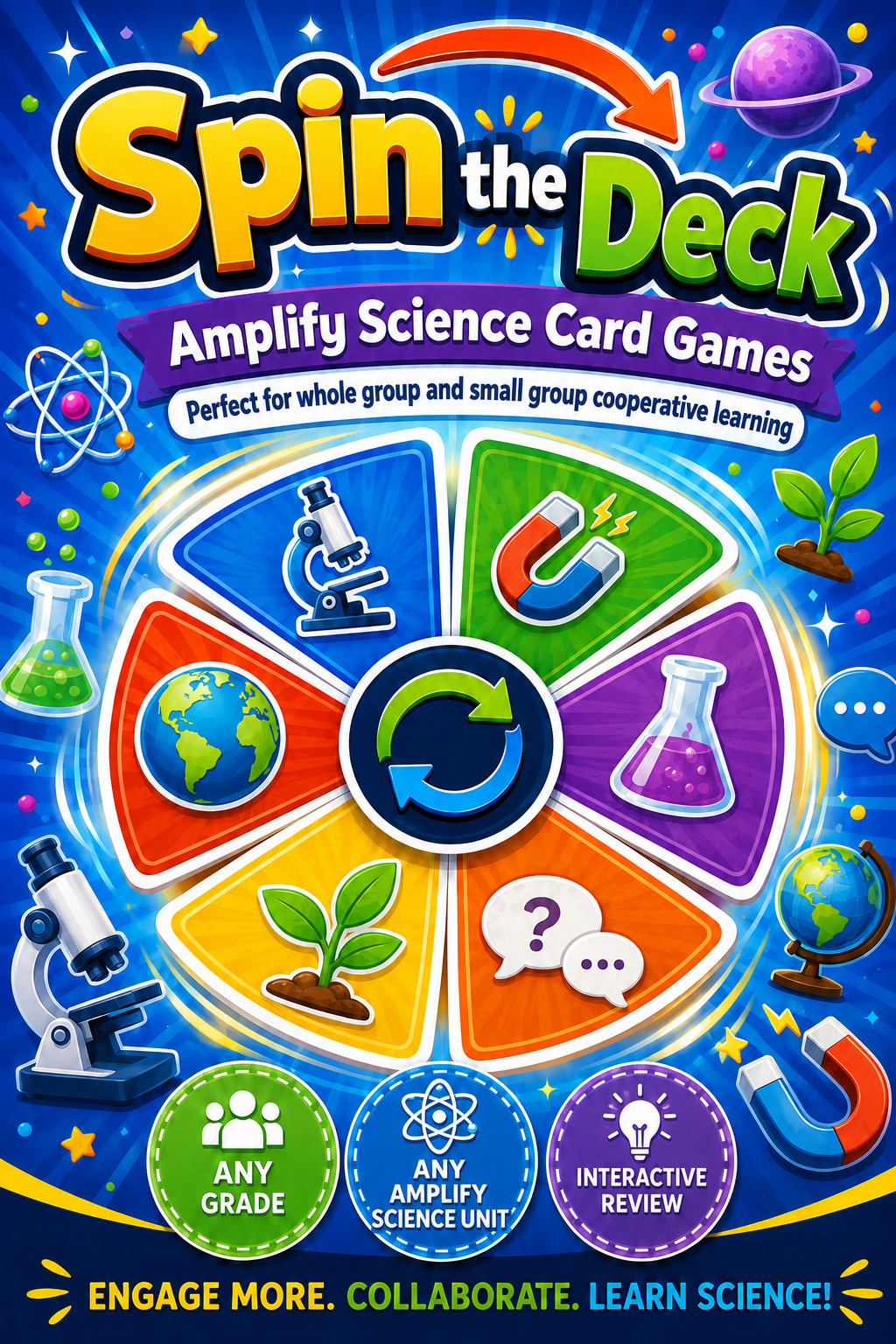
100 Interactive Science Review Cards | Cooperative Learning | Whole-Group & Small-Group Activities
SPIN THE DECK! ENGAGE MORE. COLLABORATE. DISCOVER HOW ECOSYSTEMS WORK!
Bring the Incredible World of Ecosystems to Life in Your Science Classroom!
Where does the energy that supports nearly every ecosystem on Earth originate? How do plants capture sunlight and store energy in molecules? Why do animals depend on producers for survival? What happens to carbon as it moves between living organisms and the environment?
Transform these fascinating scientific questions into an exciting classroom learning experience with Spin the Deck: Matter and Energy in Ecosystems!
Designed to complement the Grade 6 Amplify Science Matter and Energy in Ecosystems unit, this engaging collection of 100 multiple-choice science review cards helps students investigate how matter cycles and energy flows through ecosystems.
Students explore the relationships between producers, consumers, and decomposers while developing a deeper understanding of photosynthesis, cellular respiration, energy storage molecules, and the carbon cycle.
From investigating how plants transform sunlight into chemical energy to understanding how decomposers recycle matter, students discover the essential processes that keep ecosystems functioning.
They also explore how changes in populations, photosynthesis, respiration, and environmental conditions can affect the balance of carbon dioxide and energy storage molecules within an ecosystem.
Move beyond traditional worksheets and transform science review into an exciting cooperative learning experience where students answer questions, explain their thinking, discuss scientific processes, and collaborate with classmates!
Perfect for whole-group science review, small-group cooperative learning, science centers, partner activities, intervention, enrichment, and unit assessment preparation, this versatile resource helps students build essential life science knowledge through active participation and repeated practice.
Help your students become confident ecosystem investigators, curious scientific thinkers, and enthusiastic collaborative learners!
What's Included?
- 100 numbered multiple-choice science review cards covering Grade 6 Matter and Energy in Ecosystems concepts
- Four answer choices per question to encourage careful reading and scientific reasoning
- Answers printed on the reverse side for immediate feedback and student self-checking
- 50 printable PDF pages designed for double-sided printing
- 25 double-sided sheets when printed back-to-back
- Four cards per sheet, creating 100 interactive review cards
- Colorful, science-themed card designs featuring laboratory equipment, scientific imagery, and vibrant blue backgrounds
- Questions exploring photosynthesis, cellular respiration, carbon cycling, energy transfer, producers, consumers, decomposers, and ecosystem systems
- Reusable review cards compatible with multiple cooperative learning games and classroom activities
Easy Preparation: Print the PDF double-sided, cut apart the four cards on each sheet, and laminate for durability. Your interactive ecosystem review deck is ready to use!
Science Concepts & Skills Covered
Matter & Energy in Ecosystems
Help students understand how matter and energy move through living systems and the environment.
Topics include:
- Matter
- Energy
- Ecosystems
- Living and nonliving components
- Matter cycling
- Energy flow
- Ecosystem interactions
- Conservation of matter
- Energy transfer
- Heat released to the environment
Students reinforce the essential distinction that matter cycles through ecosystems while energy flows through them and is eventually transferred to the environment as heat.
Photosynthesis & Energy Storage Molecules
Explore how producers capture sunlight and transform it into chemical energy.
Topics include:
- Photosynthesis
- Sunlight as an energy source
- Chloroplasts
- Chlorophyll
- Carbon dioxide
- Water
- Glucose
- Oxygen
- Energy Storage Molecules (ESMs)
- Chemical energy
- Photosynthesis inputs and outputs
- Environmental requirements for photosynthesis
Students investigate how producers use light energy, carbon dioxide, and water to create glucose and oxygen, storing energy in molecules that support living organisms.
Cellular Respiration & Energy Release
Discover how organisms release usable energy from energy storage molecules.
Topics include:
- Cellular respiration
- Glucose
- Oxygen
- Carbon dioxide
- Mitochondria
- Energy release
- Growth and repair
- Cellular processes
- Respiration in plants
- Respiration in animals
- Respiration in decomposers
- Photosynthesis versus cellular respiration
Students learn how plants, animals, and decomposers use cellular respiration to release energy needed for essential life processes.
The Carbon Cycle
Investigate how carbon moves between living organisms and the nonliving environment.
Topics include:
- Carbon
- Carbon dioxide
- Carbon reservoirs
- Carbon cycling
- Atmospheric carbon
- Carbon in organisms
- Carbon in energy storage molecules
- Photosynthesis and carbon uptake
- Cellular respiration and carbon release
- Decomposition
- Combustion
- Fossil fuels
- Carbon movement between reservoirs
Students explore how biological and geological processes influence carbon movement throughout ecosystems.
Biotic & Abiotic Components
Strengthen students' understanding of the living and nonliving components of ecosystems.
Topics include:
- Biotic factors
- Abiotic factors
- Living organisms
- Atmospheric gases
- Water
- Sunlight
- Carbon dioxide
- Environmental resources
- Interactions between living and nonliving systems
Students examine how producers obtain carbon from abiotic sources and how matter moves between the biotic and abiotic parts of ecosystems.
Producers, Consumers & Decomposers
Explore the important roles organisms play in maintaining ecosystem functions.
Topics include:
- Producers
- Consumers
- Decomposers
- Autotrophs
- Heterotrophs
- Algae
- Plants
- Animals
- Energy storage molecules
- Nutrient recycling
- Decomposition
- Carbon transfer between organisms
Students investigate how producers create energy-rich molecules, consumers obtain matter and energy by eating other organisms, and decomposers help recycle matter.
Food Webs & Energy Transfer
Help students understand the interconnected feeding relationships within ecosystems.
Topics include:
- Food webs
- Food chains
- Producers and consumers
- Energy transfer
- Matter transfer
- Feeding relationships
- Organism interactions
- Ecosystem dependence
- Population changes
- Energy released as heat
- Ecosystem stability
Students explore how energy and matter move through feeding relationships and why producers are essential to supporting food webs.
Energy Flow vs. Matter Cycling
Reinforce one of the most important distinctions in ecosystem science.
Topics include:
- One-directional energy flow
- Matter cycling
- Chemical energy
- Light energy
- Heat energy
- Energy transformations
- Conservation of matter
- Rearrangement of atoms
- Carbon recycling
- Energy storage and release
Students compare the movement of matter with the transfer and transformation of energy through ecosystems.
Carbon Dioxide & Ecosystem Balance
Investigate how changes in ecosystem processes affect atmospheric carbon dioxide.
Topics include:
- Carbon dioxide concentration
- Photosynthesis rates
- Cellular respiration rates
- Carbon balance
- Increasing and decreasing producer populations
- Changes in consumer populations
- Carbon dioxide measurements
- Parts per million (ppm)
- Diffusion
- Ecosystem stability
Students examine why carbon dioxide levels may increase when respiration exceeds photosynthesis and decrease when photosynthesis exceeds respiration.
Ecosystem Models, Simulations & Scientific Investigations
Connect scientific concepts to the models and investigations used in the Amplify Science unit.
Topics include:
- The Econaut simulation
- Biodome investigations
- Carbon cycle balance
- Closed systems
- Open systems
- System interactions
- Changing variables
- Observing carbon dioxide levels
- Modeling photosynthesis and respiration
- Scientific explanations
- Predicting ecosystem changes
Students strengthen their understanding of how scientists use models and simulations to investigate complex relationships within ecosystems.
Plant Growth, Matter & Conservation
Explore where the matter that makes up growing organisms comes from.
Topics include:
- Plant mass
- Carbon from the atmosphere
- Glucose production
- Matter conservation
- Carbon atoms
- Molecular rearrangement
- Growth and development
- Matter inputs
- Plant and soil mass comparisons
- Conservation of atoms
Students investigate how plants obtain much of the carbon used to build new structures from atmospheric carbon dioxide rather than directly from soil.
Ecosystem Stability & Environmental Changes
Explore how changes in organisms and environmental conditions influence ecosystem functioning.
Topics include:
- Producer population changes
- Consumer population changes
- Decomposer activity
- Changes in carbon dioxide
- Sunlight availability
- Oxygen availability
- Carbon cycling disruptions
- Food web stability
- Closed ecosystem investigations
- Ecosystem balance
Students consider how disruptions to essential biological processes can influence matter cycling, energy availability, and ecosystem stability.
Perfect for Whole-Group & Small-Group Cooperative Learning!
Whole-Group Interactive Science Review
Engage your entire class in meaningful discussions about photosynthesis, cellular respiration, carbon cycling, energy transfer, and the relationships between organisms and their environments.
Fan-N-Pick
Students work in cooperative groups, taking turns selecting cards, reading questions, answering, and checking responses. This activity encourages participation, teamwork, and active listening.
Quiz-Quiz-Trade
Students pair up, quiz one another, check answers, exchange cards, and find new partners. This movement-based activity reinforces ecosystem vocabulary and concepts through repeated practice.
Science Centers & Stations
Create review stations focusing on photosynthesis, cellular respiration, carbon cycling, producers and consumers, energy transfer, and ecosystem systems.
Partner Review
Students take turns reading questions, selecting answers, explaining their reasoning, and checking responses on the reverse side.
Small-Group Ecosystem Challenges
Organize students into teams to investigate ecosystem changes, compare scientific explanations, and discuss how carbon and energy move through living systems.
Spin & Answer Review Games
Combine the cards with a classroom spinner or teacher-created game structure to add excitement and friendly competition to ecosystem review.
Science Test Preparation
Help students revisit important vocabulary, ecosystem relationships, and key scientific concepts before unit assessments.
Warm-Ups & Exit Tickets
Use selected cards to activate prior knowledge, encourage scientific discussions, or quickly check understanding.
Science Intervention & Enrichment
Target specific concepts for additional practice or challenge students to explain more complex ecosystem relationships.
Early Finishers & Substitute Plans
Provide meaningful, low-preparation science activities that reinforce important life science concepts.
Why Teachers Will Love Spin the Deck!
Low-Prep and Ready to Use!
Simply print, cut, and laminate to create a reusable classroom resource.
Designed for Cooperative Learning!
Encourage students to communicate, collaborate, listen respectfully, and explain scientific ideas to classmates.
Promotes Active Student Engagement!
Transform traditional science review into an interactive experience involving discussion, movement, teamwork, and problem-solving.
Reinforces Amplify Science Concepts!
Review essential vocabulary and scientific ideas connected to the Grade 6 Matter and Energy in Ecosystems unit.
Builds Scientific Reasoning!
Students strengthen their ability to explain ecosystem processes, compare photosynthesis and respiration, predict carbon dioxide changes, and identify relationships between organisms and their environments.
Provides Immediate Feedback!
Answers on the reverse side allow students to check their understanding during independent, partner, and group activities.
Supports Differentiated Instruction!
Select questions based on student readiness, target specific concepts, or extend learning through additional scientific discussions.
Connects Science to Real-World Ecosystems!
Students explore how plants, animals, decomposers, and environmental conditions interact to support life and maintain ecosystem functions.
Reusable Year After Year!
Laminate the cards to create a durable classroom resource that supports repeated review and cooperative learning.
Sample Spin the Deck Questions
Here are eight examples of actual questions included in this collection:
Question 1: What is the primary source of energy for most ecosystems?
Answer: The Sun.
Question 2: In which cell organelle does photosynthesis occur?
Answer: Chloroplast.
Question 3: What are "Energy Storage Molecules" (ESMs)?
Answer: Molecules like glucose that store energy.
Question 4: Which process removes Carbon Dioxide from the atmosphere?
Answer: Photosynthesis.
Question 6: Which process do both plants and animals use to release energy?
Answer: Cellular Respiration.
Question 12: What happens to the amount of carbon in an ecosystem?
Answer: It cycles between biotic and abiotic forms.
Question 17: Energy __________ through an ecosystem and is eventually lost as heat.
Answer: Flows in one direction.
Question 18: Matter __________ through an ecosystem over and over.
Answer: Cycles.
These questions reinforce important ecosystem vocabulary while encouraging students to explain photosynthesis, cellular respiration, energy storage, carbon cycling, and the movement of matter and energy through living systems.
Transform Ecosystem Science Review into an Exciting Learning Experience!
Every ecosystem depends on the movement of matter and the flow of energy. From the sunlight captured by plants to the carbon recycled by decomposers, countless processes work together to support life on Earth.
With 100 Spin the Deck Matter and Energy in Ecosystems review cards, students can investigate how organisms obtain energy, why carbon cycles through ecosystems, how photosynthesis and cellular respiration interact, and what happens when ecosystem conditions change.
Imagine students enthusiastically selecting cards, explaining how plants produce glucose, distinguishing between producers and consumers, predicting changes in carbon dioxide levels, and collaborating to understand the processes that sustain ecosystems.
Whether you're reviewing lessons, preparing for assessments, reinforcing vocabulary, or creating collaborative learning opportunities, Spin the Deck transforms ecosystem science review into an exciting, student-centered learning experience.
One deck. 100 questions. Endless opportunities to explore the science of ecosystems!
SPIN THE DECK! ENGAGE MORE. COLLABORATE. LEARN SCIENCE!
Add Spin the Deck: Matter and Energy in Ecosystems to your classroom toolkit and inspire confident, curious, and collaborative young scientists!
Important Curriculum Disclaimer
This independently created resource is designed to supplement the Amplify Science curriculum. It is not affiliated with, sponsored by, authorized by, or endorsed by Amplify Education, Inc. Amplify and Amplify Science are trademarks of their respective owner. No affiliation or endorsement is implied.
This product is a supplemental classroom review activity and is not a replacement for official Amplify Science curriculum materials, lessons, assessments, or instructional resources.
- Grade 6
- Instant digital download
- Print & reuse in class