Spin the Deck – Grade 6 Amplify Science: Ocean, Atmosphere, and Climate
$5.00
Spin the Deck – Grade 6 Amplify Science: Ocean, Atmosphere, and Climate
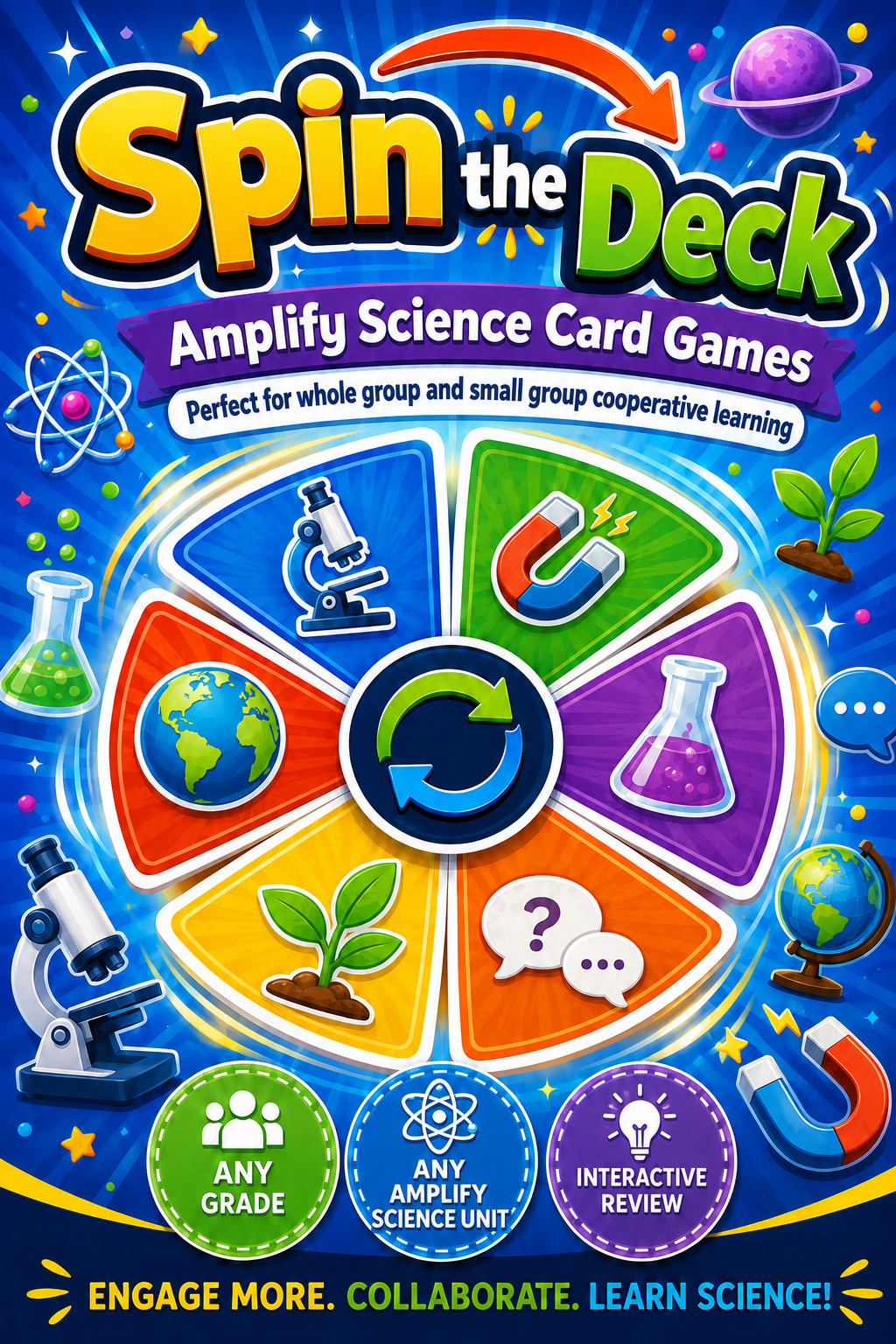
100 Interactive Science Review Cards | Cooperative Learning | Whole-Group & Small-Group Activities
SPIN THE DECK! ENGAGE MORE. COLLABORATE. LEARN SCIENCE!
Make Waves in Your Science Classroom with Interactive Climate Review!
Why are some coastal cities warmer than others at the same latitude? How do ocean currents move energy around the planet? Why does the equator receive more direct sunlight than the poles? How do winds and ocean temperatures work together to shape Earth's climate?
Dive into these fascinating scientific questions with Spin the Deck: Ocean, Atmosphere, and Climate!
Designed to complement the Grade 6 Amplify Science Ocean, Atmosphere, and Climate unit, this engaging collection of 100 multiple-choice science review cards helps students investigate energy transfer, ocean currents, prevailing winds, latitude, atmospheric circulation, and the interactions that influence climate patterns around the world.
Students explore how sunlight heats Earth's surface, how energy moves between the ocean and atmosphere, and how circulating ocean water redistributes energy from warmer regions to cooler locations.
From examining the influence of warm and cold ocean currents on coastal climates to investigating El Niño, the Coriolis effect, deep ocean circulation, and the role of prevailing winds, students develop a deeper understanding of the processes that shape Earth's climate.
Move beyond traditional worksheets and transform science review into an exciting cooperative learning experience where students answer questions, discuss scientific explanations, evaluate evidence, and collaborate with classmates!
Perfect for whole-group science review, small-group cooperative learning, science centers, partner activities, intervention, enrichment, and unit assessment preparation, this versatile resource makes complex Earth science concepts accessible, interactive, and engaging.
Help your students think like climate scientists while building confidence, collaboration, and scientific reasoning skills!
What's Included?
- 100 numbered multiple-choice science review cards covering Grade 6 Ocean, Atmosphere, and Climate concepts
- Four answer choices per question to encourage critical thinking and scientific reasoning
- Answers printed on the reverse side for immediate feedback and self-checking
- 50 printable PDF pages designed for double-sided printing
- 25 double-sided sheets when printed back-to-back
- Four cards per sheet, creating 100 interactive review cards
- Colorful science-themed card designs featuring laboratory equipment, scientific instruments, and vibrant educational imagery
- Questions addressing ocean currents, energy transfer, climate patterns, prevailing winds, latitude, ocean-atmosphere interactions, and scientific investigations
- Reusable review cards compatible with numerous classroom games and cooperative learning structures
Easy Preparation: Print the 50-page PDF double-sided to create 25 sheets. Cut apart the four cards on each sheet and laminate for durability. Your interactive science review deck is ready to use!
Science Concepts & Skills Covered
Solar Energy & Earth's Climate
Help students understand the Sun's role as the primary energy source driving Earth's climate system.
Topics include:
- Solar radiation
- Energy from the Sun
- Direct and indirect sunlight
- Earth's surface absorbing energy
- Latitude and solar energy
- Differences between equatorial and polar regions
- Earth's energy distribution
- Energy absorption and reflection
- Surface and air temperatures
Students investigate why different locations receive different amounts of solar energy and how this affects regional temperatures.
Energy Transfer & Temperature Changes
Explore how energy moves between Earth's surface, oceans, and atmosphere.
Topics include:
- Energy transfer
- Thermal energy
- Conduction
- Convection
- Radiation
- Heat capacity
- Warming and cooling
- Energy moving from warmer to cooler areas
- Molecular movement
- Temperature changes
- Ocean-atmosphere energy exchange
Students explain how thermal energy transfers between materials and why oceans play such an important role in regulating temperatures.
Ocean Currents & Energy Redistribution
Discover how ocean currents transport water and redistribute thermal energy around the planet.
Topics include:
- Surface ocean currents
- Deep ocean currents
- Warm ocean currents
- Cold ocean currents
- Ocean gyres
- Ocean circulation
- Energy redistribution
- The Gulf Stream
- The California Current
- Ocean current direction
- Currents moving toward and away from the equator
- Interactions between ocean currents and coastal climates
Students explore how moving water transfers energy between regions and influences the climates of nearby land areas.
Prevailing Winds & Atmospheric Circulation
Investigate how winds influence ocean currents and help distribute energy through Earth's systems.
Topics include:
- Prevailing winds
- Trade winds
- Westerlies
- Global wind patterns
- Uneven heating
- Earth's rotation
- Wind direction
- Surface current movement
- High- and low-pressure systems
- Atmospheric circulation
- The Coriolis effect
Students review how winds are generated and how wind patterns influence the direction and movement of surface ocean currents.
Latitude, Geography & Regional Climate
Help students recognize why geographic location influences climate.
Topics include:
- Latitude
- The equator
- Northern and Southern Hemispheres
- Polar regions
- Climate zones
- Direct and indirect sunlight
- Ocean proximity
- Coastal temperatures
- Continental influences
- Differences in regional climates
- Climate anomalies
Students investigate why locations at similar latitudes may experience different climates and how ocean currents contribute to those differences.
Ocean Density, Salinity & Deep Ocean Circulation
Explore how temperature and salt concentration affect seawater density and movement.
Topics include:
- Density
- Salinity
- Warm and cold seawater
- Density differences
- Deep ocean circulation
- Sea ice formation
- Salt concentration
- Sinking and rising water
- Upwelling
- Nutrient-rich ocean water
- The global ocean conveyor belt
Students explore why cold, salty water tends to be denser and how density differences contribute to ocean circulation.
El Niño & Changing Ocean-Atmosphere Patterns
Introduce students to important interactions between ocean temperature, wind patterns, and climate.
Topics include:
- El Niño
- Changing ocean temperatures
- Trade wind changes
- Pacific Ocean conditions
- Atmospheric circulation
- Climate variability
- Seasonal and regional climate patterns
- Ocean-atmosphere interactions
Students examine how changes in prevailing winds and ocean temperatures can influence climate conditions in different regions.
Real-World Climate Investigations
Connect scientific concepts to familiar locations and actual climate systems.
Topics include:
- Christchurch, New Zealand
- Coastal climate differences
- The Gulf Stream
- The California Current
- Equatorial ocean temperatures
- Pacific Ocean circulation
- Ocean temperature observations
- Sea surface temperature
- Regional energy redistribution
Students apply scientific reasoning to explain why ocean currents and atmospheric conditions contribute to different climates around the world.
Scientific Models, Evidence & Data Analysis
Strengthen the scientific practices students use throughout the Amplify Science curriculum.
Topics include:
- Scientific claims
- Evidence
- Reasoning
- Scientific models
- Computer simulations
- Ocean circulation models
- Climate data
- Satellite observations
- Sea surface temperature measurements
- Identifying patterns
- Analyzing trends
- Interpreting graphs
- Investigating cause-and-effect relationships
Students practice connecting scientific evidence to explanations and recognizing how scientists use models to investigate complex Earth systems.
Perfect for Whole-Group & Small-Group Cooperative Learning!
Whole-Group Interactive Science Review
Engage your entire class in meaningful discussions about ocean currents, energy redistribution, prevailing winds, climate patterns, and atmospheric interactions.
Fan-N-Pick
Students work in cooperative groups, taking turns selecting cards, reading questions, answering, and checking responses. This activity promotes participation, teamwork, and active listening.
Quiz-Quiz-Trade
Students pair up, quiz one another, check answers, exchange cards, and find new partners. This movement-based activity reinforces important science vocabulary and concepts through repeated practice.
Science Centers & Stations
Create engaging review stations focused on ocean currents, thermal energy transfer, climate patterns, prevailing winds, latitude, and ocean-atmosphere interactions.
Partner Review
Students take turns reading questions, selecting answers, explaining their reasoning, and checking responses on the reverse side.
Small-Group Climate Challenges
Organize students into teams to investigate scientific questions, explain climate relationships, and justify answers using evidence.
Spin & Answer Review Games
Combine the cards with a classroom spinner or teacher-created game structure to add excitement and friendly competition to science review.
Science Test Preparation
Help students revisit important vocabulary, scientific concepts, and key unit investigations before assessments.
Warm-Ups & Exit Tickets
Use selected cards to activate prior knowledge, encourage scientific discussions, or quickly check understanding.
Science Intervention & Enrichment
Target specific concepts for additional practice or challenge students to explain complex relationships between ocean currents, winds, and climate.
Early Finishers & Substitute Plans
Provide meaningful, low-preparation science activities that reinforce important Earth science concepts.
Why Teachers Will Love Spin the Deck!
Low-Prep and Ready to Use!
Simply print, cut, and laminate to create a reusable science review resource.
Designed for Cooperative Learning!
Encourage students to communicate, collaborate, listen respectfully, and explain scientific ideas to their classmates.
Promotes Active Student Engagement!
Transform traditional review into an interactive experience involving discussion, movement, teamwork, and problem-solving.
Reinforces Amplify Science Concepts!
Review essential vocabulary and scientific ideas connected to the Grade 6 Ocean, Atmosphere, and Climate unit.
Builds Scientific Reasoning!
Students strengthen their ability to identify patterns, explain energy transfer, analyze ocean circulation, and connect geographic conditions to regional climates.
Provides Immediate Feedback!
Answers on the reverse side allow students to check their understanding during individual, partner, and group activities.
Supports Differentiated Instruction!
Select questions based on student readiness, target specific concepts, or extend learning through additional scientific discussions.
Connects Learning to Real-World Earth Science!
Examples involving the Gulf Stream, California Current, El Niño, coastal temperatures, and ocean circulation help students recognize how ocean and atmospheric systems shape our planet.
Reusable Year After Year!
Laminate the cards to create a durable classroom resource that supports repeated review and cooperative learning.
Sample Spin the Deck Questions
Here are eight examples of questions included in this collection:
Question 1: What is the primary source of energy for Earth's climate?
Answer: The Sun.
Question 2: Which location receives the most direct sunlight?
Answer: The Equator.
Question 7: Ocean currents are like "rivers" of water that move:
Answer: Energy from place to place.
Question 10: Surface currents are mainly pushed by:
Answer: Prevailing winds.
Question 15: El Niño is a climate pattern caused by:
Answer: Changes in ocean temperature and winds.
Question 23: Deep ocean currents are driven by:
Answer: Differences in density (temperature/salt).
Question 34: The Coriolis Effect causes winds to:
Answer: Curve due to Earth's rotation.
Question 65: Which current brings cold water to the California coast?
Answer: California Current.
These questions reinforce important scientific vocabulary while encouraging students to connect energy transfer, ocean circulation, prevailing winds, and climate patterns.
Make Every Science Review an Ocean of Discovery!
The oceans and atmosphere are constantly interacting, transferring energy, moving water, and influencing climates around the world.
With 100 Spin the Deck Ocean, Atmosphere, and Climate review cards, students can investigate how sunlight heats Earth, how ocean currents transport energy, why prevailing winds influence surface circulation, and how different geographic regions experience different climates.
Imagine students enthusiastically selecting cards, explaining why the equator receives more direct solar energy, discussing how the Gulf Stream influences nearby coastal areas, comparing warm and cold ocean currents, and collaborating to explain Earth's climate patterns.
Whether you're reviewing lessons, preparing for assessments, reinforcing vocabulary, or creating collaborative learning opportunities, Spin the Deck helps transform science review into an exciting, student-centered experience.
One deck. 100 questions. Endless opportunities to explore our changing planet!
SPIN THE DECK! ENGAGE MORE. COLLABORATE. LEARN SCIENCE!
Add Spin the Deck: Ocean, Atmosphere, and Climate to your classroom toolkit and inspire confident, curious, and collaborative young scientists!
Important Curriculum Disclaimer
This independently created resource is designed to supplement the Amplify Science curriculum. It is not affiliated with, sponsored by, authorized by, or endorsed by Amplify Education, Inc. Amplify and Amplify Science are trademarks of their respective owner. No affiliation or endorsement is implied.
This product is a supplemental classroom review activity and is not a replacement for official Amplify Science curriculum materials, lessons, assessments, or instructional resources.
- Grade 6
- Instant digital download
- Print & reuse in class