Spin the Deck – Grade 6 Amplify Science: Phase Change
$5.00
Spin the Deck – Grade 6 Amplify Science: Phase Change
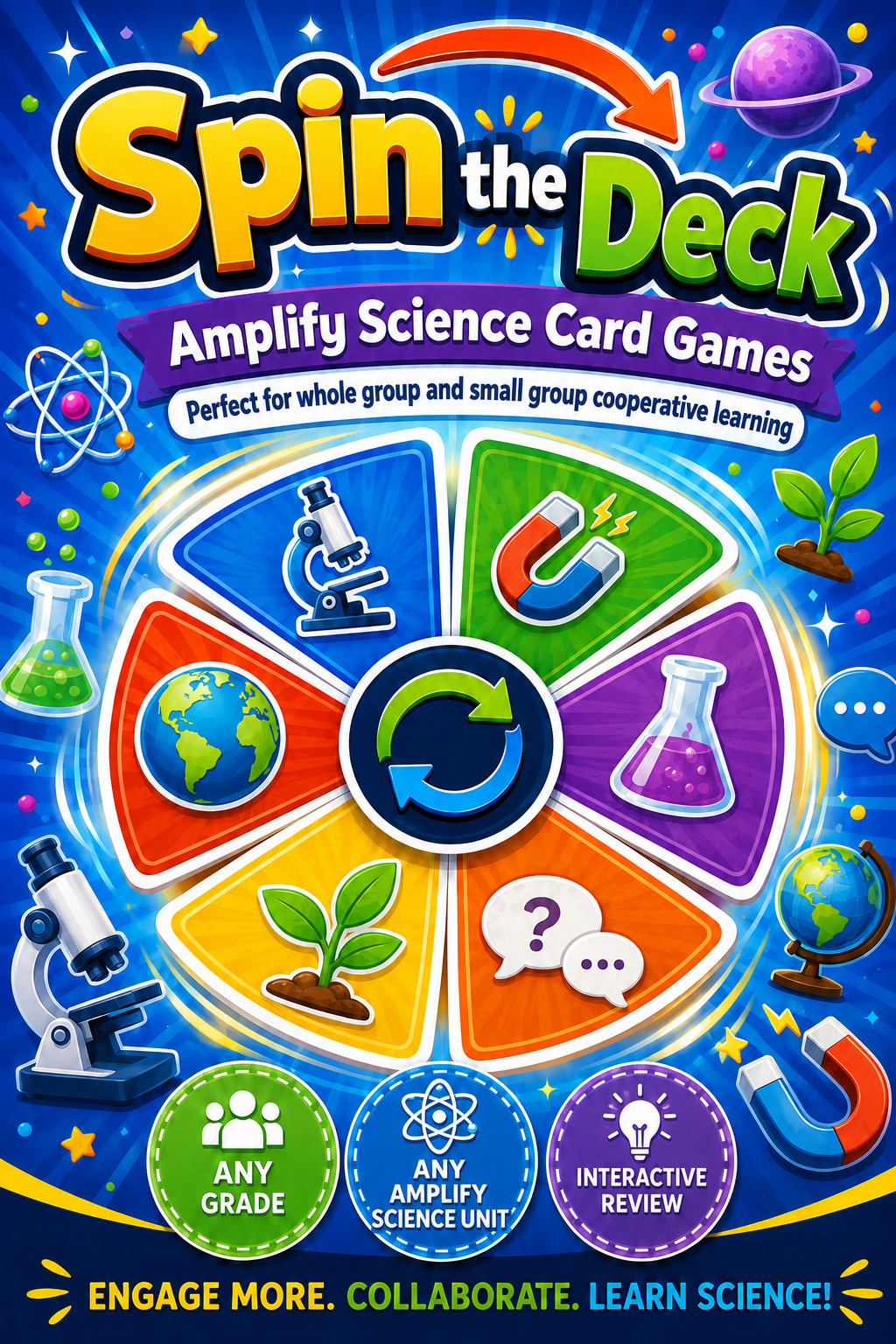
100 Interactive Science Review Cards | Cooperative Learning | Whole-Group & Small-Group Activities
SPIN THE DECK! ENGAGE MORE. COLLABORATE. DISCOVER THE SCIENCE BEHIND CHANGING MATTER!
Turn the Science of Phase Change into an Exciting Classroom Learning Experience!
Why does ice melt when it gets warmer? What causes water to evaporate? Why do water droplets form on the outside of a cold glass? How can methane exist as a liquid on Saturn's moon Titan when it is normally a gas here on Earth?
Bring these fascinating scientific questions to life with Spin the Deck: Phase Change!
Designed to complement the Grade 6 Amplify Science Phase Change unit, this engaging collection of 100 multiple-choice science review cards helps students explore how energy transfer, molecular motion, and molecular attraction determine the physical state of matter.
Students investigate the differences between solids, liquids, and gases while developing a deeper understanding of kinetic energy, thermal energy, temperature, molecular attraction, and the processes responsible for changes in matter.
From discovering why molecules move differently in solids, liquids, and gases to explaining how energy causes melting, freezing, evaporation, and condensation, students explore the invisible molecular processes behind everyday observations.
Students also investigate scientific models, heating curves, energy transfer, and the fascinating conditions on Titan, where extremely cold temperatures allow methane to exist as a liquid.
Move beyond traditional worksheets and transform science review into an exciting cooperative learning experience where students answer questions, explain their thinking, discuss scientific concepts, and collaborate with classmates!
Perfect for whole-group science review, small-group cooperative learning, science centers, partner activities, intervention, enrichment, and unit assessment preparation, this versatile resource helps students build essential physical science knowledge through active participation and repeated practice.
Help your students become confident scientific thinkers, curious investigators, and enthusiastic collaborative learners!
What's Included?
- 100 numbered multiple-choice science review cards covering Grade 6 Phase Change concepts
- Four answer choices per question to encourage careful reading and scientific reasoning
- Answers printed on the reverse side for immediate feedback and student self-checking
- 50 printable PDF pages designed for double-sided printing
- 25 double-sided sheets when printed back-to-back
- Four cards per sheet, creating 100 interactive review cards
- Colorful, science-themed card designs featuring laboratory equipment, scientific imagery, and vibrant blue backgrounds
- Questions exploring states of matter, molecular motion, kinetic energy, molecular attraction, thermal energy, temperature, energy transfer, and phase changes
- Reusable review cards compatible with multiple cooperative learning games and classroom activities
Easy Preparation: Print the PDF double-sided, cut apart the four cards on each sheet, and laminate for durability. Your interactive Phase Change review deck is ready to use!
Science Concepts & Skills Covered
States of Matter: Solids, Liquids & Gases
Help students understand the physical properties and molecular arrangements of the three common states of matter.
Topics include:
- States and phases of matter
- Solids
- Liquids
- Gases
- Substances
- Definite shape
- Definite volume
- Molecular arrangement
- Molecular movement
- Freedom of movement
- Compressibility
- Particle spacing
Students compare how molecules behave in different phases and investigate why solids maintain their shape, liquids take the shape of their containers, and gases expand to fill available space.
Molecular Motion & Kinetic Energy
Explore how the movement of molecules affects the behavior and physical state of substances.
Topics include:
- Molecular motion
- Kinetic energy
- Energy of motion
- Molecular speed
- Increasing kinetic energy
- Decreasing kinetic energy
- Vibrating molecules
- Sliding molecules
- Freely moving molecules
- Particle behavior
- Molecular models
Students investigate how changes in kinetic energy influence molecular movement and help determine whether a substance exists as a solid, liquid, or gas.
Molecular Attraction & Phase Changes
Discover how attractive forces between molecules influence the physical state of matter.
Topics include:
- Molecular attraction
- Attractive forces
- Strength of attraction
- Kinetic energy versus attraction
- Phase stability
- Substance properties
- Overcoming molecular attraction
- Weak and strong attractions
- Molecular interactions
- Different substances and their phase-change behavior
Students examine how the relationship between molecular attraction and kinetic energy helps explain why substances change phases under different conditions.
Melting, Freezing, Evaporation & Condensation
Reinforce students' understanding of the processes that change matter from one physical state to another.
Topics include:
- Melting
- Freezing
- Evaporation
- Condensation
- Boiling
- Sublimation
- Deposition
- Solid-to-liquid changes
- Liquid-to-solid changes
- Liquid-to-gas changes
- Gas-to-liquid changes
- Solid-to-gas changes
- Gas-to-solid changes
Students identify phase changes, compare the processes involved, and explain how energy transfer influences each transformation.
Thermal Energy & Energy Transfer
Help students understand how energy moves between substances and affects molecular behavior.
Topics include:
- Thermal energy
- Heat
- Energy transfer
- Energy moving into substances
- Energy moving out of substances
- Molecular speed
- Heating
- Cooling
- Temperature changes
- Energy conservation
- Energy transfer between objects
Students explore how transferring energy into or out of a substance influences molecular motion and can produce changes in physical state.
Temperature & Average Kinetic Energy
Investigate the relationship between temperature and the motion of molecules.
Topics include:
- Temperature
- Average kinetic energy
- Increasing temperature
- Decreasing temperature
- Molecular speed
- Heating and cooling
- Absolute zero
- Temperature measurements
- Temperature and phase changes
Students reinforce the connection between temperature and molecular motion while distinguishing temperature from the total thermal energy of a substance.
Melting Points, Freezing Points & Boiling Points
Explore the temperatures at which substances change their physical states.
Topics include:
- Melting point
- Freezing point
- Boiling point
- Substance properties
- Phase-change temperatures
- Energy transfer during boiling
- Temperature plateaus
- Heating curves
- Different substances and their phase-change points
Students investigate why substances have different melting and boiling points and how the strength of molecular attraction affects phase-change behavior.
Heating Curves & Phase-Change Stability
Help students interpret how temperature and phase changes relate during heating and cooling.
Topics include:
- Heating curves
- Temperature plateaus
- Phase transitions
- Energy transfer during phase changes
- Constant temperature during a phase change
- Stable phases
- Molecular attraction
- Changes in kinetic energy
- Energy and molecular behavior
Students explore why a substance's temperature may remain constant during a phase change even while energy continues to be transferred.
Microscopic & Macroscopic Models
Develop students' ability to connect observable changes in matter with invisible molecular processes.
Topics include:
- Microscopic models
- Macroscopic observations
- Molecular representations
- Particle models
- Scientific modeling
- Molecular motion diagrams
- Molecular attraction models
- Observing phase changes
- Explaining molecular behavior
Students compare what they can observe directly with what scientific models reveal about molecules and their interactions.
The Amplify Phase Change Simulation
Connect review questions to the scientific modeling tools used in the Amplify Science unit.
Topics include:
- Phase Change simulation
- Molecular movement
- Particle representations
- Molecular attraction
- Changes in kinetic energy
- Adding and removing energy
- Predicting phase changes
- Comparing substances
- Scientific investigations
Students reinforce how simulations help scientists investigate molecular behavior that cannot be observed directly.
Titan, Methane & Planetary Science
Bring real-world scientific investigation into the classroom by exploring the unusual conditions on Saturn's moon Titan.
Topics include:
- Saturn's moon Titan
- Liquid methane
- Extremely cold temperatures
- Methane as a substance
- Different environmental conditions
- Phase changes beyond Earth
- Temperature and molecular motion
- Scientific explanations
- Planetary environments
Students explore why methane can exist as a liquid on Titan and connect this phenomenon to molecular attraction, temperature, and energy transfer.
Everyday Examples of Phase Change
Connect physical science concepts to familiar experiences students encounter outside the classroom.
Topics include:
- Ice melting
- Water freezing
- Water boiling
- Steam
- Evaporation from lakes
- Condensation on cold glasses
- Evaporative cooling
- Rubbing alcohol evaporating
- Water vapor
- Gas compression
- Heating and cooling substances
Students discover how molecular behavior explains common physical changes and everyday observations.
Closed Systems & Conservation of Matter
Investigate what happens to molecules during physical changes in closed systems.
Topics include:
- Closed systems
- Conservation of matter
- Number of molecules
- Phase changes without changing substance identity
- Molecular arrangement
- Matter remaining in a system
- Physical changes versus changes in molecular motion
Students reinforce the understanding that phase changes alter the arrangement and movement of molecules without creating or destroying matter.
Perfect for Whole-Group & Small-Group Cooperative Learning!
Whole-Group Interactive Science Review
Engage your entire class in meaningful discussions about states of matter, molecular motion, energy transfer, molecular attraction, and phase-change processes.
Fan-N-Pick
Students work in cooperative groups, taking turns selecting cards, reading questions, answering, and checking responses. This activity encourages participation, teamwork, and active listening.
Quiz-Quiz-Trade
Students pair up, quiz one another, check answers, exchange cards, and find new partners. This movement-based activity reinforces scientific vocabulary and phase-change concepts through repeated practice.
Science Centers & Stations
Create review stations focusing on states of matter, kinetic energy, molecular attraction, energy transfer, phase changes, and scientific modeling.
Partner Review
Students take turns reading questions, selecting answers, explaining their reasoning, and checking responses on the reverse side.
Small-Group Phase Change Challenges
Organize students into teams to investigate molecular behavior, compare phase-change processes, and explain how energy transfer influences the physical state of matter.
Spin & Answer Review Games
Combine the cards with a classroom spinner or teacher-created game structure to add excitement and friendly competition to science review.
Science Test Preparation
Help students revisit important vocabulary, molecular interactions, and key physical science concepts before unit assessments.
Warm-Ups & Exit Tickets
Use selected cards to activate prior knowledge, encourage scientific discussions, or quickly check understanding.
Science Intervention & Enrichment
Target specific concepts for additional practice or challenge students to explain more complex relationships between kinetic energy, molecular attraction, and phase changes.
Early Finishers & Substitute Plans
Provide meaningful, low-preparation science activities that reinforce important physical science concepts.
Why Teachers Will Love Spin the Deck!
Low-Prep and Ready to Use!
Simply print, cut, and laminate to create a reusable classroom resource.
Designed for Cooperative Learning!
Encourage students to communicate, collaborate, listen respectfully, and explain scientific ideas to classmates.
Promotes Active Student Engagement!
Transform traditional science review into an interactive experience involving discussion, movement, teamwork, and problem-solving.
Reinforces Amplify Science Concepts!
Review essential vocabulary and scientific ideas connected to the Grade 6 Phase Change unit.
Builds Scientific Reasoning!
Students strengthen their ability to explain molecular behavior, predict phase changes, compare energy transfer processes, and identify relationships between temperature, kinetic energy, and molecular attraction.
Provides Immediate Feedback!
Answers on the reverse side allow students to check their understanding during independent, partner, and group activities.
Supports Differentiated Instruction!
Select questions based on student readiness, target specific concepts, or extend learning through additional scientific discussions.
Connects Science to Everyday Life!
Students explore familiar examples of melting, freezing, evaporation, and condensation while discovering the molecular processes responsible for these changes.
Reusable Year After Year!
Laminate the cards to create a durable classroom resource that supports repeated review and cooperative learning.
Sample Spin the Deck Questions
Here are eight examples of actual questions included in this collection:
Question 1: What is a "phase" in science?
Answer: A distinct form of matter.
Question 2: Which phase has molecules that move the slowest?
Answer: Solid.
Question 3: "Kinetic energy" is the energy of:
Answer: Motion.
Question 4: When molecules move faster, their kinetic energy:
Answer: Increases.
Question 9: What is "molecular attraction"?
Answer: A pull between molecules.
Question 15: What happens during "evaporation"?
Answer: Liquid turns to gas.
Question 16: What happens during "condensation"?
Answer: Gas turns to liquid.
Question 50: The "Titan" mission in Amplify focuses on:
Answer: A moon with liquid methane.
These questions reinforce essential phase-change vocabulary while encouraging students to explain molecular motion, kinetic energy, molecular attraction, energy transfer, and changes in the physical state of matter.
Transform Phase Change Review into an Exciting Learning Experience!
Every substance is made of particles that are constantly moving. From the ice melting in a student's drink to the methane lakes on Saturn's moon Titan, the behavior of matter depends on energy, temperature, and the attractive forces between molecules.
With 100 Spin the Deck Phase Change review cards, students can investigate why substances change phases, how molecular motion affects matter, what happens when energy is transferred, and why different substances behave differently under the same conditions.
Imagine students enthusiastically selecting cards, explaining how molecular attraction affects melting, comparing the movement of molecules in solids and gases, predicting the results of energy transfer, and collaborating to understand the science behind physical changes.
Whether you're reviewing lessons, preparing for assessments, reinforcing vocabulary, or creating collaborative learning opportunities, Spin the Deck transforms physical science review into an exciting, student-centered learning experience.
One deck. 100 questions. Endless opportunities to explore the science of changing matter!
SPIN THE DECK! ENGAGE MORE. COLLABORATE. LEARN SCIENCE!
Add Spin the Deck: Phase Change to your classroom toolkit and inspire confident, curious, and collaborative young scientists!
Important Curriculum Disclaimer
This independently created resource is designed to supplement the Amplify Science curriculum. It is not affiliated with, sponsored by, authorized by, or endorsed by Amplify Education, Inc. Amplify and Amplify Science are trademarks of their respective owner. No affiliation or endorsement is implied.
This product is a supplemental classroom review activity and is not a replacement for official Amplify Science curriculum materials, lessons, assessments, or instructional resources.
- Grade 6
- Instant digital download
- Print & reuse in class