Spin the Deck – Grade 6 Amplify Science: Populations and Resources
$5.00
Spin the Deck – Grade 6 Amplify Science: Populations and Resources
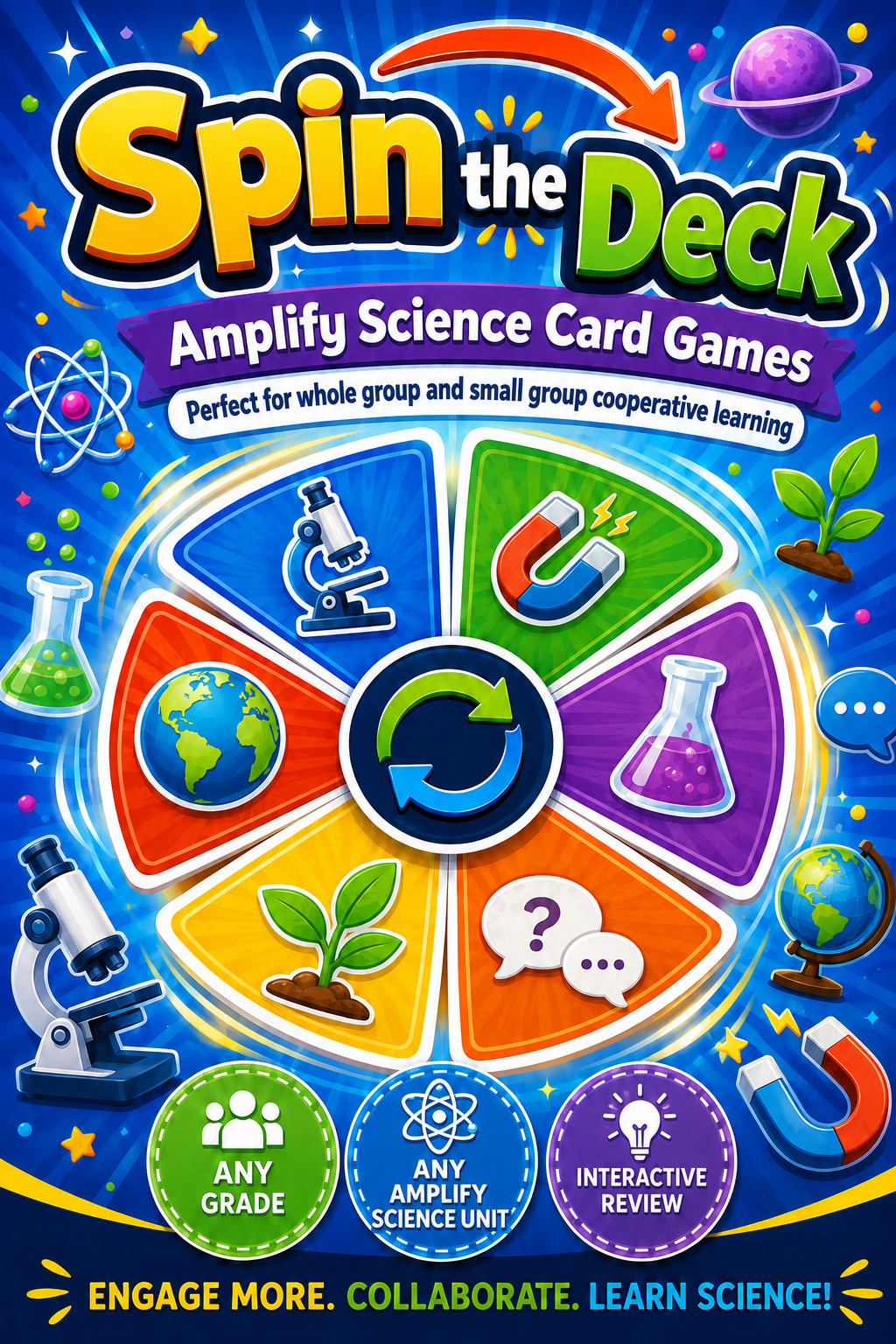
100 Interactive Science Review Cards | Cooperative Learning | Whole-Group & Small-Group Activities
SPIN THE DECK! ENGAGE MORE. COLLABORATE. EXPLORE THE CONNECTIONS THAT KEEP ECOSYSTEMS ALIVE!
Turn Ecosystems, Food Webs, and Population Changes into an Exciting Classroom Learning Experience!
What happens when a predator population suddenly decreases? Why might an increase in one population cause another population to grow? How do organisms obtain the energy storage molecules they need to survive and reproduce? What happens when an ecosystem experiences a disruption?
Bring these fascinating ecological questions to life with Spin the Deck: Populations and Resources!
Designed to complement the Grade 6 Amplify Science Populations and Resources unit, this engaging collection of 100 multiple-choice science review cards helps students explore the complex relationships between organisms, resources, energy, and population changes within ecosystems.
Students investigate how producers and consumers obtain energy storage molecules, how food webs connect living organisms, and how changes in resource availability can influence population growth, reproduction, and survival.
From understanding the importance of sunlight and carbon dioxide to producers to predicting how predator-prey relationships affect entire food webs, students develop a deeper understanding of the interactions that shape ecosystems.
Students also explore carrying capacity, competition, population stability, ecological disruptions, scientific modeling, simulations, and the importance of evidence when explaining population changes.
Move beyond traditional worksheets and transform science review into an exciting cooperative learning experience where students answer questions, explain their thinking, discuss ecological relationships, and collaborate with classmates!
Perfect for whole-group science review, small-group cooperative learning, science centers, partner activities, intervention, enrichment, and unit assessment preparation, this versatile resource helps students strengthen their ecological knowledge through active participation and repeated practice.
Help your students become confident scientific thinkers, curious ecologists, and enthusiastic collaborative learners!
What's Included?
- 100 numbered multiple-choice science review cards covering Grade 6 Populations and Resources concepts
- Four answer choices per question to encourage careful reading and scientific reasoning
- Answers printed on the reverse side for immediate feedback and student self-checking
- 50 printable PDF pages designed for double-sided printing
- 25 double-sided sheets when printed back-to-back
- Four cards per sheet, creating 100 interactive review cards
- Colorful science-themed designs featuring vibrant blue backgrounds, laboratory equipment, scientific illustrations, and numbered question cards
- Questions addressing populations, ecosystems, energy storage molecules, producers, consumers, food webs, competition, carrying capacity, population changes, and scientific investigations
- Reusable review cards compatible with cooperative learning games, partner activities, and science centers
Easy Preparation: Print the PDF double-sided, cut apart the four cards on each sheet, and laminate for durability. Your interactive Populations and Resources review deck is ready to use!
Science Concepts & Skills Covered
Populations & Ecosystems
Help students understand how organisms live and interact within ecosystems.
Topics include:
- Organisms
- Populations
- Ecosystems
- Species
- Living and nonliving components
- Biotic factors
- Abiotic factors
- Interactions between organisms and their environments
- Population size
- Ecological relationships
Students explore how populations consist of members of the same species living in an area and how ecosystems include interacting living and nonliving components.
Producers, Consumers & Decomposers
Investigate how different organisms obtain and use resources within ecosystems.
Topics include:
- Producers
- Consumers
- Decomposers
- Photosynthesis
- Primary consumers
- Secondary consumers
- Herbivores
- Feeding relationships
- Energy sources
- Organisms breaking down dead matter
Students compare the roles of producers, consumers, and decomposers while exploring how these organisms contribute to the movement of matter and energy through ecosystems.
Energy Storage Molecules (ESMs)
Explore one of the central concepts of the Amplify Science Populations and Resources unit.
Topics include:
- Energy storage molecules
- Glucose
- Fats
- Starch
- Energy for life functions
- Energy for reproduction
- Energy for survival
- Producers creating ESMs
- Consumers obtaining ESMs
- Carbon in energy storage molecules
- Resource availability and energy storage molecules
Students discover why organisms need energy storage molecules and how the availability of these molecules influences survival, growth, and reproduction.
Photosynthesis, Sunlight & Carbon Dioxide
Help students understand how producers obtain the energy and matter needed to make energy storage molecules.
Topics include:
- Photosynthesis
- Sunlight as an energy source
- Carbon dioxide
- Water
- Glucose production
- Matter used to make ESMs
- Carbon in living systems
- Producers and resource availability
Students investigate how producers use sunlight and matter from their environment to make energy storage molecules that support other organisms within food webs.
Consumer-Resource Relationships
Explore how changes in resource populations can influence consumer populations.
Topics include:
- Consumer-resource relationships
- Resource populations
- Consumer populations
- Resource availability
- Population growth
- Population decline
- Reproduction rates
- Survival rates
- Direct ecological relationships
- Changes in food availability
Students predict how increasing or decreasing resource populations can affect the organisms that depend on them.
Food Webs & Interconnected Populations
Help students visualize how organisms depend on one another within ecosystems.
Topics include:
- Food webs
- Feeding relationships
- Overlapping food chains
- Direct effects
- Indirect effects
- Predator-prey relationships
- Consumer-resource interactions
- Changes in connected populations
- Ecosystem interdependence
Students discover how a change in one population can influence other populations, including organisms that do not directly interact.
Competition & Limited Resources
Investigate how organisms compete for resources needed for survival.
Topics include:
- Competition
- Limited resources
- Consumer-consumer relationships
- Shared food sources
- Resource scarcity
- Population growth limitations
- Competing species
- Ecological interactions
Students explore why populations may compete when they depend on the same limited resources and how competition can affect population sizes.
Birth Rates, Death Rates & Population Changes
Reinforce how reproduction and survival influence population size.
Topics include:
- Birth rates
- Death rates
- Reproduction
- Population increases
- Population decreases
- Stable populations
- Population calculations
- Resource availability
- Survival and reproduction
Students determine whether populations are growing, shrinking, or remaining stable based on changes in births and deaths.
Carrying Capacity & Population Limits
Help students understand why populations cannot grow indefinitely when resources are limited.
Topics include:
- Carrying capacity
- Maximum sustainable population
- Limited resources
- Population growth
- Population decline
- Populations below carrying capacity
- Populations exceeding carrying capacity
- Environmental limitations
- Resource availability
Students investigate how environmental conditions and resource availability influence the number of organisms an ecosystem can support.
Ecosystem Stability & Disruptions
Explore how ecosystems respond to changing conditions.
Topics include:
- Ecosystem stability
- Balanced ecosystems
- Population fluctuations
- Ecological disruptions
- Changes in food webs
- Population shifts
- Predator removal
- Resource changes
- Indirect ecological effects
Students learn that stable ecosystems are dynamic and that disruptions can cause changes throughout interconnected populations.
Matter & Energy in Ecosystems
Connect ecological relationships to the movement of matter and energy.
Topics include:
- Matter cycling
- Energy flow
- Energy transfer
- Conservation of energy
- Carbon
- Energy storage molecules
- Decomposition
- Producers and consumers
- Living and nonliving components
Students investigate how matter moves through ecosystems and how energy is transferred and transformed as organisms obtain and use resources.
Ecological Sampling & Population Data
Develop students' ability to investigate populations using scientific evidence.
Topics include:
- Ecological sampling
- Population estimates
- Counting organisms
- Scientific data
- Observable evidence
- Measurable evidence
- Population trends
- Graph interpretation
- Increasing populations
- Decreasing populations
Students practice using data and observations to identify population patterns and support scientific explanations.
Scientific Models & Simulations
Help students understand how scientists investigate complex ecological systems.
Topics include:
- Scientific models
- Ecosystem models
- Population simulations
- Testing variables
- Modeling ecological relationships
- Predicting population changes
- Evidence-based explanations
- Comparing model results
- Scientific investigations
Students explore how models and simulations can help explain population changes and investigate relationships that may be difficult to observe directly.
Amplify Science Ecobottle Investigations
Connect review questions to the ecosystem investigations featured in the Amplify Science unit.
Topics include:
- Ecobottle models
- Closed ecosystems
- Interacting populations
- Resource availability
- Population changes
- Ecological relationships
- Scientific observations
- Ecosystem stability
Students reinforce how a simplified ecosystem model can be used to investigate relationships among organisms and resources.
Amplify Science Population Examples
Review specific organisms and relationships featured in the unit's scientific scenarios.
Topics include:
- Greenleaf populations
- Zoe populations
- Oshie predators
- Weebee prey
- Moon jelly populations
- Resource-dependent population growth
- Predator-prey changes
- Population predictions
Students connect general ecological principles to specific population examples and apply their understanding to predict how changes in one population may influence another.
Scientific Claims, Evidence & Reasoning
Strengthen students' ability to explain population changes using scientific evidence.
Topics include:
- Scientific claims
- Observable evidence
- Measurable evidence
- Population data
- Scientific explanations
- Graph interpretation
- Cause-and-effect relationships
- Evidence-based reasoning
Students reinforce the importance of using evidence rather than guesses or opinions when explaining ecological changes.
Perfect for Whole-Group & Small-Group Cooperative Learning!
Whole-Group Interactive Science Review
Engage the entire class in meaningful discussions about populations, ecosystems, food webs, energy storage molecules, and ecological relationships.
Fan-N-Pick
Students work in cooperative groups, taking turns selecting cards, reading questions, answering, and checking responses. This activity promotes participation, teamwork, and active listening.
Quiz-Quiz-Trade
Students pair up, quiz one another, check answers, exchange cards, and find new partners. This movement-based activity reinforces ecological vocabulary and scientific concepts through repeated practice.
Science Centers & Stations
Create review stations focusing on producers and consumers, energy storage molecules, food webs, carrying capacity, population changes, and ecosystem stability.
Partner Review
Students take turns reading questions, selecting answers, explaining their reasoning, and checking responses on the reverse side.
Small-Group Ecosystem Challenges
Organize students into teams to predict population changes, analyze consumer-resource relationships, and explain the effects of ecosystem disruptions.
Spin & Answer Review Games
Combine the cards with a classroom spinner or teacher-created game structure to add excitement and friendly competition to science review.
Science Test Preparation
Help students revisit important ecological vocabulary, resource relationships, population dynamics, and scientific investigation concepts before unit assessments.
Warm-Ups & Exit Tickets
Use selected cards to activate prior knowledge, encourage scientific discussions, or quickly assess understanding.
Science Intervention & Enrichment
Target specific ecological concepts for additional practice or challenge students to explain more complex food web relationships and population changes.
Early Finishers & Substitute Plans
Provide meaningful, low-preparation science activities that reinforce important ecological concepts.
Why Teachers Will Love Spin the Deck!
Low-Prep and Ready to Use!
Simply print, cut, and laminate to create a reusable classroom resource.
Designed for Cooperative Learning!
Encourage students to communicate, collaborate, listen respectfully, and explain scientific ideas to classmates.
Promotes Active Student Engagement!
Transform traditional science review into an interactive experience involving discussion, movement, teamwork, and problem-solving.
Reinforces Amplify Science Concepts!
Review essential vocabulary and scientific ideas connected to the Grade 6 Populations and Resources unit.
Builds Scientific Reasoning!
Students strengthen their ability to predict population changes, explain consumer-resource relationships, analyze ecological interactions, and use evidence to support scientific explanations.
Provides Immediate Feedback!
Answers on the reverse side allow students to check their understanding during independent, partner, and group activities.
Supports Differentiated Instruction!
Select questions based on student readiness, target specific concepts, or extend learning through additional scientific discussions.
Connects Science to Real-World Ecosystems!
Students investigate relationships between organisms and resources while discovering how changes in one part of an ecosystem can affect other populations.
Reusable Year After Year!
Laminate the cards to create a durable classroom resource that supports repeated review and cooperative learning.
Sample Spin the Deck Questions
Here are eight actual questions from this collection:
Question 1: What is a "population"?
Answer: A group of the same species living in an area.
Question 2: An "ecosystem" consists of:
Answer: Living and nonliving parts interacting.
Question 3: What are "Energy Storage Molecules" (ESMs)?
Answer: Molecules like fats and glucose used for energy.
Question 4: Where do producers get their energy to make ESMs?
Answer: The Sun.
Question 5: In a "Consumer-Resource" relationship, the resource is:
Answer: The organism being eaten.
Question 13: A "food web" shows:
Answer: Multiple overlapping feeding relationships.
Question 15: "Competition" occurs when two populations:
Answer: Need the same limited resource.
Question 65: "Carrying capacity" is the:
Answer: Maximum population an environment can support.
These questions reinforce important ecological vocabulary while encouraging students to explain relationships among populations, resources, energy storage molecules, and ecosystem stability.
Transform Ecosystem Review into an Exciting Learning Experience!
Every ecosystem is a complex network of organisms, resources, and interactions. From plants using sunlight to make energy storage molecules to predators depending on prey populations for survival, changes in one part of an ecosystem can influence many others.
With 100 Spin the Deck Populations and Resources review cards, students can investigate how populations grow and decline, why organisms depend on resources, how energy storage molecules support life, and what happens when ecosystems experience disruptions.
Imagine students enthusiastically selecting cards, explaining how food webs connect populations, predicting how changes in resource availability affect consumers, analyzing carrying capacity, and collaborating to understand the relationships that support ecosystem stability.
Whether you're reviewing lessons, preparing for assessments, reinforcing vocabulary, or creating collaborative learning opportunities, Spin the Deck transforms ecology review into an exciting, student-centered learning experience.
One deck. 100 questions. Endless opportunities to explore the interconnected world of ecosystems!
SPIN THE DECK! ENGAGE MORE. COLLABORATE. LEARN SCIENCE!
Add Spin the Deck: Populations and Resources to your classroom toolkit and inspire confident, curious, and collaborative young ecologists!
Important Curriculum Disclaimer
This independently created resource is designed to supplement the Amplify Science curriculum. It is not affiliated with, sponsored by, authorized by, or endorsed by Amplify Education, Inc. Amplify and Amplify Science are trademarks of their respective owner. No affiliation or endorsement is implied.
This product is a supplemental classroom review activity and is not a replacement for official Amplify Science curriculum materials, lessons, assessments, or instructional resources.
- Grade 6
- Instant digital download
- Print & reuse in class