Spin the Deck – Grade 7 Amplify Science: Force and Motion
$5.00
Spin the Deck – Grade 7 Amplify Science: Force and Motion
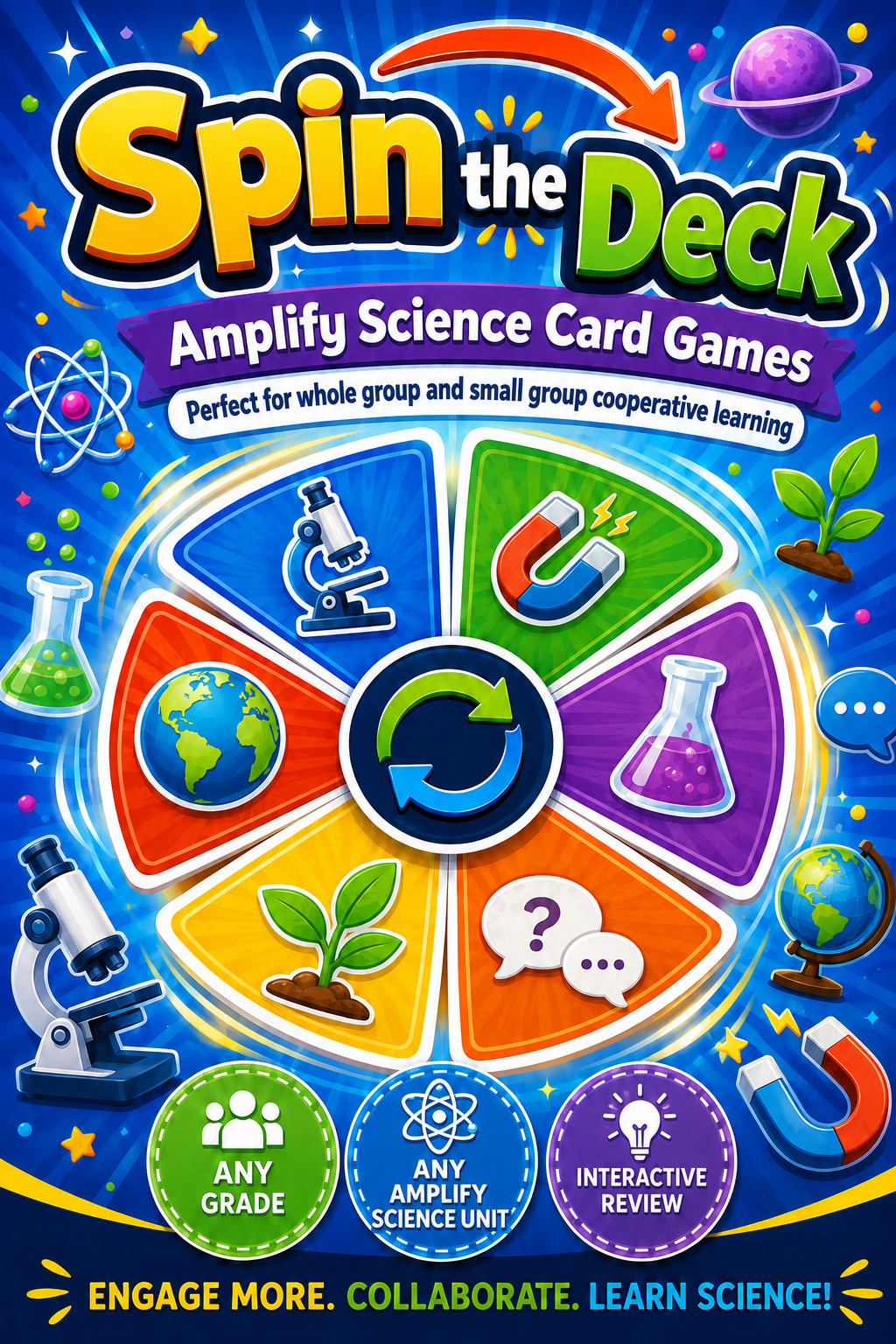
100 Interactive Science Review Cards | Cooperative Learning | Whole-Group & Small-Group Activities
SPIN THE DECK! ENGAGE MORE. COLLABORATE. DISCOVER THE FORCES THAT MAKE OUR WORLD MOVE!
Turn Forces, Velocity, Collisions, and Newton's Laws into an Exciting Classroom Learning Experience!
What causes an object to speed up, slow down, or change direction? Why does a small car experience a greater change in motion than a heavy truck during a collision? How can spacecraft change direction in the vastness of space? What happens when forces acting on an object are balanced or unbalanced?
Bring these fascinating physics questions to life with Spin the Deck: Force and Motion!
Designed to complement the Grade 7 Amplify Science Force and Motion unit, this engaging collection of 100 multiple-choice science review cards helps students investigate how forces influence the motion of objects, how mass affects changes in velocity, and why collisions produce different effects on different objects.
Students explore the relationships among force, mass, velocity, acceleration, and direction while developing a deeper understanding of the scientific principles that explain everyday motion.
From investigating balanced and unbalanced forces to exploring Newton's Third Law of Motion, students examine how objects interact, why forces occur in pairs, and how the strength and direction of a force influence an object's movement.
Students also investigate the exciting Asteroid Mission scenario, where a spacecraft pod must change direction using thruster forces. Through this real-world-inspired application of physics, students connect scientific concepts to spacecraft movement, collisions, and the challenges of navigating through space.
The deck extends learning through topics such as friction, gravity, inertia, momentum, kinetic energy, contact and at-a-distance forces, and the use of scientific models and simulations.
Move beyond traditional worksheets and transform physics review into an exciting cooperative learning experience where students answer questions, explain their thinking, analyze motion scenarios, and collaborate with classmates!
Perfect for whole-group science review, small-group cooperative learning, science centers, partner activities, intervention, enrichment, and unit assessment preparation, this versatile resource helps students strengthen their understanding of physical science through active participation and repeated practice.
Help your students become confident scientific thinkers, curious physics investigators, and enthusiastic collaborative learners!
What's Included?
- 100 numbered multiple-choice science review cards covering Grade 7 Force and Motion concepts
- Four answer choices per question to encourage careful reading and scientific reasoning
- Answers printed on the reverse side for immediate feedback and student self-checking
- 50 printable PDF pages designed for double-sided printing
- 25 double-sided sheets when printed back-to-back
- Four cards per sheet, creating 100 interactive review cards
- Colorful science-themed designs featuring vibrant blue backgrounds, scientific illustrations, laboratory equipment, and numbered question cards
- Questions addressing force, velocity, acceleration, mass, collisions, Newton's laws, momentum, energy, and scientific investigations
- Reusable review cards compatible with cooperative learning games, partner activities, and science centers
Easy Preparation: Print the PDF double-sided, cut apart the four cards on each sheet, and laminate for durability. Your interactive Force and Motion review deck is ready to use!
Science Concepts & Skills Covered
Forces & Motion Fundamentals
Help students understand the basic principles that explain how and why objects move.
Topics include:
- Force as a push or pull
- Exerting a force
- Objects in motion
- Changes in motion
- Force direction
- Force magnitude
- Force interactions
- Motion caused by forces
- Stationary objects
- Objects speeding up and slowing down
- Force and velocity relationships
Students explore how forces can change an object's velocity and why the direction of an applied force matters when predicting motion.
Velocity, Speed & Direction
Investigate how scientists describe and measure an object's motion.
Topics include:
- Speed
- Velocity
- Direction of motion
- Changes in velocity
- Constant velocity
- Motion in different directions
- Acceleration
- Displacement
- Reference frames
- Relative motion
- Motion observations
Students discover that velocity includes both speed and direction, meaning an object can experience a change in velocity even when its speed remains the same.
Balanced & Unbalanced Forces
Explore how multiple forces acting on an object determine whether its velocity changes.
Topics include:
- Balanced forces
- Unbalanced forces
- Equal and opposite forces
- Net force
- Zero net force
- Forces acting in the same direction
- Forces acting in opposite directions
- Combining forces
- Canceling forces
- Constant motion
- Changes in velocity
Students investigate why balanced forces do not change an object's velocity and how unbalanced forces cause changes in speed or direction.
Net Force & Force Vectors
Help students interpret the combined effects of forces acting on objects.
Topics include:
- Net force
- Force magnitude
- Force direction
- Vector arrows
- Representing forces
- Combining forces
- Equal forces
- Opposing forces
- Force strength
- Newtons as units of force
- Force diagrams
Students explore how vector arrows represent both the strength and direction of forces and how scientists use these representations to explain motion.
Mass & Changes in Velocity
Investigate why objects with different masses respond differently to the same applied force.
Topics include:
- Mass
- Matter in an object
- Greater mass
- Smaller mass
- Force and mass relationships
- Changes in velocity
- Acceleration
- Comparing objects
- Resistance to changes in motion
- Predicting motion
Students discover that when the same net force acts on objects of different masses, the less massive object experiences a greater acceleration.
Inertia & Resistance to Motion Changes
Explore why objects resist changes in their motion.
Topics include:
- Inertia
- Mass and inertia
- Resistance to acceleration
- Objects at rest
- Objects in motion
- Maintaining velocity
- Heavy and light objects
- Comparing inertia
- Stopping moving objects
- Changes in direction
Students investigate why a train is more difficult to stop than a bicycle and how mass influences an object's resistance to changes in velocity.
Newton's Laws of Motion
Reinforce foundational principles that explain how forces affect moving objects.
Topics include:
- Newton's First Law
- Newton's Second Law
- Newton's Third Law
- Inertia
- Net force
- Mass and acceleration
- Equal and opposite forces
- Action-reaction pairs
- Force interactions
- Motion predictions
- Everyday applications
Students connect Newton's laws to situations involving moving carts, pushing walls, collisions, and spacecraft thrusters.
Newton's Third Law & Force Pairs
Investigate how interacting objects exert forces on one another.
Topics include:
- Action-reaction forces
- Equal and opposite forces
- Force pairs
- Interacting objects
- Pushing against a wall
- Skaters pushing away from walls
- Collision forces
- Forces on both objects
- Spacecraft propulsion
- Newton's Third Law
Students explore why forces occur in pairs and how two objects can experience equal-strength forces but different changes in motion.
Collisions & Object Interactions
Help students explain what happens when two or more objects collide.
Topics include:
- Collisions
- Contact forces
- Equal and opposite collision forces
- Force interactions
- Mass differences
- Changes in velocity
- Collision outcomes
- Vehicle collisions
- Spacecraft collisions
- Momentum transfer
- Energy transfer
Students investigate why objects involved in the same collision may experience different changes in velocity even though the forces they exert on each other are equal in magnitude.
The Asteroid Mission & Spacecraft Motion
Connect physics concepts to the exciting spacecraft investigation featured in the Force and Motion unit.
Topics include:
- Asteroid Mission
- Spacecraft pods
- Thruster forces
- Spacecraft direction changes
- Spacecraft velocity
- Collisions in space
- Force direction
- Motion predictions
- Investigation goals
- Spacecraft propulsion
- Scientific simulations
Students explore how thruster forces change a spacecraft pod's motion and why scientists must carefully analyze force, mass, and velocity when investigating movement in space.
Friction & Air Resistance
Investigate forces that oppose motion.
Topics include:
- Friction
- Contact forces
- Air resistance
- Opposing forces
- Slowing objects
- Falling objects
- Terminal velocity
- Balanced forces during falling
- Motion through air
- Objects falling in a vacuum
- Hammer and feather comparisons
Students explore how friction and air resistance influence motion and why objects can behave differently when air resistance is removed.
Gravity, Mass & Weight
Help students distinguish between mass and weight while exploring gravitational forces.
Topics include:
- Gravity
- Gravitational attraction
- Mass
- Weight
- Gravity on Earth
- Gravity on the Moon
- Gravitational forces
- Falling objects
- Mass remaining constant
- Changes in weight
- At-a-distance forces
Students discover why an object's mass remains the same on the Moon while its weight changes because of differences in gravitational force.
Contact & At-a-Distance Forces
Explore the different ways forces can act on objects.
Topics include:
- Contact forces
- At-a-distance forces
- Friction
- Magnetic forces
- Gravity
- Static electricity
- Pushing objects
- Hitting objects
- Force interactions
- Motion without direct contact
Students compare forces that require physical contact with forces that can act without objects touching.
Acceleration & Changing Motion
Investigate how and why an object's velocity changes.
Topics include:
- Acceleration
- Rate of velocity change
- Speeding up
- Slowing down
- Changing direction
- Unbalanced forces
- Net force
- Force magnitude
- Mass and acceleration
- Motion predictions
- Force duration
Students strengthen their ability to explain how applied forces affect an object's acceleration and why changes in direction also represent changes in velocity.
Momentum & Motion
Introduce students to momentum and its relationship to mass and velocity.
Topics include:
- Momentum
- Mass times velocity
- Momentum of moving objects
- Zero momentum
- Increasing momentum
- Mass and momentum
- Velocity and momentum
- Momentum transfer
- Collisions
- Interacting objects
- Motion changes
Students explore how momentum depends on both mass and velocity and how momentum can be transferred during collisions.
Kinetic Energy & Energy Transfer
Connect the motion of objects to energy.
Topics include:
- Kinetic energy
- Mass and velocity
- Moving objects
- Objects at rest
- Energy during collisions
- Energy transfer
- Energy transformation
- Motion and energy
- Work
- Force and displacement
- Energy changes
Students investigate how moving objects possess kinetic energy and how energy can be transferred or transformed during collisions.
Work, Force & Displacement
Explore the relationship between applied forces and the movement of objects.
Topics include:
- Work
- Force
- Distance
- Displacement
- Changes in position
- Moving objects
- Applied forces
- Motion caused by forces
- Zero work when no displacement occurs
- Force and distance relationships
Students reinforce the idea that scientific work involves a force causing displacement and examine why pushing an unmoving object does not produce mechanical work on that object.
Force Duration & Continuous Forces
Help students investigate how long forces act on objects.
Topics include:
- Continuous forces
- Short-duration forces
- Quick pushes
- Impacts
- Force application over time
- Motion changes
- Force interactions
- Acceleration
- Rate of change
- Comparing force scenarios
Students compare brief impacts with forces applied continuously and consider how the duration of force application relates to changes in motion.
Physical Systems & Cause-and-Effect Relationships
Develop students' understanding of how objects and forces interact within a system.
Topics include:
- Physical systems
- Interacting objects
- Force relationships
- Cause and effect
- Motion changes
- Object interactions
- System components
- Predicting outcomes
- Collision systems
- Force-based explanations
Students investigate how forces cause changes in velocity and how examining all interacting objects can help explain the behavior of a physical system.
Scientific Models & Computer Simulations
Help students understand how scientists investigate motion in situations that may be difficult or expensive to reproduce.
Topics include:
- Scientific models
- Computer simulations
- Force and Motion simulations
- Spacecraft simulations
- Force vectors
- Representing motion
- Predicting outcomes
- Investigating variables
- Comparing scenarios
- Testing explanations
Students explore how simulations allow scientists to investigate spacecraft motion, analyze force interactions, and test predictions in controlled environments.
Scientific Claims, Evidence & Reasoning
Strengthen students' ability to develop scientific explanations supported by evidence.
Topics include:
- Scientific claims
- Evidence
- Reasoning
- Scientific arguments
- Cause-and-effect explanations
- Supporting claims
- Interpreting observations
- Scientific communication
- Using evidence to explain motion
- Constructing explanations
Students practice explaining how evidence supports scientific claims about forces, collisions, and changes in velocity.
Perfect for Whole-Group & Small-Group Cooperative Learning!
Whole-Group Interactive Science Review
Engage the entire class in meaningful discussions about forces, velocity, collisions, Newton's laws, and the relationships among mass, force, and acceleration.
Fan-N-Pick
Students work in cooperative groups, taking turns selecting cards, reading questions, answering, and checking responses. This activity promotes participation, teamwork, and active listening.
Quiz-Quiz-Trade
Students pair up, quiz one another, check answers, exchange cards, and find new partners. This movement-based activity reinforces physics vocabulary and scientific concepts through repeated practice.
Science Centers & Stations
Create review stations focusing on balanced and unbalanced forces, Newton's laws, mass and velocity, collisions, spacecraft motion, and scientific investigations.
Partner Review
Students take turns reading questions, selecting answers, explaining their reasoning, and checking responses on the reverse side.
Small-Group Physics Challenges
Organize students into teams to analyze motion scenarios, compare forces, predict changes in velocity, and explain how mass influences acceleration.
Spin & Answer Review Games
Combine the cards with a classroom spinner or teacher-created game structure to add excitement and friendly competition to science review.
Science Test Preparation
Help students revisit important physics vocabulary, force interactions, Newton's laws, and motion concepts before unit assessments.
Warm-Ups & Exit Tickets
Use selected cards to activate prior knowledge, encourage scientific discussions, or quickly assess understanding.
Science Intervention & Enrichment
Target specific concepts for additional practice or challenge students to explain more complex force interactions and collision scenarios.
Early Finishers & Substitute Plans
Provide meaningful, low-preparation science activities that reinforce important physical science concepts.
Why Teachers Will Love Spin the Deck!
Low-Prep and Ready to Use!
Simply print, cut, and laminate to create a reusable classroom resource.
Designed for Cooperative Learning!
Encourage students to communicate, collaborate, listen respectfully, and explain scientific ideas to classmates.
Promotes Active Student Engagement!
Transform traditional science review into an interactive experience involving discussion, movement, teamwork, and problem-solving.
Reinforces Amplify Science Concepts!
Review essential vocabulary and scientific ideas connected to the Grade 7 Force and Motion unit.
Builds Scientific Reasoning!
Students strengthen their ability to explain force interactions, predict changes in velocity, analyze collisions, and use evidence to support scientific explanations.
Provides Immediate Feedback!
Answers on the reverse side allow students to check their understanding during independent, partner, and group activities.
Supports Differentiated Instruction!
Select questions based on student readiness, target specific concepts, or extend learning through additional scientific discussions.
Connects Science to Real-World Applications!
Students investigate the physics behind everyday motion, vehicle collisions, spacecraft navigation, gravity, friction, and the forces that influence objects around them.
Challenges Common Misconceptions!
Help students understand that objects do not always need a continuous net force to keep moving, that equal collision forces can produce different changes in motion, and that velocity includes direction as well as speed.
Reusable Year After Year!
Laminate the cards to create a durable classroom resource that supports repeated review and cooperative learning.
Sample Spin the Deck Questions
Here are eight actual questions from this collection:
Question 1: What is a "force"?
Answer: A push or a pull.
Question 2: "Velocity" is a measure of speed and:
Answer: Direction.
Question 3: What is required to change an object's velocity?
Answer: A force.
Question 4: If two forces on an object are equal and opposite, they are:
Answer: Balanced.
Question 5: An "unbalanced" force causes an object to:
Answer: Change its velocity.
Question 6: What is "exerting" a force?
Answer: Applying a force to an object.
Question 7: In the "Asteroid" mission, what caused the pod to move?
Answer: A thruster force.
Question 8: If a force is exerted in the same direction as motion, the object:
Answer: Speeds up.
These questions reinforce important scientific vocabulary while encouraging students to investigate forces, predict motion changes, and explain how objects respond to interactions.
Transform Force and Motion Review into an Exciting Learning Experience!
Every moving object has a story to tell, and forces help explain what happens next. From a rolling ball slowing because of friction to a spacecraft changing direction through the use of thrusters, the principles of force and motion help students make sense of the physical world.
With 100 Spin the Deck Force and Motion review cards, students can investigate how forces affect velocity, why mass influences acceleration, how collisions produce equal and opposite forces, and how scientific evidence helps explain the movement of objects.
Imagine students enthusiastically selecting cards, analyzing collision scenarios, comparing balanced and unbalanced forces, explaining Newton's laws, and collaborating to predict how objects will move.
Whether you're reviewing lessons, preparing for assessments, reinforcing vocabulary, or creating collaborative learning opportunities, Spin the Deck transforms physics review into an exciting, student-centered learning experience.
One deck. 100 questions. Endless opportunities to discover the forces that shape our world!
SPIN THE DECK! ENGAGE MORE. COLLABORATE. LEARN SCIENCE!
Add Spin the Deck: Force and Motion to your classroom toolkit and inspire confident, curious, and collaborative young physicists!
Important Curriculum Disclaimer
This independently created resource is designed to supplement the Amplify Science curriculum. It is not affiliated with, sponsored by, authorized by, or endorsed by Amplify Education, Inc. Amplify and Amplify Science are trademarks of their respective owner. No affiliation or endorsement is implied.
This product is a supplemental classroom review activity and is not a replacement for official Amplify Science curriculum materials, lessons, assessments, or instructional resources.
- Grade 7
- Instant digital download
- Print & reuse in class