Spin the Deck – Grade 7 Amplify Science: Microbiome
$5.00
Spin the Deck – Grade 7 Amplify Science: Microbiome
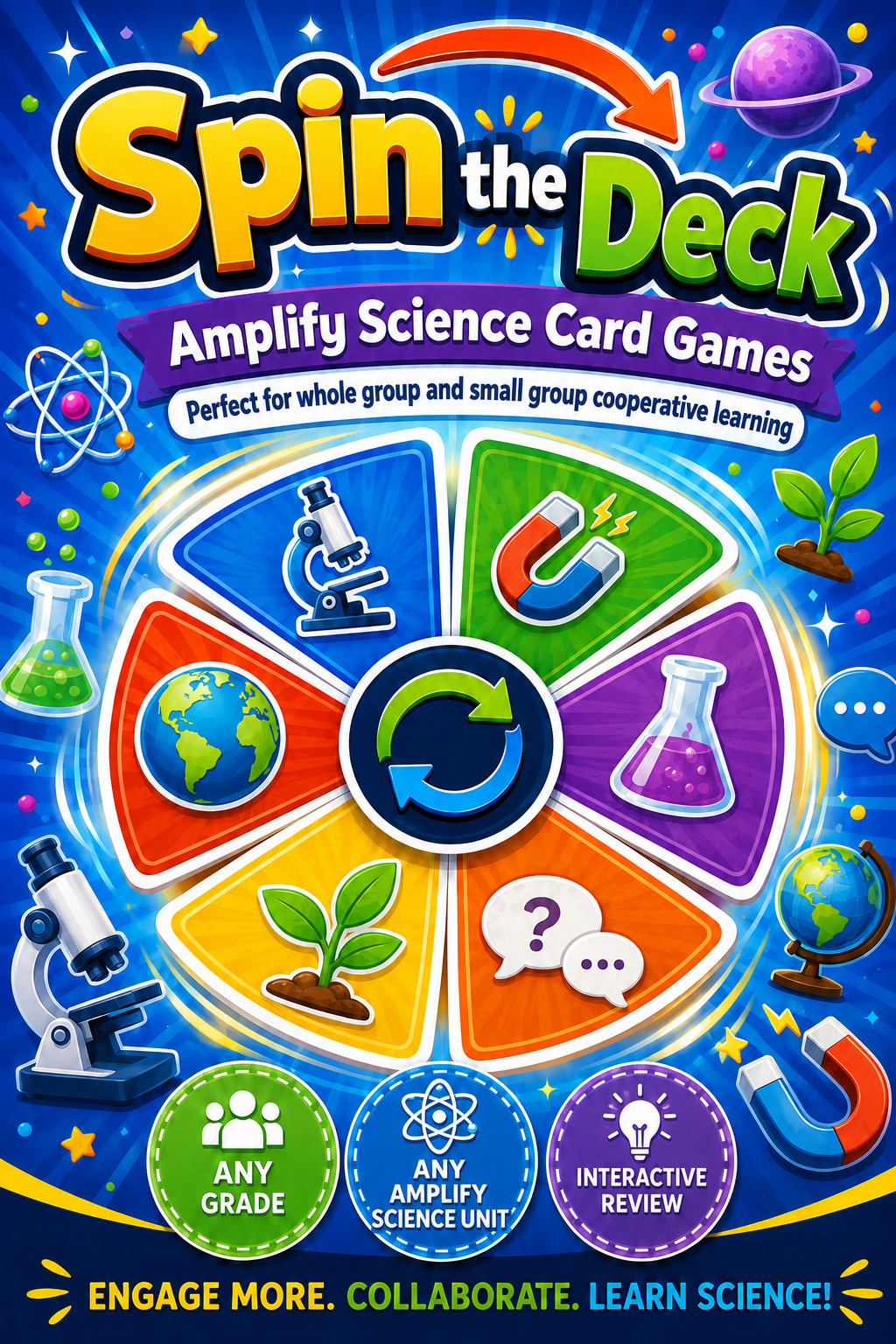
100 Interactive Science Review Cards | Cooperative Learning | Whole-Group & Small-Group Activities
SPIN THE DECK! ENGAGE MORE. COLLABORATE. EXPLORE THE AMAZING MICROSCOPIC WORLD LIVING ALL AROUND AND INSIDE US!
Turn Microorganisms, Helpful Bacteria, and Microbiome Health into an Exciting Classroom Learning Experience!
Did you know that trillions of microorganisms live on and inside the human body? Why are many bacteria actually helpful rather than harmful? What happens when antibiotics disrupt the delicate balance of microorganisms living in our digestive system? How can microscopic organisms influence digestion, immune system function, and human health?
Bring these fascinating microbiology questions to life with Spin the Deck: Microbiome!
Designed to complement the Grade 7 Amplify Science Microbiome unit, this engaging collection of 100 multiple-choice science review cards helps students investigate the microscopic organisms that live in and around us, their interactions with the human body, and the important role they play in maintaining a healthy microbiome.
Students explore how communities of microorganisms live in different environments, why bacterial diversity matters, and how helpful bacteria can protect the body from harmful microorganisms.
From understanding the role of beneficial bacteria such as Bacteroides fragilis and Lactobacillus reuteri to investigating how antibiotics affect microbial populations, students develop a deeper understanding of the relationships between microorganisms, their environments, and human health.
Students also examine how disruptions to the microbiome can create opportunities for harmful bacteria such as Clostridioides difficile to grow, why fecal microbiota transplants can help restore microbial communities, and how scientists use evidence, models, simulations, and investigations to study organisms too small to see with the naked eye.
Move beyond traditional worksheets and transform science review into an exciting cooperative learning experience where students answer questions, explain their thinking, discuss microbial relationships, and collaborate with classmates!
Perfect for whole-group science review, small-group cooperative learning, science centers, partner activities, intervention, enrichment, and unit assessment preparation, this versatile resource helps students strengthen their understanding of microbiology through active participation and repeated practice.
Help your students become confident scientific thinkers, curious microbiologists, and enthusiastic collaborative learners!
What's Included?
- 100 numbered multiple-choice science review cards covering Grade 7 Microbiome concepts
- Four answer choices per question to encourage careful reading and scientific reasoning
- Answers printed on the reverse side for immediate feedback and student self-checking
- 50 printable PDF pages designed for double-sided printing
- 25 double-sided sheets when printed back-to-back
- Four cards per sheet, creating 100 interactive review cards
- Colorful science-themed designs featuring vibrant blue backgrounds, laboratory equipment, scientific illustrations, and numbered question cards
- Questions addressing microorganisms, microbiome diversity, helpful and harmful bacteria, antibiotics, bacterial populations, immune system interactions, and scientific investigations
- Reusable review cards compatible with cooperative learning games, partner activities, and science centers
Easy Preparation: Print the PDF double-sided, cut apart the four cards on each sheet, and laminate for durability. Your interactive Microbiome review deck is ready to use!
Science Concepts & Skills Covered
Microbiomes & Microorganisms
Help students understand what microbiomes are and where microorganisms live.
Topics include:
- Microbiome definition
- Microorganisms
- Microbes
- Microscopic organisms
- Bacteria
- Fungi
- Viruses
- Microbial communities
- Microorganisms in different environments
- Human microbiome
- Microorganisms living on and inside the body
Students explore how a microbiome consists of a community of microorganisms living in a particular environment and how these microscopic organisms can influence the larger organisms and environments they inhabit.
The Human Microbiome
Investigate the enormous communities of microorganisms associated with the human body.
Topics include:
- Trillions of microorganisms
- Human gut microbiome
- Skin microorganisms
- Mouth microorganisms
- Digestive system bacteria
- Microbial habitats
- Human-microbe interactions
- Beneficial microorganisms
- Harmless microorganisms
- Microbiome development
- Microbial colonization
Students discover that the human body provides food, space, and suitable environmental conditions for many different microorganisms.
Helpful, Harmless & Harmful Bacteria
Challenge the misconception that all bacteria cause disease.
Topics include:
- Helpful bacteria
- Harmless bacteria
- Harmful bacteria
- Beneficial microorganisms
- Pathogens
- Bacterial functions
- Microbial relationships
- Protection against infection
- Bacterial populations
- Competition for resources
- Human health
Students compare the different roles bacteria can play and discover why many microorganisms are important members of healthy microbial communities.
Microbiome Diversity & Balance
Explore why a diverse microbiome is important for stability and resilience.
Topics include:
- Microbial diversity
- Different bacterial species
- Microbiome balance
- Healthy microbial communities
- Population diversity
- Resilience
- Stability
- Microbial population changes
- Microbiome disruption
- Community interactions
- Environmental influences
Students investigate how the variety of microorganisms within a microbiome can influence its stability and ability to respond to changing conditions.
Bacteria, Cells & Microscopic Scale
Help students understand the size and structure of microscopic organisms.
Topics include:
- Bacterial cells
- Single-celled organisms
- Unicellular organisms
- Cells as the basic units of life
- Microscopic scale
- Micrometers
- Relative size
- Human cells compared with bacteria
- Microscopes
- Scientific observation
- Microbial structures
Students learn why bacteria cannot ordinarily be seen without magnification and how scientists use microscopes to investigate the microscopic world.
Bacterial Growth & Reproduction
Investigate how bacterial populations increase and change.
Topics include:
- Bacterial reproduction
- Cell division
- Bacteria splitting into two
- Population growth
- Bacterial blooms
- Rapid population increases
- Resource availability
- Space for growth
- Bacterial colonization
- Population changes
- Microbial competition
Students explore how bacteria reproduce and how environmental conditions can influence the growth of microbial populations.
Microbial Habitats & Environmental Conditions
Explore why different environments support different communities of microorganisms.
Topics include:
- Microbial environments
- Human digestive system
- Large intestine
- Warm environments
- Nutrient availability
- Space for microorganisms
- Bacterial habitats
- Kitchen sponges
- Ponds
- Microorganisms in soil
- Microorganisms in oceans
- Environmental influences
Students investigate how food, space, temperature, and other environmental conditions can influence where microorganisms live and grow.
Gut Microbiome & Digestive Health
Help students understand the relationship between gut bacteria and digestion.
Topics include:
- Gut microbiome
- Large intestine
- Digestive system
- Dietary fiber
- Complex carbohydrates
- Helpful gut bacteria
- Nutrient availability
- Bacterial metabolism
- Digestion
- Microbial communities
- Human-microbe interactions
Students discover how gut microorganisms can help break down certain food components and why the digestive system provides a favorable environment for bacterial communities.
Beneficial Bacteria: B. fragilis & L. reuteri
Investigate specific helpful microorganisms featured in the Microbiome unit.
Topics include:
- Bacteroides fragilis
- Lactobacillus reuteri
- Helpful bacterial species
- Immune system signals
- Immune system balance
- Protection against infection
- Beneficial microbial interactions
- Microbial functions
- Human health
- Bacterial community relationships
Students examine how different types of bacteria can benefit the human body, including supporting immune system function and helping protect against harmful microorganisms.
Antibiotics & Microbiome Disruption
Explore how medicines designed to kill bacteria can affect entire microbial communities.
Topics include:
- Antibiotics
- Bacterial infections
- Helpful bacteria
- Harmful bacteria
- Antibiotic effects
- Population decreases
- Microbiome disruption
- Loss of bacterial diversity
- Changes in microbial balance
- Antibiotic resistance
- Microbial recovery
Students investigate why antibiotics can affect both helpful and harmful bacteria and how changes in bacterial populations may disrupt the balance of the microbiome.
C. difficile & Harmful Bacterial Overgrowth
Connect microbiome disruption to a specific harmful bacterium.
Topics include:
- Clostridioides difficile
- Harmful bacterial growth
- Bacterial overgrowth
- Infections
- Microbiome imbalance
- Antibiotic-related disruption
- Loss of helpful bacteria
- Available space and resources
- Competition among bacteria
- Illness associated with harmful microorganisms
Students explore how the reduction of helpful bacterial populations can create opportunities for harmful bacteria to increase.
Fecal Microbiota Transplants & Microbiome Restoration
Investigate how microbial communities may be restored following disruption.
Topics include:
- Fecal microbiota transplants
- Restoring microbial communities
- Helpful bacteria
- Microbiome diversity
- Bacterial population changes
- Microbial balance
- Treatment of certain intestinal infections
- Community restoration
- Healthy gut bacteria
Students examine the scientific idea of restoring a disrupted microbiome by introducing microorganisms from a healthier microbial community.
Probiotics, Dietary Fiber & Microbiome Health
Explore how food and beneficial microorganisms relate to the microbiome.
Topics include:
- Probiotics
- Helpful microorganisms
- Dietary fiber
- Complex carbohydrates
- Gut bacteria
- Nutrient availability
- Microbial diversity
- Food sources for bacteria
- Diet and microbiome changes
- Microbial community balance
Students investigate how different food sources can influence gut microorganisms and why dietary fiber is an important resource for many beneficial bacteria.
Microbial Competition & Resource Availability
Explore how microorganisms compete for the resources they need to survive.
Topics include:
- Competition
- Limited resources
- Food availability
- Space availability
- Bacterial populations
- Microbial growth
- Colonization
- Helpful bacteria occupying space
- Harmful bacterial growth
- Population interactions
- Environmental conditions
Students discover how helpful bacteria can limit the growth of harmful microorganisms by occupying space and using available resources.
Immune System & Microbiome Interactions
Help students understand how microorganisms interact with the body's defense systems.
Topics include:
- Immune system
- Pathogens
- Protection against infection
- Immune system signals
- Beneficial bacteria
- Immune system balance
- Harmful microorganisms
- Microbial interactions
- Human health
- Body defenses
Students explore how beneficial microorganisms can interact with the immune system and contribute to the body's protection against certain harmful microbes.
Gut-Brain Communication
Introduce students to the relationship between the digestive system and the brain.
Topics include:
- Gut-brain axis
- Communication between the gut and brain
- Digestive system
- Human body systems
- Microbial interactions
- Connections between body functions
Students reinforce the idea that different body systems communicate and that the gut is connected to other important processes throughout the body.
Scientific Models & Computer Simulations
Help students understand how scientists investigate microscopic organisms and complex biological systems.
Topics include:
- Scientific models
- Representations of systems
- Computer simulations
- Microscopic processes
- Bacterial population changes
- Microbiome interactions
- Scientific investigations
- Studying difficult-to-observe processes
- Model-based explanations
Students explore how models and simulations can help scientists study microorganisms and processes that are too small, slow, or complex to observe directly.
Scientific Sampling, Variables & Controls
Develop students' understanding of experimental investigations.
Topics include:
- Scientific samples
- Representative samples
- Experimental variables
- Controls
- Comparisons
- Observations
- Scientific investigations
- Measuring results
- Quantifying information
- Data collection
Students reinforce how scientists design investigations, collect information, and use comparisons to study microbial communities.
Scientific Data, Correlation & Analysis
Strengthen students' ability to interpret information from scientific investigations.
Topics include:
- Scientific data
- Data scientists
- Data analysis
- Correlation
- Patterns
- Observations
- Quantitative measurements
- Population information
- Scientific comparisons
- Interpreting evidence
Students explore how scientists use observations and data to identify patterns and investigate relationships among microorganisms and environmental conditions.
Scientific Claims, Evidence & Reasoning
Help students construct explanations supported by scientific information.
Topics include:
- Scientific claims
- Evidence
- Reasoning
- Scientific arguments
- Supporting claims
- Refuting claims
- Logical explanations
- Observations
- Evidence-based conclusions
- Scientific communication
Students practice distinguishing claims from evidence and explaining how scientific information supports conclusions about microbial populations and microbiome health.
Perfect for Whole-Group & Small-Group Cooperative Learning!
Whole-Group Interactive Science Review
Engage the entire class in meaningful discussions about microorganisms, helpful and harmful bacteria, microbiome diversity, antibiotics, and microbial interactions.
Fan-N-Pick
Students work in cooperative groups, taking turns selecting cards, reading questions, answering, and checking responses. This activity promotes participation, teamwork, and active listening.
Quiz-Quiz-Trade
Students pair up, quiz one another, check answers, exchange cards, and find new partners. This movement-based activity reinforces microbiology vocabulary and scientific concepts through repeated practice.
Science Centers & Stations
Create review stations focusing on microorganisms, bacterial diversity, antibiotics, gut microbiome interactions, immune system relationships, and scientific investigations.
Partner Review
Students take turns reading questions, selecting answers, explaining their reasoning, and checking responses on the reverse side.
Small-Group Microbiome Challenges
Organize students into teams to explain microbial relationships, predict how bacterial populations may change, and investigate the effects of disruptions to the microbiome.
Spin & Answer Review Games
Combine the cards with a classroom spinner or teacher-created game structure to add excitement and friendly competition to science review.
Science Test Preparation
Help students revisit important microbiology vocabulary, bacterial relationships, microbiome health concepts, and scientific investigation skills before unit assessments.
Warm-Ups & Exit Tickets
Use selected cards to activate prior knowledge, encourage scientific discussions, or quickly assess understanding.
Science Intervention & Enrichment
Target specific concepts for additional practice or challenge students to explain more complex microbial interactions and microbiome disruptions.
Early Finishers & Substitute Plans
Provide meaningful, low-preparation science activities that reinforce important microbiology concepts.
Why Teachers Will Love Spin the Deck!
Low-Prep and Ready to Use!
Simply print, cut, and laminate to create a reusable classroom resource.
Designed for Cooperative Learning!
Encourage students to communicate, collaborate, listen respectfully, and explain scientific ideas to classmates.
Promotes Active Student Engagement!
Transform traditional science review into an interactive experience involving discussion, movement, teamwork, and problem-solving.
Reinforces Amplify Science Concepts!
Review essential vocabulary and scientific ideas connected to the Grade 7 Microbiome unit.
Builds Scientific Reasoning!
Students strengthen their ability to explain microbial relationships, analyze microbiome changes, investigate bacterial interactions, and use evidence to support scientific explanations.
Provides Immediate Feedback!
Answers on the reverse side allow students to check their understanding during independent, partner, and group activities.
Supports Differentiated Instruction!
Select questions based on student readiness, target specific concepts, or extend learning through additional scientific discussions.
Connects Science to Real-World Human Health!
Students investigate the microorganisms living in and around the human body while exploring how microbiome diversity, antibiotics, and bacterial interactions relate to health.
Challenges Common Misconceptions!
Help students discover that not all bacteria are harmful and that many microorganisms play important roles in maintaining healthy biological systems.
Reusable Year After Year!
Laminate the cards to create a durable classroom resource that supports repeated review and cooperative learning.
Sample Spin the Deck Questions
Here are eight actual questions from this collection:
Question 1: What is the definition of a microbiome?
Answer: A collection of microorganisms in an environment.
Question 2: Most bacteria in the human microbiome are:
Answer: Helpful or harmless.
Question 3: How many microorganisms live on and in a healthy human body?
Answer: Trillions.
Question 4: Living things too small to see with the naked eye are called:
Answer: Microorganisms.
Question 5: Which of these is a microorganism?
Answer: A bacterium.
Question 6: The human body provides bacteria with:
Answer: Food and space to live.
Question 7: What is the "scale" of a bacterium compared to a human cell?
Answer: Bacteria are much smaller.
Question 8: Which instrument is necessary to see gut bacteria?
Answer: Microscope.
These questions reinforce important scientific vocabulary while encouraging students to explore microbial communities, the human microbiome, bacterial relationships, and the microscopic world.
Transform Microbiome Review into an Exciting Learning Experience!
The microscopic world is filled with fascinating organisms that influence the environments around them. From helpful bacteria supporting digestion and immune system function to harmful microorganisms competing for space and resources, microbial communities demonstrate how even the smallest living things can have important effects.
With 100 Spin the Deck Microbiome review cards, students can investigate how microorganisms live and interact, why microbiome diversity matters, how antibiotics affect bacterial populations, and how scientists study microscopic communities.
Imagine students enthusiastically selecting cards, identifying beneficial bacteria, explaining how microbiome disruptions occur, investigating the effects of antibiotics, and collaborating to understand the important relationships between microorganisms and human health.
Whether you're reviewing lessons, preparing for assessments, reinforcing vocabulary, or creating collaborative learning opportunities, Spin the Deck transforms microbiology review into an exciting, student-centered learning experience.
One deck. 100 questions. Endless opportunities to explore the incredible microscopic world!
SPIN THE DECK! ENGAGE MORE. COLLABORATE. LEARN SCIENCE!
Add Spin the Deck: Microbiome to your classroom toolkit and inspire confident, curious, and collaborative young microbiologists!
Important Curriculum Disclaimer
This independently created resource is designed to supplement the Amplify Science curriculum. It is not affiliated with, sponsored by, authorized by, or endorsed by Amplify Education, Inc. Amplify and Amplify Science are trademarks of their respective owner. No affiliation or endorsement is implied.
This product is a supplemental classroom review activity and is not a replacement for official Amplify Science curriculum materials, lessons, assessments, or instructional resources.
- Grade 7
- Instant digital download
- Print & reuse in class