Spin the Deck – Grade 7 Amplify Science: Plate Motion
$5.00
Spin the Deck – Grade 7 Amplify Science: Plate Motion
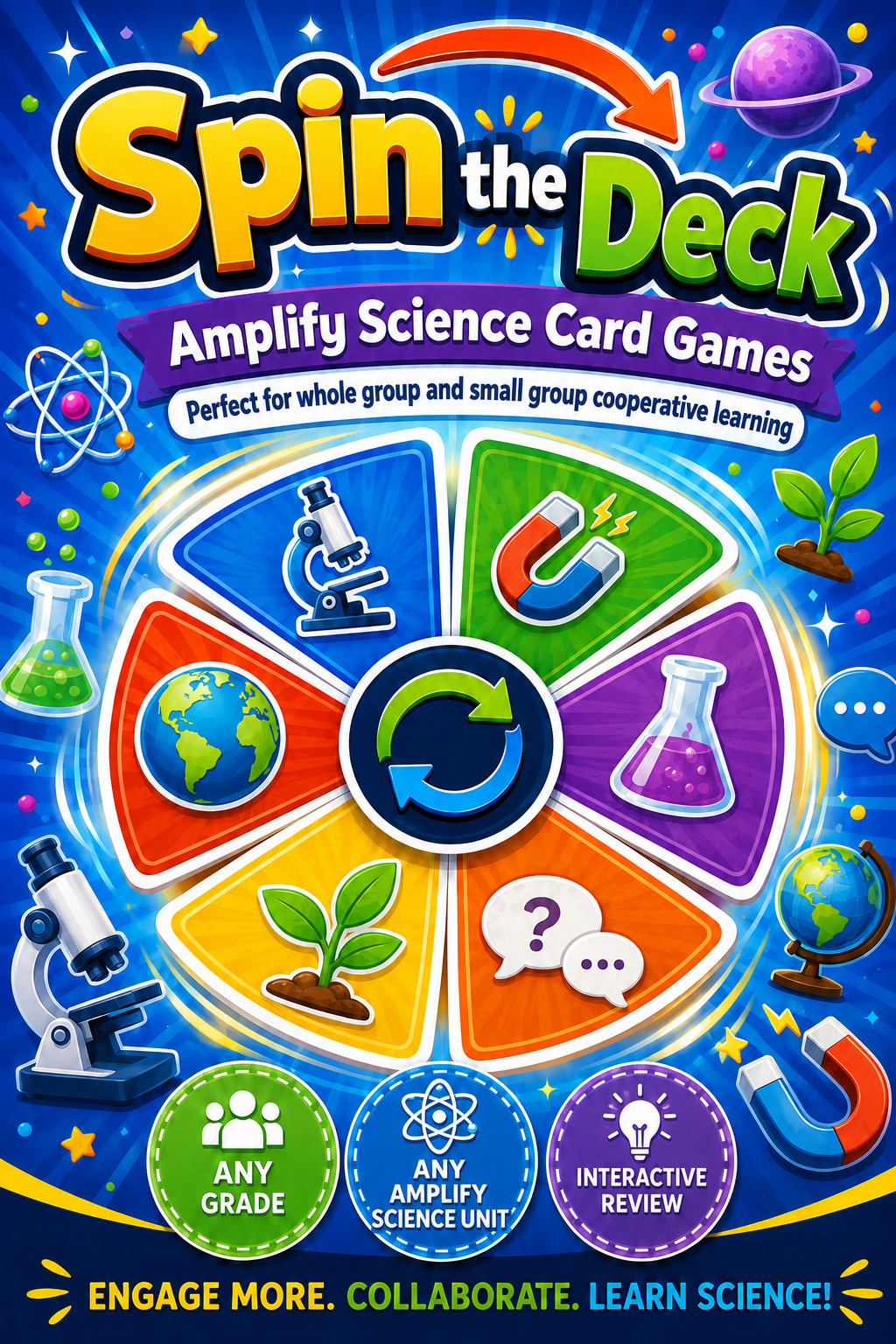
100 Interactive Science Review Cards | Cooperative Learning | Whole-Group & Small-Group Activities
SPIN THE DECK! ENGAGE MORE. COLLABORATE. DISCOVER THE POWERFUL FORCES THAT SHAPE OUR PLANET!
Turn Plate Tectonics, Earth's Layers, Earthquakes, Volcanoes, and Continental Movement into an Exciting Classroom Learning Experience!
What causes Earth's massive tectonic plates to move? Why do earthquakes and volcanoes occur in certain locations? How can fossils found on different continents provide evidence that landmasses were once connected? What happens when tectonic plates collide, separate, or slide past one another?
Bring these fascinating Earth science questions to life with Spin the Deck: Plate Motion!
Designed to complement the Grade 7 Amplify Science Plate Motion unit, this engaging collection of 100 multiple-choice science review cards helps students explore the dynamic processes that continually reshape Earth's surface.
Students investigate the structure of Earth's interior, the movement of tectonic plates, the formation of mountains and ocean trenches, and the scientific evidence supporting the theory of plate tectonics.
From understanding the differences among divergent, convergent, and transform boundaries to exploring how convection, slab pull, and ridge push contribute to plate movement, students develop a deeper understanding of the geological processes responsible for changing Earth's surface over millions of years.
The deck also introduces students to important scientific evidence, including fossil discoveries, seafloor spreading, magnetic patterns on the ocean floor, GPS measurements, and the ancient supercontinent Pangea.
Students connect these concepts to real-world geological features such as the San Andreas Fault, Himalayas, Mid-Atlantic Ridge, Pacific Ring of Fire, and Hawaiian volcanoes, discovering how the movement of Earth's plates explains the formation and location of many familiar landforms.
Move beyond traditional worksheets and transform Earth science review into an exciting cooperative learning experience where students answer questions, explain their thinking, analyze geological processes, and collaborate with classmates!
Perfect for whole-group science review, small-group cooperative learning, science centers, partner activities, intervention, enrichment, and unit assessment preparation, this versatile resource encourages active participation while reinforcing essential Earth science concepts.
Help your students become confident scientific thinkers, curious Earth science investigators, and enthusiastic collaborative learners!
What's Included?
- 100 numbered multiple-choice science review cards covering Grade 7 Plate Motion concepts
- Four answer choices per question to encourage careful reading and scientific reasoning
- Answers printed on the reverse side for immediate feedback and student self-checking
- 50 printable PDF pages designed for double-sided printing
- 25 double-sided sheets when printed back-to-back
- Four cards per sheet, creating 100 interactive review cards
- Colorful science-themed card designs featuring vibrant blue backgrounds, scientific illustrations, laboratory equipment, and clearly numbered question cards
- Questions addressing tectonic plates, Earth's interior, plate boundaries, continental drift, geological evidence, earthquakes, volcanoes, and landform formation
- Reusable review cards compatible with cooperative learning games, partner activities, and science centers
Easy Preparation: Print the PDF double-sided, cut apart the four cards on each sheet, and laminate for durability. Your interactive Plate Motion review deck is ready to use!
Science Concepts & Skills Covered
Earth's Layers & Internal Structure
Help students understand the different layers that make up our planet and their roles in geological processes.
Topics include:
- Earth's crust
- The mantle
- The lithosphere
- The asthenosphere
- Earth's inner core
- Earth's internal structure
- Temperature changes with depth
- Pressure changes with depth
- Earth's internal heat
- Interactions among Earth's layers
Students explore how Earth's outermost layers interact and why understanding the structure of the planet is essential for explaining tectonic movement.
Tectonic Plates & the Lithosphere
Investigate how Earth's outer layer is divided into massive sections that move slowly over time.
Topics include:
- Tectonic plates
- The lithosphere
- Earth's crust and uppermost mantle
- Plate movement
- Plate size
- Plate location
- Plate interactions
- Plate motion rates
- Major tectonic plates
- Earth's changing surface
Students discover that Earth's lithosphere is broken into large plates that move gradually, changing the positions of continents and ocean basins over geological time.
Types of Plate Boundaries
Explore the three major ways tectonic plates interact.
Topics include:
- Divergent boundaries
- Convergent boundaries
- Transform boundaries
- Plates moving apart
- Plates moving toward one another
- Plates sliding past one another
- Boundary interactions
- Geological processes
- Landform formation
- Plate motion patterns
Students learn to distinguish among the three major boundary types and explain how each produces different geological features.
Divergent Boundaries & Seafloor Spreading
Investigate what happens when tectonic plates move away from one another.
Topics include:
- Divergent plate boundaries
- Plates separating
- Seafloor spreading
- Mid-ocean ridges
- Rising magma
- New crust formation
- Rift valleys
- Continental rifting
- Ocean floor formation
- The Mid-Atlantic Ridge
Students discover how rising magma can create new crust and how the movement of plates away from one another contributes to the formation of ocean basins.
Convergent Boundaries & Plate Collisions
Help students understand what happens when tectonic plates move toward one another.
Topics include:
- Convergent boundaries
- Plate collisions
- Continental plate interactions
- Oceanic plate interactions
- Mountain formation
- Subduction
- Crustal deformation
- Plate density
- Geological changes
- The Himalayas
Students investigate how colliding tectonic plates can create enormous mountain ranges and other geological features.
Transform Boundaries & Fault Movement
Explore what happens when tectonic plates slide horizontally past one another.
Topics include:
- Transform boundaries
- Sliding plates
- Faults
- Friction
- Energy release
- Earthquakes
- Plate movement
- Transform faults
- Crustal movement
- The San Andreas Fault
Students discover how plates can become stuck along faults and how the sudden release of stored energy can produce earthquakes.
Subduction Zones & Ocean Trenches
Investigate how one tectonic plate can move beneath another.
Topics include:
- Subduction
- Oceanic crust
- Continental crust
- Plate density
- Descending plates
- Ocean trenches
- Convergent boundaries
- Crust recycling
- Volcanic activity
- Earth's mantle
Students explore why denser oceanic plates commonly descend beneath less dense plates and how this process contributes to the formation of trenches and volcanic regions.
Earth's Mantle & Convection
Help students understand how heat and differences in density influence movement within Earth's interior.
Topics include:
- Mantle convection
- Earth's internal heat
- Heating and cooling
- Density differences
- Hot mantle rock
- Cool mantle rock
- Rising material
- Sinking material
- Convection currents
- Plate movement
Students investigate how warmer material becomes less dense and tends to rise, while cooler, denser material tends to sink.
Forces That Drive Plate Motion
Explore the processes that contribute to the movement of Earth's tectonic plates.
Topics include:
- Slab pull
- Ridge push
- Gravity
- Plate density
- Mantle movement
- Subducting plates
- Mid-ocean ridges
- Earth's internal energy
- Plate interactions
- Slow geological movement
Students investigate how gravity and differences in density contribute to the forces that move tectonic plates.
Continental Drift & Pangea
Travel back millions of years to investigate how Earth's continents have changed position.
Topics include:
- Continental drift
- Pangea
- Ancient supercontinents
- Continental movement
- Plate tectonics
- Geological time
- Continental separation
- Reconstructing ancient landmasses
- Evidence of connected continents
- Earth's changing geography
Students discover how Pangea began breaking apart approximately 200 million years ago and how the movement of tectonic plates continues to reshape the planet.
Fossil Evidence & Continental Connections
Investigate how fossils provide clues about Earth's geological history.
Topics include:
- Fossils
- Ancient organisms
- Mesosaurus
- Glossopteris
- Fossil distribution
- Matching fossils
- Continental connections
- Ancient environments
- Scientific evidence
- Continental drift
Students explore why fossils of the same organisms found on widely separated continents provide evidence that those landmasses were once connected.
Oceanic Crust vs. Continental Crust
Compare the properties of Earth's two major types of crust.
Topics include:
- Oceanic crust
- Continental crust
- Crust thickness
- Crust density
- Basalt
- Granite
- Crust composition
- Plate interactions
- Subduction
- Earth's outer structure
Students investigate why oceanic crust is generally thinner and denser than continental crust and how these differences influence plate interactions.
Earthquakes & Faults
Explore how tectonic movement can cause sudden changes within Earth's crust.
Topics include:
- Earthquakes
- Faults
- Plate boundaries
- Stored energy
- Energy release
- Crustal movement
- Transform faults
- Geological activity
- Earthquake locations
- Plate interactions
Students discover why earthquakes occur frequently near plate boundaries and how movement along faults can release energy.
Volcanoes & Volcanic Activity
Investigate how volcanic activity is connected to plate movement and Earth's interior.
Topics include:
- Volcanoes
- Magma
- Lava
- Volcanic eruptions
- Subduction zones
- Divergent boundaries
- Hotspots
- Volcanic activity
- Earth's mantle
- Geological processes
Students explore how volcanoes form in different tectonic settings and why volcanic activity is concentrated in certain regions.
The Pacific Ring of Fire
Connect plate tectonics to one of Earth's most active geological regions.
Topics include:
- Pacific Ocean
- Ring of Fire
- Plate boundaries
- Subduction zones
- Volcanoes
- Earthquakes
- Ocean trenches
- Geological activity
- Tectonic interactions
- Volcanic regions
Students investigate why the Pacific Ocean is surrounded by many active volcanoes and earthquake zones.
Hotspots & the Hawaiian Islands
Explore how volcanoes can form away from plate boundaries.
Topics include:
- Volcanic hotspots
- Hawaii
- Intraplate volcanoes
- Magma
- Volcanic formation
- Plate movement
- Earth's mantle
- Volcanic islands
- Geological activity
- Hotspot locations
Students discover that volcanic activity can occur in the middle of tectonic plates, not only along plate boundaries.
Mountain Building & Geological Time
Investigate how enormous mountain ranges form through slow geological processes.
Topics include:
- Mountain formation
- Continental collisions
- Convergent boundaries
- The Himalayas
- Plate movement
- Crustal uplift
- Geological time
- Millions of years
- Continuing plate convergence
- Earth's changing surface
Students explore why mountains can take millions of years to form and how some mountain ranges continue to grow as tectonic plates converge.
Seafloor Evidence & Magnetic Patterns
Explore the scientific evidence that supports seafloor spreading and plate motion.
Topics include:
- Seafloor spreading
- Magnetic stripes
- Ocean floor patterns
- Mid-ocean ridges
- New crust formation
- Plate movement
- Geological evidence
- Oceanic crust
- Scientific observations
- Plate tectonics theory
Students discover how magnetic patterns preserved in oceanic crust provide evidence for seafloor spreading and the movement of tectonic plates.
GPS Measurements & Plate Movement
Investigate how modern technology helps scientists measure slow geological changes.
Topics include:
- GPS technology
- Plate movement measurements
- Changes in position
- Slow plate motion
- Scientific data
- Plate speed
- Plate direction
- Geological observations
- Modern measurement tools
- Evidence of tectonic movement
Students learn how scientists use GPS data to measure small changes in plate positions over time.
Scientific Models & Earth's Cross-Sections
Develop students' ability to interpret representations of Earth's interior and geological processes.
Topics include:
- Scientific models
- Earth cross-sections
- Geological diagrams
- Earth's layers
- Plate boundaries
- Plate interactions
- Geological processes
- Visual representations
- Scientific explanations
- Model limitations
Students investigate how scientists use models to visualize processes that are too large, too slow, or too difficult to observe directly.
Density, Temperature & Pressure
Strengthen students' understanding of physical properties that influence Earth's internal processes.
Topics include:
- Density
- Mass per unit volume
- Temperature
- Pressure
- Heating and cooling
- Material expansion
- Material contraction
- Mantle movement
- Rising and sinking materials
- Earth's interior
Students explore how density, temperature, and pressure help explain the behavior of materials within Earth.
Geological Systems & Interacting Parts
Help students recognize that plate tectonics involves many connected components.
Topics include:
- Geological systems
- Interacting parts
- Earth's layers
- Tectonic plates
- Plate boundaries
- Mantle movement
- Geological processes
- Cause-and-effect relationships
- Earth systems
- Scientific explanations
Students develop a systems-thinking approach to understanding how movement within Earth's interior influences changes at the surface.
Scientific Evidence & Reasoning
Build students' ability to use observations and measurements to support scientific explanations.
Topics include:
- Scientific evidence
- Observable data
- Measurable data
- Fossil evidence
- GPS measurements
- Magnetic seafloor patterns
- Scientific models
- Geological observations
- Scientific reasoning
- Supporting explanations
Students practice connecting scientific observations to explanations about continental movement, plate boundaries, and geological change.
Real-World Geological Features
Connect classroom learning to recognizable locations around the world.
Topics include:
- San Andreas Fault
- Himalayas
- Mid-Atlantic Ridge
- Pacific Ring of Fire
- Hawaiian volcanoes
- Pacific Plate
- African Plate
- Ocean trenches
- Rift valleys
- Mountain ranges
Students discover how plate tectonics explains many of the geological features found across Earth's surface.
Perfect for Whole-Group & Small-Group Cooperative Learning!
Whole-Group Interactive Science Review
Engage the entire class in meaningful discussions about Earth's layers, tectonic plate movement, geological evidence, and the formation of mountains, volcanoes, and earthquakes.
Fan-N-Pick
Students work in cooperative groups, taking turns selecting cards, reading questions, answering, and checking responses. This activity promotes participation, teamwork, and active listening.
Quiz-Quiz-Trade
Students pair up, quiz one another, check answers, exchange cards, and find new partners. This movement-based activity reinforces Earth science vocabulary and scientific concepts through repeated practice.
Science Centers & Stations
Create review stations focusing on Earth's layers, plate boundaries, continental drift, geological evidence, earthquakes, volcanoes, and landform formation.
Partner Review
Students take turns reading questions, selecting answers, explaining their reasoning, and checking responses on the reverse side.
Small-Group Plate Motion Challenges
Organize students into teams to compare plate boundary types, identify geological features, analyze evidence of continental movement, and explain how Earth's surface changes over time.
Spin & Answer Review Games
Combine the cards with a classroom spinner or teacher-created game structure to add excitement and friendly competition to science review.
Science Test Preparation
Help students revisit important plate tectonics vocabulary, geological processes, Earth science evidence, and scientific models before unit assessments.
Warm-Ups & Exit Tickets
Use selected cards to activate prior knowledge, encourage scientific discussions, or quickly assess understanding.
Science Intervention & Enrichment
Target specific concepts for additional practice or challenge students to explain more complex geological processes and relationships.
Early Finishers & Substitute Plans
Provide meaningful, low-preparation science activities that reinforce important Earth science concepts.
Why Teachers Will Love Spin the Deck!
Low-Prep and Ready to Use!
Simply print, cut, and laminate to create a reusable classroom resource.
Designed for Cooperative Learning!
Encourage students to communicate, collaborate, listen respectfully, and explain scientific ideas to classmates.
Promotes Active Student Engagement!
Transform traditional science review into an interactive experience involving discussion, movement, teamwork, and problem-solving.
Reinforces Amplify Science Concepts!
Review essential vocabulary and scientific ideas connected to the Grade 7 Plate Motion unit.
Builds Scientific Reasoning!
Students strengthen their ability to compare plate boundaries, interpret geological evidence, explain landform formation, and connect observations to scientific explanations.
Provides Immediate Feedback!
Answers on the reverse side allow students to check their understanding during independent, partner, and group activities.
Supports Differentiated Instruction!
Select questions based on student readiness, target specific concepts, or extend learning through additional scientific discussions.
Connects Science to Real-World Phenomena!
Students investigate the geological processes responsible for familiar features such as the Himalayas, San Andreas Fault, Pacific Ring of Fire, and Hawaiian volcanoes.
Challenges Common Misconceptions!
Help students understand that tectonic plates are constantly moving, that geological changes often occur over millions of years, and that earthquakes and volcanoes are closely connected to Earth's dynamic structure.
Reusable Year After Year!
Laminate the cards to create a durable classroom resource that supports repeated review and cooperative learning.
Sample Spin the Deck Questions
Here are eight actual questions from this collection:
Question 1: What is the "lithosphere"?
Answer: The crust and uppermost mantle.
Question 2: Earth's outer layer is broken into:
Answer: Large sections called plates.
Question 3: What is the "mantle"?
Answer: The layer under the plates.
Question 4: The plates "float" on top of the:
Answer: Soft, hot rock of the mantle.
Question 5: How fast do tectonic plates move?
Answer: Inches per year.
Question 6: A "divergent" boundary occurs when:
Answer: Plates move apart.
Question 7: A "convergent" boundary occurs when:
Answer: Plates move toward each other.
Question 8: What is a "transform" boundary?
Answer: Plates slide past each other.
These questions reinforce essential scientific vocabulary while encouraging students to investigate tectonic movement, compare plate boundary interactions, and explain how geological processes change Earth's surface.
Transform Plate Motion Review into an Exciting Learning Experience!
Earth's surface is constantly changing, even when those changes are too slow for us to notice. From enormous mountain ranges and deep ocean trenches to powerful earthquakes and volcanic eruptions, the movement of tectonic plates provides fascinating opportunities for scientific discovery.
With 100 Spin the Deck Plate Motion review cards, students can investigate how Earth's layers interact, why tectonic plates move, how different plate boundaries produce geological features, and what scientific evidence reveals about our planet's history.
Imagine students enthusiastically selecting cards, comparing plate boundaries, explaining how mountains form, identifying evidence of continental drift, and collaborating to solve Earth science challenges.
Whether you're reviewing lessons, preparing for assessments, reinforcing vocabulary, or creating collaborative learning opportunities, Spin the Deck transforms plate tectonics review into an exciting, student-centered learning experience.
One deck. 100 questions. Endless opportunities to explore the forces that shape our planet!
SPIN THE DECK! ENGAGE MORE. COLLABORATE. LEARN SCIENCE!
Add Spin the Deck: Plate Motion to your classroom toolkit and inspire confident, curious, and collaborative young Earth scientists!
Important Curriculum Disclaimer
This independently created resource is designed to supplement the Amplify Science curriculum. It is not affiliated with, sponsored by, authorized by, or endorsed by Amplify Education, Inc. Amplify and Amplify Science are trademarks of their respective owner. No affiliation or endorsement is implied.
This product is a supplemental classroom review activity and is not a replacement for official Amplify Science curriculum materials, lessons, assessments, or instructional resources.
- Grade 7
- Instant digital download
- Print & reuse in class