Spin the Deck – Grade 8 Amplify Science: Chemical Reactions
$5.00
Transform Chemical Reactions, Atomic Rearrangement, Conservation of Matter, and Scientific Investigation into an Exciting Classroom Learning Experience!
What happens to atoms during a chemical reaction? How can scientists determine whether a new substance has formed? Why does iron rust? Can matter ever disappear during a chemical reaction?
Bring these fascinating chemistry questions to life with Spin the Deck: Chemical Reactions!
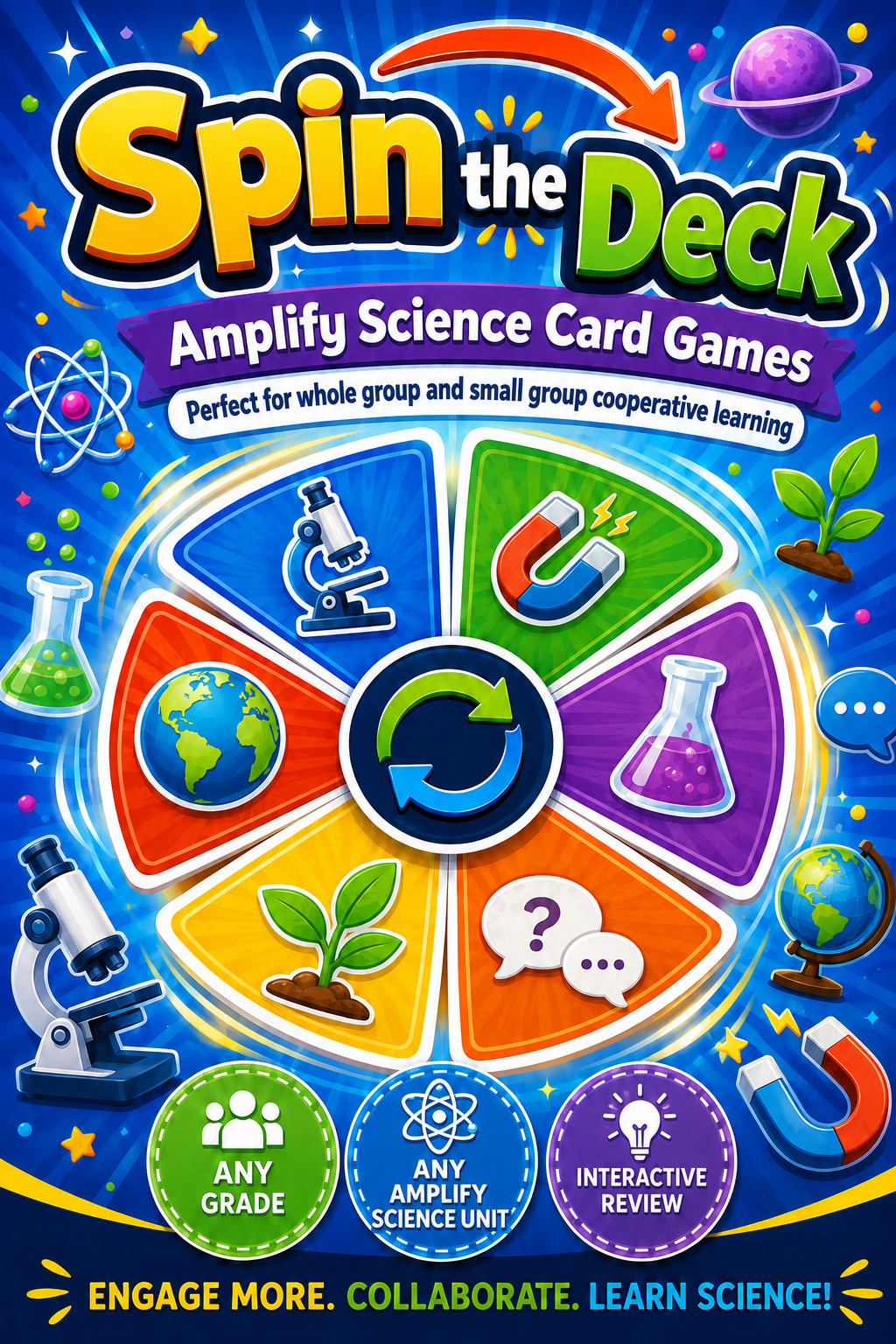
Designed to complement the Grade 8 Amplify Science Chemical Reactions unit, this engaging collection of 100 multiple-choice science review cards helps students investigate the fundamental principles of chemistry while strengthening their understanding of how substances interact, change, and form new materials.
Students explore the relationships among atoms, molecules, reactants, products, chemical properties, physical properties, chemical formulas, atomic rearrangement, and the Law of Conservation of Matter as they discover what happens at the microscopic level during chemical reactions.
From investigating why rust forms on iron pipes to exploring how atoms rearrange during combustion, students learn that chemical reactions produce new substances with different properties while conserving the atoms involved.
The deck challenges students to distinguish chemical changes from physical changes, recognize evidence of chemical reactions, interpret chemical formulas, identify reactants and products, and apply conservation principles to real-world situations.
Students also investigate open and closed systems, mass conservation, chemical bonds, energy transfer, precipitation reactions, solubility, density, flammability, and chemical equations.
With connections to rusting pipes, burning candles, hydroponics, synthetic substances, and laboratory investigations, students discover how chemistry explains changes in everyday materials.
Students strengthen their scientific reasoning skills through questions involving claims, evidence, reasoning, scientific models, simulations, controlled experiments, and macroscopic versus microscopic observations.
Move beyond traditional worksheets and transform chemistry review into an exciting cooperative learning experience where students answer questions, explain their thinking, investigate chemical phenomena, and collaborate with classmates!
Perfect for whole-group science review, small-group cooperative learning, science centers, partner activities, intervention, enrichment, and unit assessment preparation, this versatile resource encourages active participation while reinforcing essential chemistry concepts.
Help your students become confident scientific thinkers, curious chemistry investigators, and enthusiastic collaborative learners!
What's Included?
- 100 numbered multiple-choice science review cards covering Grade 8 Chemical Reactions concepts
- Four answer choices per question to encourage careful reading, scientific reasoning, and critical thinking
- Answers printed on the reverse side for immediate feedback and student self-checking
- 50 printable PDF pages designed for double-sided printing
- 25 double-sided sheets when printed back-to-back
- Four cards per sheet, creating 100 interactive review cards
- Colorful science-themed card designs featuring vibrant blue backgrounds, laboratory equipment, molecules, scientific illustrations, and clearly numbered question cards
- Questions addressing atoms, molecules, substances, chemical reactions, conservation of matter, chemical formulas, properties, scientific models, and experimental evidence
- Reusable review cards compatible with cooperative learning games, partner activities, and science centers
Easy Preparation: Print the PDF double-sided, cut apart the four cards on each sheet, and laminate for durability. Your interactive Chemical Reactions review deck is ready to use!
Science Concepts & Skills Covered
Substances & the Nature of Matter
Help students understand what substances are and how they differ from mixtures and other forms of matter.
Topics include:
- Substances
- Matter
- Atoms
- Molecules
- Elements
- Compounds
- Chemical composition
- Types of substances
- Identifying materials
- Properties of matter
Students learn that substances consist of specific types of atoms or molecules and can be identified through their characteristic properties.
Atoms: The Building Blocks of Matter
Introduce students to the microscopic particles that make up all matter.
Topics include:
- Atoms
- Elements
- Atomic structure
- Matter
- Building blocks of substances
- Types of atoms
- Conservation of atoms
- Atomic rearrangement
- Chemical composition
- Scientific models
Students discover that atoms are the tiny building blocks of matter and that chemical reactions rearrange existing atoms rather than create or destroy them.
Molecules & Chemical Bonds
Explore how atoms combine to form molecules.
Topics include:
- Molecules
- Chemical bonds
- Joined atoms
- Molecular structure
- Chemical composition
- Bond breaking
- Bond formation
- Atomic rearrangement
- Chemical reactions
- Molecular models
Students investigate how atoms join together and how chemical bonds can break and form during reactions.
Chemical Reactions & New Substances
Help students understand what makes a chemical reaction different from other changes.
Topics include:
- Chemical reactions
- New substances
- Reactants
- Products
- Atomic rearrangement
- Chemical changes
- Substance properties
- Chemical bonds
- Evidence of reactions
- Changes in matter
Students discover that chemical reactions involve the rearrangement of atoms to form substances with different chemical identities.
Reactants & Products
Introduce the starting and ending substances involved in chemical reactions.
Topics include:
- Reactants
- Products
- Starting substances
- Ending substances
- Chemical equations
- Chemical changes
- Atomic rearrangement
- Reaction diagrams
- Conservation of atoms
- Identifying reaction components
Students learn to distinguish reactants from products and identify their positions in chemical equations.
Atomic Rearrangement During Reactions
Explore what happens to atoms when substances undergo chemical changes.
Topics include:
- Rearrangement of atoms
- Breaking bonds
- Forming bonds
- Reactants
- Products
- New molecules
- Chemical composition
- Conservation of atoms
- Chemical equations
- Molecular models
Students investigate how atoms detach and reattach in different arrangements to produce new substances.
Law of Conservation of Matter
Reinforce one of the most important principles in chemistry.
Topics include:
- Conservation of matter
- Conservation of mass
- Conservation of atoms
- Chemical reactions
- Reactants and products
- Closed systems
- Matter preservation
- Atomic quantities
- Mass calculations
- Scientific laws
Students discover that matter cannot be created or destroyed during ordinary chemical reactions and that the number of atoms of each element must remain the same.
Mass & Quantitative Reasoning
Help students connect chemical reactions to measurable quantities.
Topics include:
- Mass
- Matter
- Grams
- Reactant mass
- Product mass
- Conservation calculations
- Measuring substances
- Closed systems
- Mass comparisons
- Scientific evidence
Students practice using mass relationships to predict the total mass of products in chemical reactions.
Open & Closed Systems
Explore how system boundaries influence observations of matter.
Topics include:
- Open systems
- Closed systems
- Conservation of mass
- Escaping gases
- Matter entering systems
- Matter leaving systems
- Reactants
- Products
- Mass measurements
- Experimental observations
Students investigate why the measured mass of materials in an open container may decrease when gases escape, even though matter is conserved overall.
Physical Changes vs. Chemical Changes
Help students recognize the difference between changes in physical state and changes that produce new substances.
Topics include:
- Physical changes
- Chemical changes
- Phase changes
- Boiling
- Melting
- Burning
- Rusting
- New substance formation
- Atomic rearrangement
- Identifying changes
Students learn that boiling water is a physical change while rusting iron and burning wood involve chemical reactions.
Physical Properties of Substances
Introduce measurable and observable characteristics used to identify materials.
Topics include:
- Physical properties
- Density
- Boiling point
- Solubility
- Color
- Conductivity
- Identifying substances
- Comparing materials
- Characteristic properties
- Scientific observations
Students investigate how scientists use physical properties to distinguish substances that may appear similar.
Chemical Properties & Flammability
Explore properties that describe how substances behave during chemical reactions.
Topics include:
- Chemical properties
- Flammability
- Combustion
- Burning
- Reactivity
- Chemical changes
- Energy release
- Substance identification
- Chemical behavior
- Material properties
Students discover that flammability describes a substance's ability to burn and is an example of a chemical property.
Density & Substance Identification
Help students understand why density is useful when identifying materials.
Topics include:
- Density
- Mass
- Volume
- Characteristic properties
- Substance identification
- Comparing liquids
- Physical properties
- Material composition
- Measurements
- Scientific investigations
Students explore how density can help distinguish substances, including clear liquids that look alike.
Boiling Point & Solubility
Investigate additional properties used to identify substances.
Topics include:
- Boiling point
- Solubility
- Dissolving
- Liquids
- Physical properties
- Substance comparison
- Material identification
- Phase changes
- Laboratory testing
- Scientific evidence
Students learn how boiling point and solubility provide useful information about the characteristics of different substances.
Chemical Formulas & Atomic Composition
Help students interpret the symbols and numbers used to represent chemical substances.
Topics include:
- Chemical formulas
- Element symbols
- Atomic composition
- Subscripts
- Molecules
- Compounds
- Carbon dioxide
- Water
- Glucose
- Counting atoms
Students investigate how chemical formulas communicate the types and numbers of atoms in substances.
Subscripts & Counting Atoms
Strengthen students' ability to interpret chemical notation.
Topics include:
- Subscripts
- Chemical formulas
- Atomic quantities
- Element symbols
- Molecules
- Coefficients
- Counting atoms
- Hydrogen molecules
- Carbon dioxide
- Molecular composition
Students practice determining the number of atoms represented by formulas such as H₂O, CO₂, C₆H₁₂O₆, and 2H₂.
Chemical Equations & Reaction Symbols
Introduce the basic structure of chemical equations.
Topics include:
- Chemical equations
- Reactants
- Products
- Reaction arrows
- Chemical symbols
- Atomic rearrangement
- Chemical formulas
- Equation interpretation
- Reaction representation
- Conservation of atoms
Students learn that reactants appear on the left side of a reaction arrow while products appear on the right.
Atomic Ratios & Molecular Composition
Explore how the relative numbers of different atoms influence chemical identity.
Topics include:
- Atomic ratios
- Molecular composition
- Chemical formulas
- Types of atoms
- Numbers of atoms
- Chemical identity
- Molecules
- Compounds
- Chemical rearrangement
- Substance properties
Students discover that changing the number or arrangement of atoms in a molecule can result in a different substance.
Evidence of Chemical Reactions
Help students recognize observations that may indicate chemical changes.
Topics include:
- Color changes
- Gas formation
- Precipitate formation
- New substances
- Changes in properties
- Chemical evidence
- Laboratory observations
- Chemical reactions
- Scientific explanations
- Reaction identification
Students investigate how changes in observable properties can provide evidence that a chemical reaction has occurred.
Precipitates & Solid Formation
Explore how chemical reactions can produce solids from solutions.
Topics include:
- Precipitates
- Solid formation
- Liquid reactions
- New substances
- Chemical changes
- Observable evidence
- Reaction products
- Solubility
- Laboratory investigations
- Substance properties
Students discover that a precipitate is a solid formed during a reaction involving substances in solution.
Gas Production & Chemical Reactions
Investigate how gas formation can provide evidence of chemical changes.
Topics include:
- Gas production
- Bubbles
- Chemical reactions
- New substances
- Open systems
- Escaping gases
- Mass measurements
- Observable evidence
- Reaction products
- Laboratory investigations
Students explore how gas production can indicate a chemical reaction and why escaping gases affect mass measurements in open containers.
Rusting Iron & Chemical Changes
Connect chemistry concepts to a real-world phenomenon featured in the unit.
Topics include:
- Rusting iron
- Iron oxide
- Oxygen
- Water
- Chemical reactions
- New substances
- Substance properties
- Atomic rearrangement
- Chemical evidence
- Rusting pipes
Students investigate how iron reacts with substances in its environment to form rust and change the properties of the original material.
Combustion & Burning
Explore chemical reactions that release energy.
Topics include:
- Combustion
- Burning
- Oxygen
- Fuel
- Reactants
- Products
- Energy release
- Chemical changes
- Flammability
- Burning candles
Students discover that burning is a chemical reaction involving the rearrangement of atoms and the transfer of energy.
Energy Transfer in Chemical Reactions
Help students understand the relationship between chemical bonds and energy.
Topics include:
- Energy transfer
- Chemical bonds
- Bond breaking
- Bond formation
- Combustion
- Energy release
- Chemical reactions
- Reactants
- Products
- Changes in matter
Students investigate how energy is involved when chemical bonds break and new bonds form.
Elements, Compounds & Synthetic Substances
Introduce students to different categories of materials.
Topics include:
- Elements
- Carbon
- Oxygen
- Nitrogen
- Compounds
- Sodium chloride
- Synthetic substances
- Human-made materials
- Chemical composition
- Substance classification
Students distinguish elements from compounds and explore how synthetic substances are produced.
Carbon & Organic Molecules
Explore the importance of carbon in chemical composition.
Topics include:
- Carbon
- Elements
- Organic molecules
- Atomic composition
- Chemical formulas
- Molecules
- Chemical identity
- Compounds
- Types of atoms
- Chemical structures
Students learn that carbon is an essential component of organic molecules.
Macroscopic & Microscopic Observations
Help students connect visible chemical changes to processes occurring at the atomic level.
Topics include:
- Macroscopic observations
- Microscopic models
- Color changes
- Atomic rearrangement
- Observable evidence
- Molecules
- Chemical bonds
- Scientific explanations
- Reaction models
- Chemical changes
Students distinguish between visible observations, such as a color change, and microscopic explanations involving atoms and molecules.
Scientific Models & Simulations
Explore how scientists investigate processes too small to observe directly.
Topics include:
- Scientific models
- Atomic models
- Molecular models
- Simulations
- Chemical reactions
- Atomic rearrangement
- Chemical bonds
- Predicting outcomes
- Testing explanations
- Scientific investigations
Students discover how models and simulations help scientists visualize and investigate the behavior of atoms during reactions.
Scientific Claims, Evidence & Reasoning
Develop students' ability to support scientific explanations.
Topics include:
- Scientific claims
- Evidence
- Reasoning
- Observations
- Experimental data
- Supporting explanations
- Refuting claims
- Scientific arguments
- Chemical investigations
- Evaluating conclusions
Students practice identifying evidence, supporting scientific claims, and recognizing when observations contradict an explanation.
Controlled Experiments & Scientific Investigation
Strengthen students' understanding of experimental design.
Topics include:
- Controlled experiments
- Control groups
- Comparison standards
- Scientific investigations
- Observations
- Data collection
- Experimental evidence
- Variables
- Scientific models
- Testing explanations
Students learn how a control provides a standard for comparison when investigating chemical phenomena.
Real-World Chemistry & the Hydroponics Mystery
Connect chemical reactions to authentic scientific investigations.
Topics include:
- Hydroponics
- Fertilizer
- Chemical substances
- Reactants
- Scientific evidence
- Identifying materials
- Chemical mysteries
- Real-world applications
- Scientific reasoning
- Experimental observations
Students connect chemistry vocabulary and reasoning to the hydroponics mystery referenced in the review cards.
Perfect for Whole-Group & Small-Group Cooperative Learning!
Whole-Group Interactive Science Review
Engage the entire class in meaningful discussions about chemical reactions, atomic rearrangement, chemical properties, conservation of matter, and scientific evidence.
Fan-N-Pick
Students work in cooperative groups, taking turns selecting cards, reading questions, answering, and checking responses. This activity promotes participation, teamwork, and active listening.
Quiz-Quiz-Trade
Students pair up, quiz one another, check answers, exchange cards, and find new partners. This movement-based activity reinforces chemistry vocabulary and scientific concepts through repeated practice.
Science Centers & Stations
Create review stations focusing on atoms and molecules, reactants and products, chemical properties, conservation of matter, chemical formulas, and scientific investigations.
Partner Review
Students take turns reading questions, selecting answers, explaining their reasoning, and checking responses on the reverse side.
Small-Group Chemistry Challenges
Organize students into teams to investigate chemical changes, interpret formulas, calculate conserved mass, identify evidence of reactions, and explain atomic rearrangement.
Spin & Answer Review Games
Combine the cards with a classroom spinner or teacher-created game structure to add excitement and friendly competition to science review.
Science Test Preparation
Help students revisit important chemistry vocabulary, atomic processes, scientific evidence, and conservation principles before unit assessments.
Warm-Ups & Exit Tickets
Use selected cards to activate prior knowledge, encourage scientific discussions, or quickly assess understanding.
Science Intervention & Enrichment
Target specific concepts for additional practice or challenge students to explain more complex relationships among atoms, molecules, and chemical reactions.
Early Finishers & Substitute Plans
Provide meaningful, low-preparation science activities that reinforce essential chemistry concepts.
Why Teachers Will Love Spin the Deck!
Low-Prep and Ready to Use!
Simply print, cut, and laminate to create a reusable classroom resource.
Designed for Cooperative Learning!
Encourage students to communicate, collaborate, listen respectfully, and explain scientific ideas to classmates.
Promotes Active Student Engagement!
Transform traditional science review into an interactive experience involving discussion, movement, teamwork, and problem-solving.
Reinforces Amplify Science Concepts!
Review essential vocabulary and scientific ideas connected to the Grade 8 Chemical Reactions unit.
Builds Scientific Reasoning!
Students strengthen their ability to interpret chemical formulas, identify reaction evidence, explain atomic rearrangement, and apply conservation principles.
Provides Immediate Feedback!
Answers on the reverse side allow students to check their understanding during independent, partner, and group activities.
Supports Differentiated Instruction!
Select questions based on student readiness, target specific concepts, or extend learning through additional scientific discussions.
Connects Chemistry to Real-World Phenomena!
Students investigate rusting pipes, combustion, chemical changes, laboratory reactions, and familiar materials.
Challenges Common Misconceptions!
Help students understand that atoms are not destroyed during chemical reactions, that physical changes do not necessarily produce new substances, and that mass remains conserved even when gases escape an open container.
Reusable Year After Year!
Laminate the cards to create a durable classroom resource that supports repeated review and cooperative learning.
Sample Spin the Deck Questions
Here are eight actual questions from this collection:
Question 1: What is a "substance"?
Answer: Matter made of only one type of atom or molecule.
Question 2: What is a "chemical reaction"?
Answer: A process where atoms rearrange to form new substances.
Question 3: In a chemical reaction, the starting substances are:
Answer: Reactants.
Question 4: In a chemical reaction, the ending substances are:
Answer: Products.
Question 5: What are "atoms"?
Answer: The tiny building blocks of matter.
Question 6: A "molecule" is a group of:
Answer: Two or more atoms joined together.
Question 7: Which is a sign of a chemical reaction?
Answer: Formation of a new substance.
Question 8: What is "rearrangement" in a reaction?
Answer: Atoms detaching and reattaching in new ways.
These questions reinforce essential scientific vocabulary while encouraging students to explain chemical processes, recognize evidence of reactions, and understand how matter changes at the atomic level.
Transform Chemical Reactions Review into an Exciting Learning Experience!
Chemical reactions occur all around us, from the rusting of metal to the burning of fuel, the formation of new materials, and countless changes in everyday substances.
Understanding these processes requires students to investigate the behavior of atoms, recognize evidence of chemical changes, and apply scientific principles to explain how substances interact.
With 100 Spin the Deck Chemical Reactions review cards, students can investigate how atoms rearrange, why new substances form, how mass remains conserved, and what scientific evidence reveals about chemical changes.
Imagine students enthusiastically selecting cards, interpreting chemical formulas, identifying reactants and products, explaining conservation of matter, and collaborating to solve chemistry challenges.
Whether you're reviewing lessons, preparing for assessments, reinforcing vocabulary, or creating collaborative learning opportunities, Spin the Deck transforms chemistry review into an exciting, student-centered learning experience.
One deck. 100 questions. Endless opportunities to explore the science of chemical reactions!
SPIN THE DECK! ENGAGE MORE. COLLABORATE. LEARN SCIENCE!
Add Spin the Deck: Chemical Reactions to your classroom toolkit and inspire confident, curious, and collaborative young chemists!
Important Curriculum Disclaimer
This independently created resource is designed to supplement the Amplify Science curriculum. It is not affiliated with, sponsored by, authorized by, or endorsed by Amplify Education, Inc. Amplify and Amplify Science are trademarks of their respective owner. No affiliation or endorsement is implied.
This product is a supplemental classroom review activity and is not a replacement for official Amplify Science curriculum materials, lessons, assessments, or instructional resources.
- Grade 8
- Instant digital download
- Print & reuse in class