Spin the Deck – Grade 8 Amplify Science: Evolutionary History
$5.00
Spin the Deck – Grade 8 Amplify Science: Evolutionary History
100 Interactive Science Review Cards | Cooperative Learning | Whole-Group & Small-Group Activities
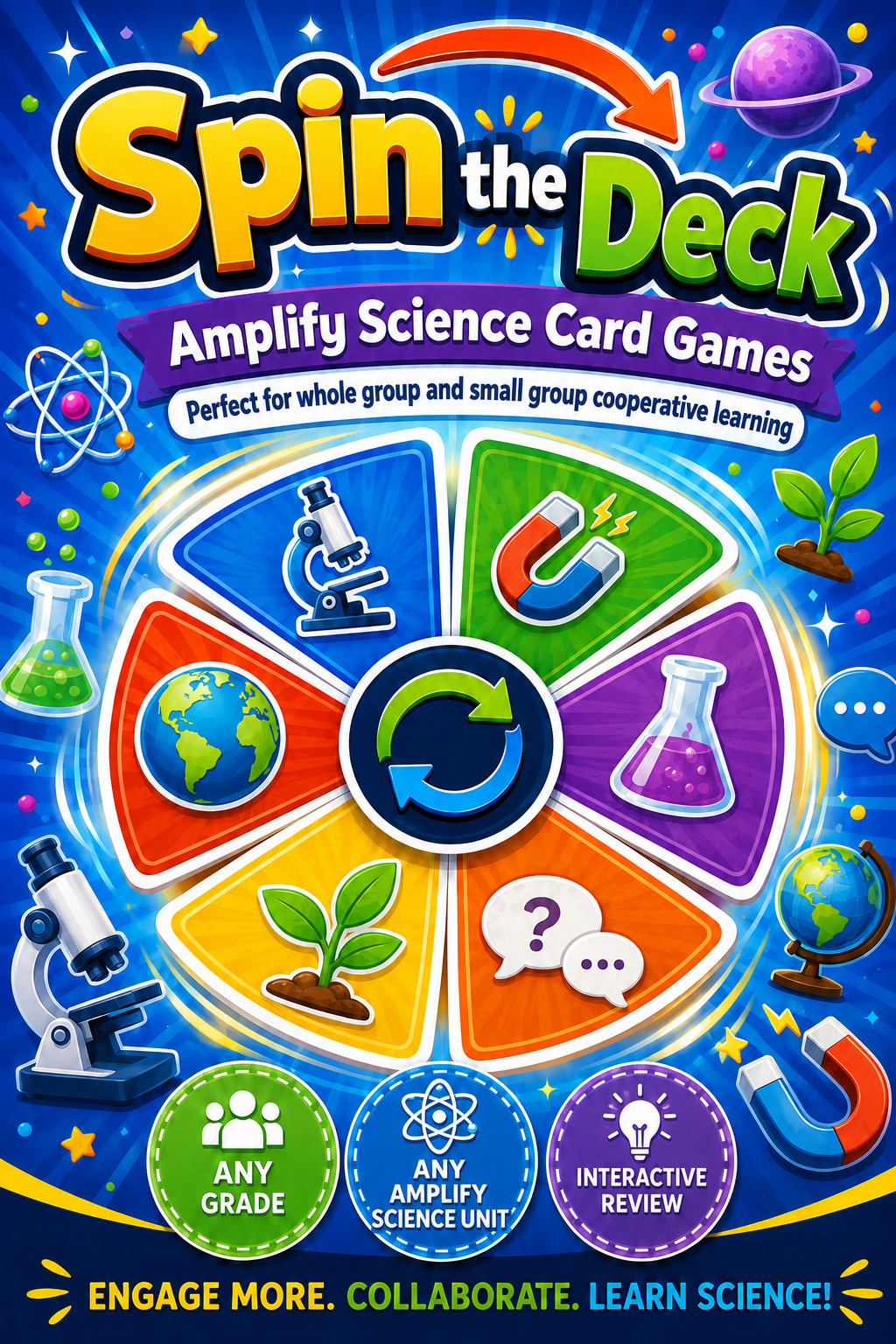
SPIN THE DECK! ENGAGE MORE. COLLABORATE. DISCOVER THE HISTORY OF LIFE ON EARTH!
Transform Fossils, Common Ancestry, Evolutionary Relationships, and the History of Life into an Exciting Classroom Learning Experience!
How do scientists know what organisms lived millions of years ago? Why do humans and bats have similar bone structures? What can fossils reveal about extinct species? How can DNA help scientists uncover evolutionary relationships?
Bring these fascinating scientific questions to life with this exciting interactive Evolutionary History review game!
Designed to complement the Grade 8 Amplify Science Evolutionary History unit, this engaging collection of 100 multiple-choice science review cards helps students investigate the evidence scientists use to reconstruct the history of life on Earth while strengthening their understanding of evolution, common ancestry, and biodiversity.
Students explore the relationships among fossils, the fossil record, common ancestors, descendants, homologous structures, comparative anatomy, DNA evidence, speciation, extinction, and evolutionary change as they discover how organisms have changed over billions of years.
From investigating why whales have hip bones to examining the similarities between human arms and bat wings, students discover how shared anatomical structures provide important evidence of common ancestry.
The deck challenges students to interpret fossil evidence, compare anatomical structures, recognize evolutionary relationships, understand branching diagrams, and explain how scientists use multiple sources of evidence to reconstruct the evolutionary history of organisms.
Students also investigate relative dating, radiometric dating, sedimentary rock, transitional fossils, natural selection, adaptation, geologic time, mass extinction, evolutionary lineages, and the Tree of Life.
With connections to ancient organisms, fossil discoveries, mammal and reptile evolution, the Cambrian Explosion, and the diversity of life on Earth, students discover how scientists develop explanations about organisms that lived long before humans existed.
Students strengthen their scientific reasoning skills through questions involving scientific evidence, evolutionary models, simulations, DNA comparisons, anatomical similarities, and interpreting the fossil record.
Move beyond traditional worksheets and transform evolutionary science review into an exciting cooperative learning experience where students answer questions, explain their thinking, investigate scientific evidence, and collaborate with classmates!
Perfect for whole-group science review, small-group cooperative learning, science centers, partner activities, intervention, enrichment, and unit assessment preparation, this versatile resource encourages active participation while reinforcing essential evolutionary science concepts.
Help your students become confident scientific thinkers, curious evolutionary investigators, and enthusiastic collaborative learners!
What's Included?
- 100 numbered multiple-choice science review cards covering Grade 8 Evolutionary History concepts
- Four answer choices per question to encourage careful reading, scientific reasoning, and critical thinking
- Answers printed on the reverse side for immediate feedback and student self-checking
- 50 printable PDF pages designed for double-sided printing
- 25 double-sided sheets when printed back-to-back
- Four cards per sheet, creating 100 interactive review cards
- Colorful science-themed card designs featuring vibrant blue backgrounds, scientific equipment, laboratory illustrations, and clearly numbered question cards
- Questions addressing fossils, common ancestry, evolutionary relationships, comparative anatomy, DNA evidence, natural selection, extinction, and scientific models
- Reusable review cards compatible with cooperative learning games, partner activities, and science centers
Easy Preparation: Print the PDF double-sided, cut apart the four cards on each sheet, and laminate for durability. Your interactive Evolutionary History review deck is ready to use!
Science Concepts & Skills Covered
Evolutionary History & the History of Life
Help students understand how life on Earth has changed over billions of years.
Topics include:
- Evolutionary history
- Evolution
- Ancient organisms
- Changes in life over time
- Common ancestry
- Descendants
- Evolutionary relationships
- Biodiversity
- Geologic time
- The history of life on Earth
Students investigate how scientists reconstruct the history of life using evidence from fossils, DNA, and anatomical structures.
Fossils & the Fossil Record
Explore how preserved remains and traces of ancient organisms provide evidence of Earth's biological history.
Topics include:
- Fossils
- Fossil formation
- Fossil evidence
- Ancient organisms
- Preserved footprints
- Fossil records
- Extinct organisms
- Sedimentary rock
- Fossil discoveries
- Changes in organisms over time
Students discover how fossils help scientists investigate organisms that lived millions of years ago.
Fossilization & Preservation
Help students understand how fossils form and why fossilization is uncommon.
Topics include:
- Fossilization
- Preservation
- Hard body parts
- Bones
- Shells
- Rapid burial
- Sediment
- Fossil formation
- Rare preservation events
- Incomplete fossil records
Students investigate why organisms with hard body parts and rapid burial conditions are more likely to become fossils.
Relative Dating & Radiometric Dating
Introduce students to scientific methods used to investigate the ages of fossils.
Topics include:
- Relative dating
- Radiometric dating
- Absolute dating
- Fossil ages
- Rock layers
- Sedimentary rock
- Older fossils
- Younger fossils
- Geologic time
- Scientific dating methods
Students learn how scientists determine whether fossils are older or younger than others and how radiometric dating can provide numerical age estimates.
Rock Layers & Fossil Evidence
Explore how the location of fossils within rock layers helps scientists reconstruct Earth's history.
Topics include:
- Sedimentary rock
- Rock layers
- Fossil positions
- Deeper layers
- Older fossils
- Relative ages
- Fossil succession
- Geological evidence
- Erosion
- Earth's history
Students investigate why fossils found in deeper, undisturbed sedimentary layers are generally older than fossils found in layers above them.
Common Ancestry & Evolutionary Relationships
Help students understand how different species can descend from shared ancestors.
Topics include:
- Common ancestors
- Descendants
- Related species
- Shared ancestry
- Evolutionary relationships
- Ancestral organisms
- Shared structures
- Evolutionary lineages
- Divergence
- The Tree of Life
Students discover how similarities among organisms provide evidence of shared evolutionary histories.
Homologous Structures & Shared Anatomy
Explore how similar body structures provide evidence of common ancestry.
Topics include:
- Homologous structures
- Shared structures
- Comparative anatomy
- Limb bones
- Skeletal similarities
- Common ancestry
- Vertebrates
- Body structures
- Evolutionary relationships
- Anatomical evidence
Students investigate why humans and bats have similar arm and wing bones despite using these structures for different purposes.
Comparative Anatomy
Introduce students to the scientific practice of comparing body structures among species.
Topics include:
- Comparative anatomy
- Anatomical similarities
- Skeletal structures
- Body plans
- Shared traits
- Homologous structures
- Related organisms
- Common ancestors
- Evolutionary evidence
- Structural comparisons
Students learn how scientists compare anatomical features to investigate evolutionary relationships.
Vestigial Structures & Evolutionary Evidence
Help students understand how inherited body structures can reveal evolutionary history.
Topics include:
- Vestigial structures
- Inherited traits
- Ancestral structures
- Whale hip bones
- Land-dwelling ancestors
- Common ancestry
- Evolutionary changes
- Body structures
- Anatomical evidence
- Evolutionary relationships
Students investigate how the presence of hip bones in whales provides evidence of their evolutionary connection to land-dwelling ancestors.
DNA & Molecular Evidence
Explore how genetic information helps scientists investigate relationships among organisms.
Topics include:
- DNA
- Genetic information
- Molecular evidence
- Protein sequences
- Genetic similarities
- Genetic differences
- Common ancestry
- Evolutionary divergence
- Related species
- Genetic comparisons
Students discover how similarities in DNA and protein sequences can provide evidence of evolutionary relationships.
Embryology & Early Development
Investigate how similarities during early development can reveal shared ancestry.
Topics include:
- Embryology
- Embryos
- Early development
- Developmental similarities
- Ancestral genes
- Common ancestry
- Related organisms
- Evolutionary evidence
- Shared developmental patterns
- Biological relationships
Students explore how similarities in early development can provide clues about the evolutionary relationships among organisms.
Branching Diagrams & Cladograms
Help students interpret visual representations of evolutionary relationships.
Topics include:
- Branching diagrams
- Cladograms
- Common ancestors
- Evolutionary relationships
- Branch points
- Shared ancestry
- Descendants
- Species divergence
- Evolutionary trees
- Scientific models
Students learn how branching diagrams represent hypothesized evolutionary relationships and how branch points indicate common ancestors.
The Tree of Life & Evolutionary Lineages
Explore how all living organisms are connected through ancestry.
Topics include:
- Tree of Life
- Evolutionary lineages
- Common ancestors
- Descendants
- Shared ancestry
- Branching patterns
- Species relationships
- Evolutionary history
- Biodiversity
- Evolutionary connections
Students discover how evolutionary lineages represent sequences of ancestors and descendants throughout the history of life.
Phylogeny & Taxonomy
Introduce students to scientific methods for organizing and understanding relationships among organisms.
Topics include:
- Phylogeny
- Taxonomy
- Classification
- Naming organisms
- Grouping species
- Evolutionary relationships
- Common ancestry
- Evolutionary history
- Related organisms
- Scientific classification
Students investigate how scientists classify organisms and develop hypotheses about their evolutionary histories.
Speciation & Evolutionary Divergence
Explore how populations can diverge and eventually form new species.
Topics include:
- Speciation
- Divergence
- Population changes
- New species
- Common ancestors
- Evolutionary pathways
- Genetic differences
- Descendants
- Evolutionary change
- Long-term evolution
Students learn how evolutionary divergence can produce separate species over long periods of time.
Descent with Modification
Help students understand how inherited traits can change across generations.
Topics include:
- Descent with modification
- Inherited traits
- Ancestors
- Descendants
- Evolutionary changes
- Genetic variation
- Populations
- Species relationships
- Long-term changes
- Evolutionary history
Students discover how descendants inherit traits from ancestors while populations change across generations.
Natural Selection & Adaptation
Explore mechanisms that influence evolutionary change.
Topics include:
- Natural selection
- Adaptation
- Helpful traits
- Environmental pressures
- Survival
- Evolutionary change
- Populations
- Inherited variation
- Species persistence
- Changing environments
Students investigate how environmental conditions influence which inherited traits become more common in populations over time.
Mutations & Evolutionary Change
Introduce students to the role of genetic changes in evolution.
Topics include:
- Mutations
- Genetic changes
- Inherited variation
- Evolution
- New traits
- Populations
- Natural selection
- Species divergence
- Genetic evidence
- Long-term evolutionary change
Students explore how mutations contribute to genetic variation that can influence evolutionary change over generations.
Populations & Evolution
Help students understand why evolution occurs across populations rather than within individual organisms.
Topics include:
- Populations
- Individuals
- Evolutionary change
- Genetic variation
- Natural selection
- Inherited traits
- Adaptation
- Environmental pressures
- Species
- Changes across generations
Students learn that populations evolve as inherited characteristics change in frequency over generations.
Extinction & Environmental Change
Explore why species disappear and how environmental changes influence survival.
Topics include:
- Extinction
- Extinct species
- Environmental changes
- Survival
- Species loss
- Evolutionary history
- Adaptation
- Fossil evidence
- Biodiversity
- Changing ecosystems
Students investigate how rapid environmental changes can contribute to extinction when species cannot survive new conditions.
Mass Extinction Events
Introduce students to major events that affected biodiversity throughout Earth's history.
Topics include:
- Mass extinction
- Species loss
- Environmental changes
- Geologic history
- Fossil evidence
- Biodiversity
- Ancient ecosystems
- Evolutionary change
- Species survival
- Long-term consequences
Students discover that mass extinction events involve the disappearance of many species over relatively short geological periods.
Geologic Time & Earth's History
Help students understand the immense timescales involved in evolution.
Topics include:
- Geologic time
- Earth's history
- Billions of years
- Millions of years
- Ancient life
- Fossil records
- Evolutionary timelines
- Long-term changes
- Geological evidence
- The origins of life
Students explore how life has existed on Earth for billions of years and how evolutionary changes occur across vast periods of time.
The Cambrian Explosion
Explore an important period in the history of animal life.
Topics include:
- Cambrian Explosion
- Animal diversification
- Ancient organisms
- Evolutionary history
- Biodiversity
- Fossil evidence
- Geologic time
- New animal groups
- Evolutionary changes
- History of life
Students investigate the Cambrian Explosion as a period of relatively rapid diversification of animal life.
Biodiversity & the Diversity of Life
Help students understand how evolution contributes to the variety of organisms on Earth.
Topics include:
- Biodiversity
- Variety of life
- Species diversity
- Evolutionary history
- Common ancestry
- Speciation
- Extinction
- Adaptation
- Environmental changes
- Biological relationships
Students discover how evolutionary processes contribute to the diversity of living organisms.
Mammals, Reptiles & Evolutionary History
Connect evolutionary concepts to recognizable groups of animals.
Topics include:
- Mammals
- Reptiles
- Fur and hair
- Milk production
- Vertebrates
- Evolutionary relationships
- Common ancestors
- Fossil evidence
- Animal classification
- Evolutionary timelines
Students investigate characteristics of mammals and reptiles and examine their places in evolutionary history.
Transitional Fossils & Evolutionary Change
Explore how fossils can reveal characteristics connecting ancestral and descendant groups.
Topics include:
- Transitional fossils
- Ancestral traits
- Descendant traits
- Fossil evidence
- Evolutionary changes
- Common ancestry
- Intermediate characteristics
- Evolutionary relationships
- Ancient organisms
- Fossil interpretation
Students discover how transitional fossils provide evidence of evolutionary changes among related groups.
Stability, Change & Macroevolution
Help students recognize different patterns in evolutionary history.
Topics include:
- Evolutionary stability
- Long-term change
- Macroevolution
- Species persistence
- Evolutionary divergence
- Fossil records
- Changes in body plans
- Extinction
- Species formation
- Evolutionary patterns
Students investigate how some groups remain relatively stable over long periods while others undergo substantial evolutionary changes.
Scientific Models & Simulations
Explore how scientists use models to investigate evolutionary processes.
Topics include:
- Scientific models
- Digital models
- Computer simulations
- Evolutionary hypotheses
- Long-term changes
- Scientific predictions
- Fossil evidence
- Evolutionary relationships
- Testing explanations
- Scientific investigations
Students discover how simulations allow scientists to investigate evolutionary processes and test hypotheses about the past.
Scientific Evidence & Evolutionary Explanations
Develop students' ability to evaluate evidence and construct scientific explanations.
Topics include:
- Scientific evidence
- Fossil evidence
- DNA evidence
- Anatomical evidence
- Scientific conclusions
- Evolutionary explanations
- Interpreting data
- Scientific hypotheses
- Models
- Evidence-based reasoning
Students practice using multiple sources of evidence to explain evolutionary relationships and changes in organisms over time.
Perfect for Whole-Group & Small-Group Cooperative Learning!
Whole-Group Interactive Science Review
Engage the entire class in meaningful discussions about fossils, common ancestry, natural selection, evolutionary relationships, and the history of life on Earth.
Fan-N-Pick
Students work in cooperative groups, taking turns selecting cards, reading questions, answering, and checking responses. This activity promotes participation, teamwork, and active listening.
Quiz-Quiz-Trade
Students pair up, quiz one another, check answers, exchange cards, and find new partners. This movement-based activity reinforces evolutionary science vocabulary and concepts through repeated practice.
Science Centers & Stations
Create review stations focusing on fossils and fossilization, comparative anatomy, DNA evidence, evolutionary relationships, extinction, and natural selection.
Partner Review
Students take turns reading questions, selecting answers, explaining their reasoning, and checking responses on the reverse side.
Small-Group Evolutionary Investigations
Organize students into teams to interpret fossil evidence, compare anatomical structures, identify common ancestors, and investigate evolutionary relationships.
Spin & Answer Review Games
Combine the cards with a classroom spinner or teacher-created game structure to add excitement and friendly competition to science review.
Science Test Preparation
Help students revisit important evolutionary vocabulary, fossil evidence, common ancestry, natural selection, and scientific reasoning before unit assessments.
Warm-Ups & Exit Tickets
Use selected cards to activate prior knowledge, encourage scientific discussions, or quickly assess understanding.
Science Intervention & Enrichment
Target specific concepts for additional practice or challenge students to explain more complex evolutionary relationships.
Early Finishers & Substitute Plans
Provide meaningful, low-preparation science activities that reinforce important evolutionary science concepts.
Why Teachers Will Love This Resource!
Low-Prep and Ready to Use!
Simply print, cut, and laminate to create a reusable classroom resource.
Designed for Cooperative Learning!
Encourage students to communicate, collaborate, listen respectfully, and explain scientific ideas to classmates.
Promotes Active Student Engagement!
Transform traditional science review into an interactive experience involving discussion, movement, teamwork, and problem-solving.
Reinforces Amplify Science Concepts!
Review essential vocabulary and scientific ideas connected to the Grade 8 Evolutionary History unit.
Builds Scientific Reasoning!
Students strengthen their ability to interpret fossil evidence, compare anatomical structures, identify evolutionary relationships, and evaluate scientific explanations.
Provides Immediate Feedback!
Answers on the reverse side allow students to check their understanding during independent, partner, and group activities.
Supports Differentiated Instruction!
Select questions based on student readiness, target specific concepts, or extend learning through additional scientific discussions.
Connects Evolutionary Science to Real-World Evidence!
Students investigate fossils, DNA similarities, skeletal structures, extinct species, and the evolutionary relationships among living organisms.
Challenges Common Misconceptions!
Help students understand that evolution occurs across populations over generations, that shared anatomical structures can provide evidence of common ancestry, and that the fossil record is incomplete because fossilization is rare.
Reusable Year After Year!
Laminate the cards to create a durable classroom resource that supports repeated review and cooperative learning.
Sample Review Questions
Here are eight actual questions from this collection:
Question 1: What is a "fossil"?
Answer: Preserved remains of an ancient organism.
Question 2: "Evolutionary history" is the study of:
Answer: How life has changed over billions of years.
Question 3: A "common ancestor" is an organism that:
Answer: Two or more species descended from.
Question 4: If two species share many similar structures, they are likely:
Answer: Closely related.
Question 5: "Speciation" occurs when:
Answer: A population splits and becomes two species.
Question 6: What are "homologous structures"?
Answer: Body parts with similar structures from an ancestor.
Question 7: The "Fossil Record" provides evidence for:
Answer: How organisms have changed over time.
Question 8: An "extinct" species is one that:
Answer: No longer has any living members.
These questions reinforce essential scientific vocabulary while encouraging students to investigate fossil evidence, recognize evolutionary relationships, and understand how life on Earth has changed over time.
Transform Evolutionary History Review into an Exciting Learning Experience!
The history of life on Earth is an incredible scientific story spanning billions of years, countless generations, and extraordinary changes in the diversity of living organisms.
Understanding this history requires students to investigate fossil evidence, compare anatomical structures, examine genetic similarities, and apply scientific reasoning to reconstruct evolutionary relationships.
With 100 interactive Evolutionary History review cards, students can investigate how fossils reveal ancient life, why organisms share common ancestors, how species change over time, and how scientists use evidence to understand the origins of biodiversity.
Imagine students enthusiastically selecting cards, comparing skeletal structures, interpreting evolutionary relationships, explaining fossil evidence, and collaborating to solve scientific challenges.
Whether you're reviewing lessons, preparing for assessments, reinforcing vocabulary, or creating collaborative learning opportunities, this resource transforms evolutionary science review into an exciting, student-centered learning experience.
One deck. 100 questions. Endless opportunities to explore the evolutionary history of life on Earth!
SPIN THE DECK! ENGAGE MORE. COLLABORATE. LEARN SCIENCE!
Add this engaging Evolutionary History review game to your classroom toolkit and inspire confident, curious, and collaborative young scientists!
Important Curriculum Disclaimer
This independently created resource is designed to supplement the Amplify Science curriculum. It is not affiliated with, sponsored by, authorized by, or endorsed by Amplify Education, Inc. Amplify and Amplify Science are trademarks of their respective owner. No affiliation or endorsement is implied.
This product is a supplemental classroom review activity and is not a replacement for official Amplify Science curriculum materials, lessons, assessments, or instructional resources.
- Grade 8
- Instant digital download
- Print & reuse in class