Spin the Deck – Grade 8 Amplify Science: Harnessing Human Energy
$5.00
Spin the Deck – Grade 8 Amplify Science: Harnessing Human Energy
100 Interactive Science Review Cards | Cooperative Learning | Energy Transfer & Transformation | Middle School Science
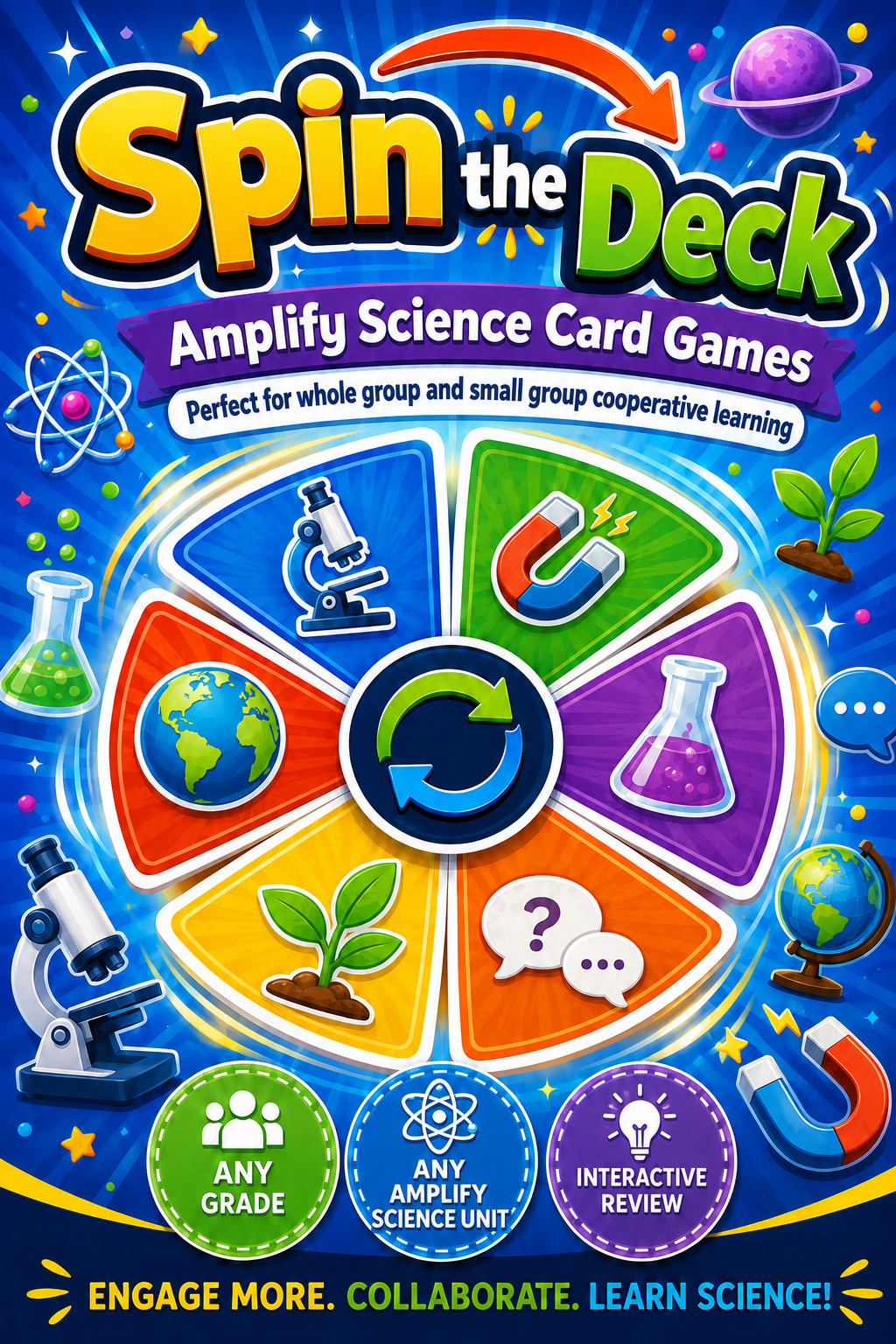
SPIN THE DECK! ENGAGE MORE. COLLABORATE. DISCOVER THE POWER OF HUMAN ENERGY!
Transform Energy Transfer, Energy Conversion, Conservation of Energy, and Human-Powered Technology into an Exciting Classroom Learning Experience!
How can the movement of your body generate electricity? Why does a hand-crank flashlight work without batteries? Where does energy go when a bicycle slows down? How can engineers design devices that capture human energy to help people during emergencies?
Bring these fascinating scientific questions to life with this engaging Spin the Deck: Harnessing Human Energy Review Game!
Designed to complement the Grade 8 Amplify Science Harnessing Human Energy unit, this interactive collection of 100 multiple-choice science review cards helps students investigate how energy is stored, transferred, transformed, and harnessed to power useful technologies.
Students explore the relationships among kinetic energy, potential energy, chemical energy, electrical energy, thermal energy, energy transfer, energy conversion, and conservation of energy while discovering how human movement can be transformed into electricity.
From investigating how a hand-crank generator produces electrical energy to examining how friction transfers energy to the surroundings, students develop a deeper understanding of the scientific principles that make energy-powered systems possible.
The deck challenges students to identify energy sources, trace energy pathways, analyze energy inputs and outputs, explain the role of energy converters, and evaluate the efficiency and reliability of different energy systems.
Students also investigate generators, batteries, electric motors, capacitors, flywheels, solar cells, renewable energy, conductors, insulators, and human-powered devices.
With real-world connections to emergency rescue equipment, portable generators, bicycles, flashlights, and charging devices, students discover how scientists and engineers apply energy principles to solve practical problems.
Students strengthen their scientific reasoning through questions involving scientific claims, supporting evidence, system models, energy simulations, and engineering design decisions.
Move beyond traditional worksheets and transform energy science review into an exciting cooperative learning experience where students answer questions, explain their thinking, explore scientific concepts, and collaborate with classmates!
Perfect for whole-group science review, small-group cooperative learning, science centers, partner activities, intervention, enrichment, and unit assessment preparation, this versatile resource encourages active participation while reinforcing essential physical science concepts.
Help your students become confident scientific thinkers, creative problem-solvers, and enthusiastic collaborative learners!
What's Included?
- 100 numbered multiple-choice science review cards covering Grade 8 Harnessing Human Energy concepts
- Four answer choices per question to encourage careful reading, scientific reasoning, and critical thinking
- Answers printed on the reverse side for immediate feedback and student self-checking
- 50 printable PDF pages designed for double-sided printing
- 25 double-sided sheets when printed back-to-back
- Four cards per sheet, creating 100 interactive review cards
- Colorful science-themed card designs featuring vibrant blue backgrounds, scientific equipment, laboratory illustrations, and clearly numbered question cards
- Questions addressing energy transfer, energy conversion, kinetic and potential energy, generators, energy storage, efficiency, and conservation of energy
- Reusable review cards compatible with cooperative learning games, partner activities, and science centers
Easy Preparation: Print the PDF double-sided, cut apart the four cards on each sheet, and laminate for durability. Your interactive Harnessing Human Energy review deck is ready to use!
Science Concepts & Skills Covered
Understanding Energy
Help students develop a foundational understanding of energy and its importance in everyday life.
Topics include:
- Scientific definition of energy
- Energy and work
- Energy in physical systems
- Energy sources
- Energy movement
- Energy storage
- Energy use
- Energy transformations
- Energy in everyday activities
- Measuring energy in joules
Students investigate how energy makes motion, electricity, light, and other physical processes possible.
Kinetic Energy & Motion
Explore how moving objects possess kinetic energy.
Topics include:
- Kinetic energy
- Motion
- Speed
- Mass
- Moving objects
- Human movement
- Walking and running
- Bicycle motion
- Energy changes
- Energy transfer through motion
Students discover how the speed and mass of an object influence its kinetic energy.
Potential Energy & Stored Energy
Help students understand how energy can be stored for later use.
Topics include:
- Potential energy
- Stored energy
- Gravitational potential energy
- Elastic potential energy
- Height and mass
- Compressed springs
- Stored energy in systems
- Energy conversion
- Energy release
- Kinetic and potential energy relationships
Students investigate how objects store energy through their position or configuration.
Kinetic & Potential Energy Transformations
Explore how energy changes between kinetic and potential forms.
Topics include:
- Potential-to-kinetic energy
- Kinetic-to-potential energy
- Rolling objects
- Pendulums
- Gravitational energy
- Height changes
- Speed changes
- Energy transformations
- Moving systems
- Conservation of energy
Students examine examples such as a ball rolling down a hill, a ball moving uphill, and a swinging pendulum.
Energy Transfer
Help students understand how energy moves between objects and different parts of a system.
Topics include:
- Energy transfer
- Interacting objects
- Energy pathways
- Systems
- Energy sources
- Energy destinations
- Motion
- Electrical energy transfer
- Thermal energy transfer
- Energy movement through systems
Students learn how energy transfers from one part of a system to another without being created or destroyed.
Energy Conversion & Transformation
Introduce students to the process of changing energy from one form into another.
Topics include:
- Energy conversion
- Energy converters
- Mechanical energy
- Electrical energy
- Chemical energy
- Light energy
- Thermal energy
- Sound energy
- Energy transformation
- Useful energy outputs
Students investigate how devices convert energy into forms that can perform useful tasks.
Law of Conservation of Energy
Explore one of the fundamental principles of physical science.
Topics include:
- Conservation of energy
- Energy cannot be created
- Energy cannot be destroyed
- Energy transfers
- Energy transformations
- Total energy
- Energy in systems
- Energy entering systems
- Energy leaving systems
- Energy balance
Students develop an understanding of why energy changes form or location rather than disappearing.
Chemical Energy & Human Metabolism
Connect energy science to the human body.
Topics include:
- Chemical energy
- Food as an energy source
- Stored chemical energy
- Molecules
- Human metabolism
- Energy from food
- Muscle movement
- Kinetic energy
- Thermal energy
- Energy transformations in the body
Students discover how the body transforms chemical energy from food into movement and heat.
Harnessing Human Energy
Investigate how human movement can power useful technologies.
Topics include:
- Human kinetic energy
- Harnessing energy
- Human-powered devices
- Hand-crank generators
- Mechanical energy
- Electrical energy production
- Portable technology
- Human-powered charging
- Energy conversion
- Emergency applications
Students explore how human motion can provide energy to operate devices without relying on an electrical power grid.
Generators & Electrical Energy
Help students understand how generators convert motion into electricity.
Topics include:
- Generators
- Electrical energy
- Mechanical motion
- Rotating components
- Magnetic fields
- Electrical current
- Energy conversion
- Hand-crank technology
- Moving magnets
- Coils of wire
Students investigate how generators use motion and electromagnetic interactions to produce electrical energy.
Electric Motors & Energy Conversion
Explore how electric motors transform electrical energy into movement.
Topics include:
- Electric motors
- Electrical energy
- Mechanical motion
- Energy inputs
- Energy outputs
- Energy conversion
- Moving components
- Powered devices
- Energy systems
- Motor applications
Students compare how motors and generators perform different energy conversions.
Energy Storage Devices
Investigate why energy storage is important in technological systems.
Topics include:
- Batteries
- Capacitors
- Flywheels
- Stored energy
- Chemical energy storage
- Electrical energy storage
- Kinetic energy storage
- Energy availability
- Energy release
- Storage systems
Students discover why energy must sometimes be stored for use when an energy source is unavailable.
Batteries & Capacitors
Explore devices that store energy for future use.
Topics include:
- Batteries
- Capacitors
- Stored energy
- Electrical systems
- Energy supply
- Energy release
- Energy storage technology
- Portable devices
- Energy inputs
- Energy outputs
Students investigate the role of batteries and capacitors in maintaining an energy supply.
Flywheels & Mechanical Energy Storage
Introduce students to rotating devices that store kinetic energy.
Topics include:
- Flywheels
- Rotational motion
- Kinetic energy
- Mechanical energy
- Energy storage
- Rotating systems
- Energy release
- Motion
- Energy transfer
- Engineering applications
Students learn how a spinning flywheel can store kinetic energy.
Thermal Energy & Friction
Help students understand how friction affects moving systems.
Topics include:
- Thermal energy
- Heat
- Temperature
- Molecular motion
- Friction
- Energy transfer
- Energy dissipation
- Motion slowing down
- Surroundings
- Energy transformations
Students investigate why moving objects slow down and how energy transfers into thermal energy through friction.
Energy Efficiency
Explore how effectively devices convert input energy into useful output.
Topics include:
- Energy efficiency
- Useful energy
- Input energy
- Output energy
- Energy converters
- Thermal energy
- Energy transfer
- Device performance
- Energy system design
- Engineering improvements
Students learn why efficient devices produce more useful output from a given energy input.
Energy Sources & Energy Sinks
Investigate where energy originates and where it goes within systems.
Topics include:
- Energy sources
- Energy sinks
- System inputs
- System outputs
- Energy transfer
- The Sun
- Surroundings
- Thermal energy
- Energy pathways
- Energy systems
Students explore how energy enters, moves through, and leaves different systems.
Open & Closed Energy Systems
Help students understand how system boundaries affect energy movement.
Topics include:
- Closed energy systems
- Energy entering systems
- Energy leaving systems
- System boundaries
- Energy balance
- Conservation of energy
- Energy transfers
- System interactions
- Energy inputs
- Energy outputs
Students investigate how the amount of energy within a system changes when energy enters or leaves its boundaries.
Energy Inputs & Outputs
Develop students' ability to analyze the operation of energy systems.
Topics include:
- Energy inputs
- Energy outputs
- Human energy systems
- Mechanical systems
- Electrical systems
- Energy converters
- Motion
- Energy pathways
- System stability
- Energy balance
Students identify inputs and outputs in systems involving humans, generators, motors, and other devices.
Renewable Energy & Solar Technology
Connect energy science to alternative energy sources.
Topics include:
- Renewable energy
- Naturally replenished resources
- Solar energy
- Solar panels
- Photovoltaic cells
- Electrical energy
- Energy conversion
- Sunlight
- Renewable energy technology
- Energy availability
Students discover how solar cells convert light into electrical energy and why renewable energy sources are replenished naturally.
Conductors & Insulators
Explore how materials influence the movement of electrical energy.
Topics include:
- Conductors
- Insulators
- Copper
- Metals
- Rubber
- Electrical current
- Electrical energy
- Material properties
- Energy flow
- Electrical systems
Students identify materials that conduct electricity and materials that resist electrical current.
Human-Powered Emergency Technology
Connect scientific concepts to real-world engineering challenges.
Topics include:
- Emergency rescue equipment
- Human-powered generators
- Portable energy sources
- Electrical power outages
- Emergency situations
- Reliable technology
- Hand-crank devices
- Energy availability
- Rescue equipment
- Engineering solutions
Students investigate why human-powered devices can be valuable when traditional electricity sources are unavailable.
Rescue Reach Engineering Challenge
Explore the real-world problem-solving context introduced in the Harnessing Human Energy unit.
Topics include:
- Rescue Reach
- Emergency situations
- Human-powered technology
- Energy conversion
- Reliable energy sources
- Engineering decisions
- Portable equipment
- Energy requirements
- Device effectiveness
- Scientific problem-solving
Students examine how energy principles can be applied to help people in emergency situations.
Scientific Models & Energy Simulations
Help students understand how scientists use models to investigate energy behavior.
Topics include:
- Energy Lab simulation
- Scientific models
- Energy transfer models
- Energy representations
- Simulated systems
- Energy movement
- System interactions
- Energy conservation
- Testing ideas
- Scientific investigations
Students explore how simulations can represent energy movement and help explain complex energy systems.
Scientific Claims & Evidence
Strengthen students' ability to construct and evaluate scientific explanations.
Topics include:
- Scientific claims
- Supporting evidence
- Refuting claims
- Scientific questions
- Energy investigations
- Interpreting observations
- Evidence-based explanations
- Scientific reasoning
- Evaluating information
- Scientific conclusions
Students practice identifying claims and understanding how evidence supports or challenges scientific explanations.
Perfect for Whole-Group & Small-Group Cooperative Learning!
Whole-Group Interactive Science Review
Engage the entire class in discussions about kinetic energy, potential energy, energy transfer, conservation of energy, generators, and human-powered technologies.
Fan-N-Pick
Students work in cooperative groups, taking turns selecting cards, reading questions, answering, and checking responses. This activity promotes participation, teamwork, and active listening.
Quiz-Quiz-Trade
Students pair up, quiz one another, check answers, exchange cards, and find new partners. This movement-based activity reinforces energy science vocabulary and concepts through repeated practice.
Science Centers & Stations
Create review stations focusing on energy forms, energy transfers, generators, energy storage, conservation of energy, and engineering applications.
Partner Review
Students take turns reading questions, selecting answers, explaining their reasoning, and checking responses on the reverse side.
Small-Group Energy Investigations
Organize students into teams to trace energy pathways, identify energy converters, analyze energy inputs and outputs, and investigate how human movement can produce electricity.
Spin & Answer Review Games
Combine the cards with a classroom spinner or teacher-created game structure to add excitement and friendly competition to science review.
Science Test Preparation
Help students revisit important energy vocabulary, conservation principles, energy conversions, and engineering concepts before unit assessments.
Warm-Ups & Exit Tickets
Use selected cards to activate prior knowledge, encourage scientific discussions, or quickly assess understanding.
Science Intervention & Enrichment
Target specific energy concepts for additional practice or challenge students to explain complex energy pathways.
Early Finishers & Substitute Plans
Provide meaningful, low-preparation science activities that reinforce essential physical science concepts.
Why Teachers Will Love This Resource!
Low-Prep and Ready to Use!
Simply print, cut, and laminate to create a reusable classroom resource.
Designed for Cooperative Learning!
Encourage students to communicate, collaborate, listen respectfully, and explain scientific ideas to classmates.
Promotes Active Student Engagement!
Transform traditional science review into an interactive experience involving discussion, movement, teamwork, and problem-solving.
Reinforces Amplify Science Concepts!
Review essential vocabulary and scientific ideas connected to the Grade 8 Harnessing Human Energy unit.
Builds Scientific Reasoning!
Students strengthen their ability to analyze energy systems, trace energy pathways, identify energy transformations, and explain how energy is conserved.
Provides Immediate Feedback!
Answers on the reverse side allow students to check their understanding during independent, partner, and group activities.
Supports Differentiated Instruction!
Select questions based on student readiness, target specific concepts, or extend learning through additional scientific discussions.
Connects Science to Real-World Engineering!
Students investigate how hand-crank generators, electric motors, batteries, flywheels, and human-powered devices use energy to perform useful tasks.
Challenges Common Misconceptions!
Help students understand that energy is not created or destroyed, that energy transfers to the surroundings when objects slow down, and that energy converters change energy from one form to another.
Reusable Year After Year!
Laminate the cards to create a durable classroom resource that supports repeated review and cooperative learning.
Sample Review Questions
Here are eight actual questions from this collection:
Question 1: What is the scientific definition of "energy"?
Answer: The ability to do work.
Question 2: "Kinetic energy" is the energy of:
Answer: Motion.
Question 3: "Potential energy" is energy that is:
Answer: Stored.
Question 4: What happens to kinetic energy if an object moves faster?
Answer: Increases.
Question 5: A "generator" is a device that:
Answer: Converts motion into electrical energy.
Question 6: Energy cannot be created or destroyed, only:
Answer: Transferred or converted.
Question 7: What is a "system"?
Answer: A set of interacting parts.
Question 8: To "harness" energy means to:
Answer: Capture and use it.
These questions reinforce essential scientific vocabulary while encouraging students to explain energy transformations, understand conservation principles, and investigate how energy can be captured and used in real-world technologies.
Transform Harnessing Human Energy Review into an Exciting Learning Experience!
Energy is everywhere! From the chemical energy stored in the food we eat to the electrical energy that powers our devices, energy transfers and transformations make modern life possible.
Understanding how energy moves through systems allows students to explore scientific principles while discovering how engineers design technologies that solve real-world problems.
With 100 interactive Harnessing Human Energy review cards, students can investigate how energy is stored, transferred, and converted, why energy is conserved, and how human movement can be harnessed to generate electricity.
Imagine students enthusiastically selecting cards, explaining how generators work, tracing energy pathways, comparing energy sources, investigating conservation of energy, and collaborating to solve engineering challenges.
Whether you're reviewing lessons, preparing for assessments, reinforcing vocabulary, or creating collaborative learning opportunities, this resource transforms physical science review into an exciting, student-centered learning experience.
One deck. 100 questions. Endless opportunities to explore the power of energy!
SPIN THE DECK! ENGAGE MORE. COLLABORATE. LEARN SCIENCE!
Add this engaging Harnessing Human Energy review game to your classroom toolkit and inspire confident, curious, and collaborative young scientists!
Important Curriculum Disclaimer
This independently created resource is designed to supplement the Amplify Science curriculum. It is not affiliated with, sponsored by, authorized by, or endorsed by Amplify Education, Inc. Amplify and Amplify Science are trademarks of their respective owner. No affiliation or endorsement is implied.
This product is a supplemental classroom review activity and is not a replacement for official Amplify Science curriculum materials, lessons, assessments, or instructional resources.
- Grade 8
- Instant digital download
- Print & reuse in class