Spin the Deck – Grade 8 Amplify Science: Light Waves
$5.00
Spin the Deck – Grade 8 Amplify Science: Light Waves
100 Interactive Science Review Cards | Cooperative Learning | Electromagnetic Spectrum | Light Energy | Middle School Science
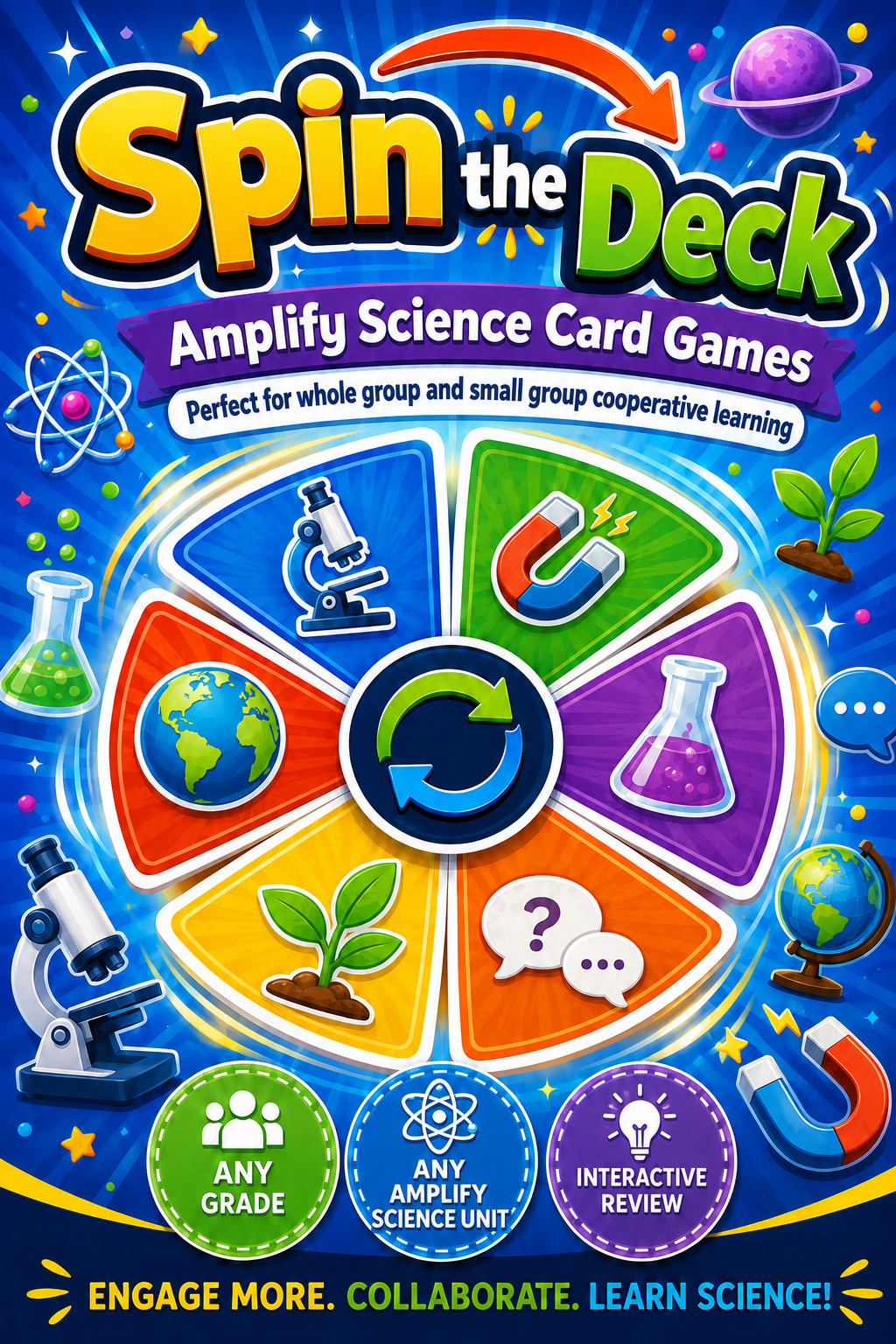
SPIN THE DECK! ENGAGE MORE. COLLABORATE. DISCOVER THE AMAZING SCIENCE OF LIGHT!
Transform Light Waves, the Electromagnetic Spectrum, and Energy Interactions into an Exciting Classroom Learning Experience!
Why is the sky blue? How can ultraviolet light damage human skin? Why does a black shirt become warmer in sunlight? How do scientists explain the different colors of visible light? And how can light waves transmit information through fiber-optic cables?
Bring these fascinating scientific questions to life with this engaging Spin the Deck: Light Waves Review Game!
Designed to complement the Grade 8 Amplify Science Light Waves unit, this interactive collection of 100 multiple-choice science review cards helps students investigate how light waves transfer energy, interact with materials, and influence the world around us.
Students explore the relationships among wavelength, frequency, amplitude, light energy, absorption, reflection, transmission, refraction, and the electromagnetic spectrum while discovering how different types of light affect matter.
From investigating why ultraviolet radiation can damage DNA to exploring how visible light produces the colors we see, students develop a deeper understanding of the scientific principles governing electromagnetic radiation.
The deck challenges students to identify wave properties, compare electromagnetic wavelengths, explain light interactions, analyze energy absorption, and investigate the relationship between light energy and changes in materials.
Students also explore ultraviolet radiation, infrared light, radio waves, microwaves, X-rays, gamma rays, spectrophotometers, scientific models, and light-wave simulations.
With real-world connections to sunscreen, skin cancer prevention, rainbows, solar energy, fiber-optic communication, medical imaging, and photosynthesis, students discover how light-wave science influences technology, health, and everyday life.
The resource also reinforces the unit's investigation into high skin cancer rates in Australia, encouraging students to connect scientific evidence about ultraviolet radiation to an important real-world phenomenon.
Students strengthen their scientific reasoning through questions involving scientific claims, evidence, experimental variables, consistent results, models, and wave-energy investigations.
Move beyond traditional worksheets and transform light-wave review into an exciting cooperative learning experience where students answer questions, explain their thinking, explore scientific concepts, and collaborate with classmates!
Perfect for whole-group science review, small-group cooperative learning, science centers, partner activities, intervention, enrichment, and unit assessment preparation, this versatile resource encourages active participation while reinforcing essential physical science concepts.
Help your students become confident scientific thinkers, curious investigators, and enthusiastic collaborative learners!
What's Included?
- 100 numbered multiple-choice science review cards covering Grade 8 Light Waves concepts
- Four answer choices per question to encourage careful reading, scientific reasoning, and critical thinking
- Answers printed on the reverse side for immediate feedback and student self-checking
- 50 printable PDF pages designed for double-sided printing
- 25 double-sided sheets when printed back-to-back
- Four cards per sheet, creating 100 interactive review cards
- Colorful science-themed card designs featuring vibrant blue backgrounds, scientific equipment, laboratory illustrations, and clearly numbered question cards
- Questions addressing wave properties, electromagnetic radiation, absorption, transmission, reflection, light energy, ultraviolet radiation, and scientific investigations
- Reusable review cards compatible with cooperative learning games, partner activities, and science centers
Easy Preparation: Print the PDF double-sided, cut apart the four cards on each sheet, and laminate for durability. Your interactive Light Waves review deck is ready to use!
Science Concepts & Skills Covered
Understanding Light Waves
Help students develop a foundational understanding of light as a form of energy.
Topics include:
- Light waves
- Energy transfer
- Electromagnetic radiation
- Light traveling in straight lines
- Light sources
- Wave energy
- Light and matter
- Visible light
- Light propagation
- Energy movement
Students investigate how light carries energy from one location to another and how that energy interacts with materials.
Wave Properties & Characteristics
Explore the essential characteristics scientists use to describe waves.
Topics include:
- Wavelength
- Frequency
- Amplitude
- Wave crests
- Wave troughs
- Rest position
- Transverse waves
- Wave patterns
- Wave measurements
- Wave behavior
Students learn how scientists describe, compare, and analyze waves using their measurable properties.
Wavelength & Frequency
Help students understand the relationship between wavelength, frequency, and electromagnetic energy.
Topics include:
- Long wavelengths
- Short wavelengths
- High-frequency waves
- Low-frequency waves
- Wave cycles
- Frequency measurements
- Wavelength comparisons
- Electromagnetic energy
- Light colors
- Wave relationships
Students investigate how wavelength and frequency help distinguish different types of electromagnetic radiation.
Amplitude & Light Brightness
Explore how wave amplitude relates to the intensity of light.
Topics include:
- Wave amplitude
- Wave height
- Light brightness
- Light intensity
- Energy transfer
- Wave comparisons
- Increasing amplitude
- Decreasing amplitude
- Wave models
- Scientific observations
Students examine how changes in amplitude affect the brightness of light.
The Electromagnetic Spectrum
Introduce students to the full range of electromagnetic radiation.
Topics include:
- Electromagnetic spectrum
- Radio waves
- Microwaves
- Infrared radiation
- Visible light
- Ultraviolet radiation
- X-rays
- Gamma rays
- Wavelength comparisons
- Frequency and energy
Students compare different electromagnetic waves and investigate how their properties influence their uses and interactions with matter.
Visible Light & Color
Explore how different wavelengths of visible light produce the colors we observe.
Topics include:
- Visible light
- Red light
- Orange light
- Yellow light
- Green light
- Blue light
- Violet light
- White light
- Wavelength and color
- The visible spectrum
Students investigate why red light has a longer wavelength than violet light and how wavelength determines the color of visible light.
Light Absorption
Help students understand what happens when materials absorb light energy.
Topics include:
- Absorption
- Light energy
- Energy transfer
- Material properties
- Absorbed wavelengths
- Thermal energy
- Light interactions
- Dark-colored materials
- Molecular changes
- Energy conversion
Students explore why dark materials often become warmer in sunlight and how absorbed light energy can be transferred or transformed.
Light Reflection
Investigate how light interacts with reflective surfaces.
Topics include:
- Reflection
- Reflected light
- Mirrors
- Light bouncing off surfaces
- Visible colors
- Surface properties
- Light direction
- Reflective materials
- Light energy
- Light interactions
Students discover how reflected light allows us to see objects and how different materials reflect different wavelengths.
Light Transmission
Explore how light passes through materials.
Topics include:
- Transmission
- Transmitted light
- Transparent materials
- Glass
- Light pathways
- Material properties
- Energy transfer
- Wavelength interactions
- Clear materials
- Light movement
Students investigate why light can pass through some materials while other materials block or absorb it.
Transparent, Translucent & Opaque Materials
Help students compare how different materials interact with incoming light.
Topics include:
- Transparent materials
- Translucent materials
- Opaque materials
- Light transmission
- Light scattering
- Light blocking
- Material properties
- Clear glass
- Light absorption
- Light reflection
Students learn to classify materials based on how much light passes through them and how clearly objects can be seen.
Light Refraction
Explore why light changes direction when traveling between different materials.
Topics include:
- Refraction
- Light bending
- Material changes
- Prisms
- Water
- Glass
- Wavelengths
- Light direction
- Rainbows
- Color separation
Students investigate how prisms separate white light into different colors and how water droplets contribute to rainbow formation.
Light Scattering
Help students understand how light spreads in different directions.
Topics include:
- Scattering
- Light direction
- Atmospheric scattering
- Blue light
- Wavelength interactions
- The blue sky
- Light energy
- Material interactions
- Reflected light
- Scientific explanations
Students explore why shorter wavelengths of visible light scatter more strongly in Earth's atmosphere.
Ultraviolet Radiation
Introduce students to the properties and effects of ultraviolet light.
Topics include:
- Ultraviolet radiation
- UV light
- High-energy light
- Wavelength
- Frequency
- Light absorption
- Molecular changes
- DNA damage
- Skin exposure
- Sunlight
Students investigate why ultraviolet radiation can affect biological molecules differently from visible light.
Light Energy & DNA Damage
Connect wave science to important biological processes.
Topics include:
- DNA
- Genetic material
- Ultraviolet radiation
- Energy absorption
- Molecular changes
- DNA mutations
- Skin cells
- High-energy radiation
- Skin cancer
- Biological effects of light
Students discover how absorbed ultraviolet energy can damage genetic material and contribute to changes in cells.
Skin Cancer & the Australia Mystery
Reinforce the real-world scientific investigation featured in the Light Waves unit.
Topics include:
- Australia
- Skin cancer rates
- Ultraviolet radiation
- Sun exposure
- DNA damage
- Light energy
- Skin protection
- Scientific explanations
- Evidence-based reasoning
- Real-world investigations
Students explore the scientific relationship between ultraviolet exposure, molecular changes, and skin cancer risk.
Melanin & Sun Protection
Help students understand how the body and protective materials interact with ultraviolet radiation.
Topics include:
- Melanin
- Skin pigmentation
- UV absorption
- Skin cells
- Sunscreen
- UV protection
- Light reflection
- Light absorption
- Energy transfer
- Skin safety
Students investigate how melanin absorbs ultraviolet light and how sunscreen helps reduce UV exposure.
Infrared Radiation & Thermal Energy
Explore how infrared radiation relates to energy transfer and heating.
Topics include:
- Infrared light
- Thermal energy
- Heat
- Radiation
- Energy absorption
- Electromagnetic waves
- Light energy
- Material temperature
- Energy conversion
- Infrared applications
Students examine how infrared radiation can transfer energy to materials.
X-Rays & Gamma Rays
Introduce students to high-energy electromagnetic radiation.
Topics include:
- X-rays
- Gamma rays
- High-frequency waves
- Short wavelengths
- Electromagnetic energy
- Medical imaging
- Soft tissue
- Bones
- Radiation interactions
- Energy absorption
Students compare high-energy electromagnetic waves and explore how X-rays can be used in medicine.
Radio Waves & Microwaves
Investigate electromagnetic waves used in communication and everyday technology.
Topics include:
- Radio waves
- Microwaves
- Low-frequency waves
- Long wavelengths
- Wireless communication
- Heating food
- Electromagnetic radiation
- Wave energy
- Technology applications
- Wave comparisons
Students discover how different electromagnetic wavelengths are used for communication and energy transfer.
Light & Material Interactions
Help students analyze how the same light wave may behave differently when interacting with different materials.
Topics include:
- Material properties
- Light wavelength
- Absorption
- Reflection
- Transmission
- Scattering
- Energy transfer
- Molecular interactions
- Light behavior
- Scientific predictions
Students investigate how both the properties of the material and the wavelength of incoming light influence what happens to light energy.
Light, Color & Object Appearance
Explore why objects appear to have different colors.
Topics include:
- Reflected wavelengths
- Absorbed wavelengths
- White objects
- Black objects
- Colored objects
- Green leaves
- Red light
- Visible wavelengths
- Light sources
- Color perception
Students investigate how the color of an object depends on the wavelengths of light it reflects and the light available to illuminate it.
Light & Photosynthesis
Connect electromagnetic energy to living systems.
Topics include:
- Photosynthesis
- Chlorophyll
- Light absorption
- Red light
- Blue light
- Green light
- Plants
- Light energy
- Energy conversion
- Biological processes
Students explore why chlorophyll absorbs red and blue light strongly while reflecting more green light.
Scientific Tools & Spectrophotometers
Introduce students to instruments used to investigate light.
Topics include:
- Spectrophotometers
- Light absorption
- Wavelength measurements
- Nanometers
- Light energy
- Scientific equipment
- Material testing
- Experimental observations
- Light interactions
- Scientific data
Students learn how scientists measure light absorption and investigate the properties of different materials.
Scientific Models & Light Simulations
Strengthen students' understanding of how scientists use models to explain wave behavior.
Topics include:
- Scientific models
- Light-wave simulations
- Energy detectors
- Wave representations
- Energy transfer
- Light interactions
- System observations
- Scientific predictions
- Model limitations
- Testing explanations
Students explore how models and simulations help scientists investigate phenomena that may be difficult to observe directly.
Scientific Investigations & Experimental Variables
Develop students' ability to design and interpret investigations.
Topics include:
- Experimental variables
- Wavelength changes
- Controlled investigations
- Scientific observations
- Repeatable results
- Consistent data
- Evidence
- Scientific explanations
- Testing predictions
- Experimental reasoning
Students practice identifying variables and recognizing the importance of consistent, repeatable results.
Light Emission & Luminescence
Explore how materials produce light.
Topics include:
- Light emission
- Luminescence
- Light sources
- Energy release
- Visible radiation
- Light production
- Fluorescence
- Material properties
- Light interactions
- Scientific applications
Students investigate how light can be emitted by different materials and how emission differs from reflection or absorption.
Fiber Optics & Light-Based Communication
Connect light-wave science to modern information technology.
Topics include:
- Fiber-optic cables
- Light pulses
- Binary code
- Data transmission
- Communication technology
- Light pathways
- Optical fibers
- Light energy
- Information transfer
- Technological applications
Students explore how light can carry information through fiber-optic communication systems.
Perfect for Whole-Group & Small-Group Cooperative Learning!
Whole-Group Interactive Science Review
Engage the entire class in discussions about wavelength, frequency, absorption, reflection, transmission, ultraviolet radiation, and electromagnetic energy.
Fan-N-Pick
Students work in cooperative groups, taking turns selecting cards, reading questions, answering, and checking responses. This activity promotes participation, teamwork, and active listening.
Quiz-Quiz-Trade
Students pair up, quiz one another, check answers, exchange cards, and find new partners. This movement-based activity reinforces light-wave vocabulary and concepts through repeated practice.
Science Centers & Stations
Create review stations focusing on wave properties, electromagnetic radiation, light interactions, visible colors, ultraviolet radiation, and scientific investigations.
Partner Review
Students take turns reading questions, selecting answers, explaining their reasoning, and checking responses on the reverse side.
Small-Group Light Investigations
Organize students into teams to compare electromagnetic wavelengths, trace light-energy pathways, analyze material interactions, and explain how different forms of radiation affect matter.
Spin & Answer Review Games
Combine the cards with a classroom spinner or teacher-created game structure to add excitement and friendly competition to science review.
Science Test Preparation
Help students revisit important light-wave vocabulary, electromagnetic spectrum concepts, energy interactions, and scientific explanations before unit assessments.
Warm-Ups & Exit Tickets
Use selected cards to activate prior knowledge, encourage scientific discussions, or quickly assess understanding.
Science Intervention & Enrichment
Target specific light-wave concepts for additional practice or challenge students to explain complex interactions between electromagnetic radiation and matter.
Early Finishers & Substitute Plans
Provide meaningful, low-preparation science activities that reinforce essential physical science concepts.
Why Teachers Will Love This Resource!
Low-Prep and Ready to Use!
Simply print, cut, and laminate to create a reusable classroom resource.
Designed for Cooperative Learning!
Encourage students to communicate, collaborate, listen respectfully, and explain scientific ideas to classmates.
Promotes Active Student Engagement!
Transform traditional science review into an interactive experience involving discussion, movement, teamwork, and problem-solving.
Reinforces Amplify Science Concepts!
Review essential vocabulary and scientific ideas connected to the Grade 8 Light Waves unit.
Builds Scientific Reasoning!
Students strengthen their ability to compare wave properties, explain light interactions, investigate energy transfer, and analyze the effects of electromagnetic radiation on materials.
Provides Immediate Feedback!
Answers on the reverse side allow students to check their understanding during independent, partner, and group activities.
Supports Differentiated Instruction!
Select questions based on student readiness, target specific concepts, or extend learning through additional scientific discussions.
Connects Science to Real-World Phenomena!
Students investigate why the sky is blue, how sunscreen protects skin, why objects appear different colors, and how fiber-optic technology transmits information.
Challenges Common Misconceptions!
Help students understand that light transfers energy, that different wavelengths interact differently with matter, and that absorbed light energy does not simply disappear.
Reusable Year After Year!
Laminate the cards to create a durable classroom resource that supports repeated review and cooperative learning.
Sample Review Questions
Here are eight actual questions from this collection:
Question 1: What is a "light wave"?
Answer: A pattern of energy that travels.
Question 2: Light travels in a __________ line.
Answer: Straight.
Question 3: "Amplitude" is the measure of a wave's:
Answer: Height from the rest position.
Question 4: "Wavelength" is the distance between:
Answer: Two crests.
Question 5: When the amplitude of a light wave increases, the light gets:
Answer: Brighter.
Question 6: "Frequency" is the number of:
Answer: Waves in a certain time.
Question 7: Which characteristic determines the color of visible light?
Answer: Wavelength.
Question 8: A "spectrophotometer" is a tool used to:
Answer: Measure how much light is absorbed.
These questions reinforce essential scientific vocabulary while encouraging students to explain light-wave behavior, understand electromagnetic energy, and investigate how different wavelengths interact with materials.
Transform Light Waves Review into an Exciting Learning Experience!
Light is everywhere! From the sunlight that warms our planet to the invisible electromagnetic waves that power modern communication technologies, light waves influence countless aspects of our everyday lives.
Understanding how light transfers energy and interacts with matter allows students to explore scientific principles while discovering important connections to health, technology, and the natural world.
With 100 interactive Light Waves review cards, students can investigate wave properties, explore the electromagnetic spectrum, compare light interactions, explain visible colors, and discover how ultraviolet radiation can affect living cells.
Imagine students enthusiastically selecting cards, explaining why the sky is blue, comparing wavelengths, investigating light absorption, analyzing the effects of UV radiation, and collaborating to solve scientific questions.
Whether you're reviewing lessons, preparing for assessments, reinforcing vocabulary, or creating collaborative learning opportunities, this resource transforms physical science review into an exciting, student-centered learning experience.
One deck. 100 questions. Endless opportunities to explore the amazing science of light!
SPIN THE DECK! ENGAGE MORE. COLLABORATE. LEARN SCIENCE!
Add this engaging Light Waves review game to your classroom toolkit and inspire confident, curious, and collaborative young scientists!
Important Curriculum Disclaimer
This independently created resource is designed to supplement the Amplify Science curriculum. It is not affiliated with, sponsored by, authorized by, or endorsed by Amplify Education, Inc. Amplify and Amplify Science are trademarks of their respective owner. No affiliation or endorsement is implied.
This product is a supplemental classroom review activity and is not a replacement for official Amplify Science curriculum materials, lessons, assessments, or instructional resources.
- Grade 8
- Instant digital download
- Print & reuse in class