Spin the Deck – Grade 8 Amplify Science: Natural Selection
$5.00
Spin the Deck – Grade 8 Amplify Science: Natural Selection
100 Interactive Science Review Cards | Cooperative Learning | Adaptations | Evolution | Inherited Traits | Middle School Science
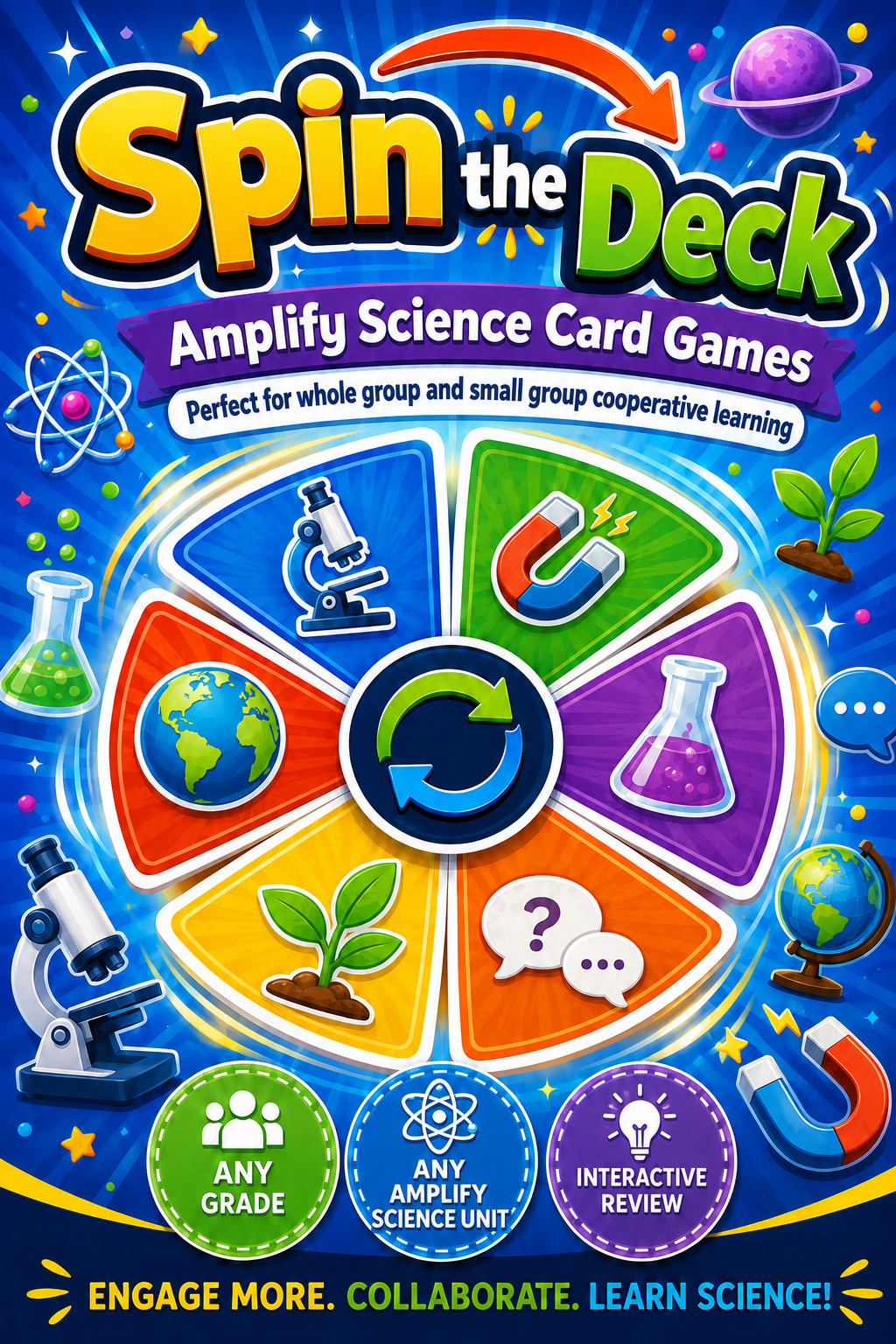
SPIN THE DECK! ENGAGE MORE. COLLABORATE. DISCOVER THE SCIENCE OF NATURAL SELECTION!
Transform Natural Selection, Adaptations, and Evolution into an Exciting Classroom Learning Experience!
Why do some organisms survive better than others? How does camouflage help animals avoid predators? Why do certain inherited traits become more common over generations? How do bacteria develop antibiotic resistance? And what happens when environmental conditions change?
Bring these fascinating scientific questions to life with this engaging Spin the Deck: Natural Selection Review Game!
Designed to complement the Grade 8 Amplify Science Natural Selection unit, this interactive collection of 100 multiple-choice science review cards helps students investigate how inherited traits, environmental pressures, and reproductive success influence populations over generations.
Students explore the relationships among natural selection, genetic variation, adaptations, selective pressures, fitness, inheritance, reproduction, and evolution while discovering why some traits become more common and others decrease within populations.
From investigating why dark-colored mice survive better on dark rocks to examining how antibiotic-resistant bacteria reproduce, students develop a deeper understanding of how environmental conditions influence the survival and reproduction of organisms.
The deck challenges students to identify inherited traits, compare adaptations, interpret changes in trait distribution, explain selective pressures, and analyze evidence of natural selection.
Students also explore camouflage, predation, competition, resource availability, mutations, population changes, extinction, and differential reproduction.
With real-world connections to bird beak shapes, moth coloration, drought-resistant plants, pesticide-resistant insects, antibiotic-resistant bacteria, and changing environmental conditions, students discover how natural selection shapes populations over time.
Students strengthen their scientific reasoning through questions involving trait percentages, population data, experimental evidence, scientific models, sample sizes, and changes across generations.
Move beyond traditional worksheets and transform natural selection review into an exciting cooperative learning experience where students answer questions, explain their thinking, analyze evidence, and collaborate with classmates!
Perfect for whole-group science review, small-group cooperative learning, science centers, partner activities, intervention, enrichment, and unit assessment preparation, this versatile resource encourages active participation while reinforcing essential life science concepts.
Help your students become confident scientific thinkers, curious investigators, and enthusiastic collaborative learners!
What's Included?
- 100 numbered multiple-choice science review cards covering Grade 8 Natural Selection concepts
- Four answer choices per question to encourage careful reading, scientific reasoning, and critical thinking
- Answers printed on the reverse side for immediate feedback and student self-checking
- 50 printable PDF pages designed for double-sided printing
- 25 double-sided sheets when printed back-to-back
- Four cards per sheet, creating 100 interactive review cards
- Colorful science-themed card designs featuring vibrant blue backgrounds, laboratory equipment, scientific illustrations, and clearly numbered question cards
- Questions addressing inherited traits, variation, adaptations, selective pressures, fitness, natural selection, and evolution
- Real-world examples involving predators, camouflage, environmental changes, antibiotic resistance, and competition
- Data interpretation questions examining changes in trait percentages and population characteristics
- Reusable review cards compatible with cooperative learning games, partner activities, and science centers
Easy Preparation: Print the PDF double-sided, cut apart the four cards on each sheet, and laminate for durability. Your interactive Natural Selection review deck is ready to use!
Science Concepts & Skills Covered
Understanding Natural Selection
Help students develop a foundational understanding of how natural selection influences populations.
Topics include:
- Natural selection
- Inherited traits
- Trait variation
- Environmental pressures
- Survival
- Reproduction
- Population changes
- Beneficial traits
- Trait distribution
- Evolution over generations
Students investigate how inherited traits that improve survival and reproductive success may become more common within a population.
Populations & Generations
Explore how scientists study organisms and changes within populations.
Topics include:
- Populations
- Species
- Individuals
- Generations
- Reproduction
- Offspring
- Population characteristics
- Trait frequencies
- Population change
- Changes over time
Students learn why natural selection is studied across multiple generations rather than through changes within a single organism's lifetime.
Variation Within Populations
Introduce students to the importance of differences among individuals.
Topics include:
- Variation
- Inherited differences
- Physical characteristics
- Trait diversity
- Population variation
- Fur color
- Beak shape
- Body patterns
- Genetic differences
- Survival advantages
Students explore why variation is essential for natural selection and how differences among individuals can influence survival.
Inherited & Acquired Traits
Help students distinguish between characteristics passed from parents to offspring and characteristics developed during life.
Topics include:
- Inherited traits
- Acquired traits
- Genetic inheritance
- Parent-offspring similarities
- Natural fur color
- Eye color
- Scars
- Learned behaviors
- Injuries
- Reproduction
Students learn why natural selection depends on inherited variation rather than learned skills or acquired injuries.
Adaptations & Environmental Conditions
Investigate how inherited characteristics can improve an organism's success in a particular environment.
Topics include:
- Adaptations
- Environmental conditions
- Survival advantages
- Reproductive success
- Helpful traits
- Habitat characteristics
- Changing environments
- Trait effectiveness
- Fitness
- Population change
Students discover why a trait that is beneficial in one environment may be less useful or harmful in another.
Selective Pressures
Explore the environmental factors that influence which organisms survive and reproduce.
Topics include:
- Selective pressures
- Predation
- Competition
- Food availability
- Water availability
- Disease
- Climate
- Habitat conditions
- Survival differences
- Reproductive success
Students investigate how environmental pressures influence the distribution of inherited traits within populations.
Fitness & Reproductive Success
Help students understand the scientific meaning of fitness.
Topics include:
- Biological fitness
- Survival
- Reproduction
- Surviving offspring
- Differential reproduction
- Inherited advantages
- Environmental suitability
- Population changes
- Trait success
- Natural selection
Students discover that fitness refers to reproductive success in a particular environment rather than simply physical strength or body size.
Competition for Resources
Explore how limited resources influence survival and natural selection.
Topics include:
- Competition
- Food resources
- Water resources
- Resource scarcity
- Environmental limitations
- Survival
- Reproduction
- Population size
- Selective pressures
- Adaptations
Students examine why organisms with traits that improve their ability to obtain limited resources may have greater reproductive success.
Predation & Camouflage
Investigate how predator-prey interactions influence inherited traits.
Topics include:
- Predators
- Prey
- Camouflage
- Protective coloration
- Survival advantages
- Predation pressure
- Trait variation
- Natural selection
- Environmental backgrounds
- Reproductive success
Students explore how organisms that blend into their surroundings may be less likely to be eaten and more likely to reproduce.
Fur Color & Environmental Adaptations
Use animal coloration to illustrate natural selection.
Topics include:
- Dark-colored mice
- White-colored mice
- Dark rocks
- Snowy environments
- Camouflage
- Predation
- Fur color inheritance
- Environmental changes
- Survival differences
- Trait frequency
Students investigate why dark fur may provide an advantage on dark rocks while white fur may provide an advantage in snowy environments.
Bird Beaks & Food Availability
Explore how differences in beak characteristics influence survival.
Topics include:
- Bird beak shapes
- Strong beaks
- Deep beaks
- Long beaks
- Food availability
- Hard seeds
- Feeding adaptations
- Competition
- Reproductive success
- Natural selection
Students examine how environmental changes affecting food availability can favor birds with particular inherited beak characteristics.
Plant Adaptations & Drought
Connect natural selection to plant survival.
Topics include:
- Drought
- Deep roots
- Waxy leaves
- Water conservation
- Plant traits
- Environmental pressures
- Water availability
- Survival advantages
- Inherited characteristics
- Adaptations
Students investigate how traits that help plants obtain or conserve water may become advantageous in dry environments.
Mutations & Genetic Variation
Introduce students to the role of DNA changes in producing variation.
Topics include:
- Mutations
- DNA
- Genetic variation
- Inherited characteristics
- Helpful mutations
- Harmful mutations
- Neutral effects
- Population diversity
- Trait differences
- Evolution
Students discover that mutations can have different effects and that inherited genetic variation provides material upon which natural selection can act.
Antibiotic Resistance
Connect natural selection to an important real-world health phenomenon.
Topics include:
- Antibiotic resistance
- Bacteria
- Resistant traits
- Survival
- Reproduction
- Environmental pressure
- Inherited variation
- Population changes
- Natural selection
- Resistance frequency
Students investigate why resistant bacteria may survive antibiotic treatment and reproduce, causing resistance to become more common within a population.
Pesticide Resistance
Explore how repeated pesticide use can influence insect populations.
Topics include:
- Pesticides
- Insect populations
- Resistant insects
- Inherited resistance
- Survival differences
- Reproductive success
- Selective pressures
- Population changes
- Trait frequency
- Natural selection
Students learn why resistant insects may become more common over generations when pesticide exposure favors their survival.
Disease & Natural Selection
Investigate how disease can act as a selective pressure.
Topics include:
- Disease resistance
- Inherited resistance
- Survival
- Reproduction
- Population variation
- Selective pressures
- Adaptations
- Fitness
- Trait frequency
- Evolutionary change
Students explore why individuals with inherited resistance may have an advantage when disease affects a population.
Evolution & Population Change
Help students understand the relationship between natural selection and evolution.
Topics include:
- Evolution
- Population change
- Generations
- Inherited variation
- Natural selection
- Trait frequencies
- Environmental pressures
- Reproductive success
- Population characteristics
- Long-term change
Students discover that populations evolve over generations and that individual organisms do not evolve simply because they need a particular trait.
Trait Distribution & Frequency
Strengthen students' understanding of how inherited traits are distributed within populations.
Topics include:
- Trait distribution
- Trait frequency
- Population percentages
- Common traits
- Rare traits
- Increasing frequencies
- Decreasing frequencies
- Population comparisons
- Generational change
- Scientific data
Students investigate how the percentage of individuals with a particular trait can increase or decrease over time.
Interpreting Population Data
Develop students' ability to analyze numerical evidence of natural selection.
Topics include:
- Percentage changes
- Percentage-point differences
- Trait frequency
- Population data
- Comparing generations
- Data interpretation
- Scientific conclusions
- Population trends
- Evidence
- Evolutionary explanations
Students practice interpreting changes such as a trait increasing from 40% to 70% and recognizing that this represents an increase of 30 percentage points.
Differential Survival & Reproduction
Explore why some individuals contribute more offspring to future generations.
Topics include:
- Differential survival
- Differential reproduction
- Inherited variation
- Reproductive success
- Population changes
- Fitness
- Environmental pressures
- Survival rates
- Offspring numbers
- Natural selection
Students investigate how differences in survival and reproduction influence which inherited traits become more common.
Scientific Evidence & Claims
Help students evaluate evidence supporting explanations of natural selection.
Topics include:
- Scientific claims
- Evidence
- Reasoning
- Survival data
- Reproduction data
- Trait comparisons
- Generational trends
- Scientific conclusions
- Reliable observations
- Testing explanations
Students examine why evidence collected across multiple generations is more useful than isolated observations when investigating natural selection.
Scientific Models & Investigations
Develop students' understanding of how scientists investigate population changes.
Topics include:
- Scientific models
- Inheritance
- Trait variation
- Selective pressures
- Population simulations
- Experimental comparisons
- Sample sizes
- Reliable results
- Data collection
- Scientific predictions
Students investigate how models can represent inheritance, selection, and reproduction while recognizing the importance of reliable evidence.
Common Misconceptions About Natural Selection
Challenge students to distinguish scientific explanations from common misunderstandings.
Topics include:
- Organisms do not choose inherited traits
- Need does not directly create adaptations
- Individuals do not evolve during their lifetimes
- Natural selection does not guarantee survival
- Helpful traits are not always advantageous
- Natural selection does not produce perfect organisms
- Mutations are not always beneficial
- Environmental changes can alter fitness
- Learned traits are not automatically inherited
- Natural selection acts on existing variation
Students develop more accurate explanations of how natural selection operates within populations.
Perfect for Whole-Group & Small-Group Cooperative Learning!
Whole-Group Interactive Science Review
Engage the entire class in discussions about inherited traits, adaptations, selective pressures, fitness, variation, and population change.
Fan-N-Pick
Students work in cooperative groups, taking turns selecting cards, reading questions, answering, and checking responses. This activity promotes participation, teamwork, and active listening.
Quiz-Quiz-Trade
Students pair up, quiz one another, check answers, exchange cards, and find new partners. This movement-based activity reinforces natural selection vocabulary and concepts through repeated practice.
Science Centers & Stations
Create review stations focusing on inherited traits, adaptations, predation, environmental pressures, population data, and evolution.
Partner Review
Students take turns reading questions, selecting answers, explaining their reasoning, and checking responses on the reverse side.
Small-Group Natural Selection Investigations
Organize students into teams to compare inherited traits, analyze survival advantages, interpret population changes, and explain how environmental conditions influence reproductive success.
Spin & Answer Review Games
Combine the cards with a classroom spinner or teacher-created game structure to add excitement and friendly competition to science review.
Science Test Preparation
Help students revisit important vocabulary, population concepts, selective pressures, and scientific explanations before unit assessments.
Warm-Ups & Exit Tickets
Use selected cards to activate prior knowledge, encourage scientific discussions, or quickly assess understanding.
Science Intervention & Enrichment
Target specific natural selection concepts for additional practice or challenge students to analyze more complex examples of environmental change and population evolution.
Early Finishers & Substitute Plans
Provide meaningful, low-preparation science activities that reinforce essential life science concepts.
Why Teachers Will Love This Resource!
Low-Prep and Ready to Use!
Simply print, cut, and laminate to create a reusable classroom resource.
Designed for Cooperative Learning!
Encourage students to communicate, collaborate, listen respectfully, and explain scientific ideas to classmates.
Promotes Active Student Engagement!
Transform traditional science review into an interactive experience involving discussion, movement, teamwork, and problem-solving.
Reinforces Amplify Science Concepts!
Review essential vocabulary and scientific ideas connected to the Grade 8 Natural Selection unit.
Builds Scientific Reasoning!
Students strengthen their ability to interpret population data, compare adaptations, evaluate selective pressures, and explain changes in inherited traits.
Provides Immediate Feedback!
Answers on the reverse side allow students to check their understanding during independent, partner, and group activities.
Supports Differentiated Instruction!
Select questions based on student readiness, target specific concepts, or extend learning through additional scientific discussions.
Connects Science to Real-World Phenomena!
Students investigate camouflage, antibiotic resistance, pesticide resistance, drought adaptations, and changing environmental conditions.
Challenges Common Misconceptions!
Help students understand that organisms do not develop inherited traits simply because they need them and that natural selection influences populations over generations.
Reusable Year After Year!
Laminate the cards to create a durable classroom resource that supports repeated review and cooperative learning.
Sample Review Questions
Here are eight actual questions from this collection:
Question 1: What is natural selection?
Answer: Helpful inherited traits spread.
Question 2: What is a population?
Answer: One species living in one area.
Question 3: What is variation?
Answer: Differences among individuals.
Question 4: What is an adaptation?
Answer: An inherited trait that improves fitness.
Question 5: What is a selective pressure?
Answer: A factor affecting survival or reproduction.
Question 6: What does fitness mean?
Answer: Success at surviving and reproducing.
Question 7: What is trait distribution?
Answer: How common each trait is.
Question 8: What is evolution?
Answer: Population change over generations.
These questions reinforce essential scientific vocabulary while encouraging students to explain how inherited variation, environmental pressures, and reproductive success influence populations over time.
Transform Natural Selection Review into an Exciting Learning Experience!
Natural selection is happening throughout the living world! From insects developing pesticide resistance to animals surviving through camouflage, environmental pressures influence which inherited traits become more common over generations.
Understanding natural selection helps students explain how populations change, why organisms have different adaptations, and how inherited variation influences survival and reproductive success.
With 100 interactive Natural Selection review cards, students can investigate adaptations, analyze selective pressures, interpret population data, compare inherited traits, and explore the relationship between natural selection and evolution.
Imagine students enthusiastically selecting cards, explaining why certain fur colors are advantageous, comparing bird beak adaptations, investigating antibiotic resistance, interpreting trait percentages, and collaborating to solve scientific questions.
Whether you're reviewing lessons, preparing for assessments, reinforcing vocabulary, or creating collaborative learning opportunities, this resource transforms life science review into an exciting, student-centered learning experience.
One deck. 100 questions. Endless opportunities to explore the fascinating science of natural selection!
SPIN THE DECK! ENGAGE MORE. COLLABORATE. LEARN SCIENCE!
Add this engaging Natural Selection review game to your classroom toolkit and inspire confident, curious, and collaborative young scientists!
Important Curriculum Disclaimer
This independently created resource is designed to supplement the Amplify Science curriculum. It is not affiliated with, sponsored by, authorized by, or endorsed by Amplify Education, Inc. Amplify and Amplify Science are trademarks of their respective owner. No affiliation or endorsement is implied.
This product is a supplemental classroom review activity and is not a replacement for official Amplify Science curriculum materials, lessons, assessments, or instructional resources.
- Grade 8
- Instant digital download
- Print & reuse in class