Spin the Deck – Grade 8 Amplify Science: Traits and Reproduction
$5.00
Spin the Deck – Grade 8 Amplify Science: Traits and Reproduction
100 Interactive Science Review Cards | Genetics | Inherited Traits | DNA | Proteins | Alleles | Reproduction | Cooperative Learning | Middle School Science
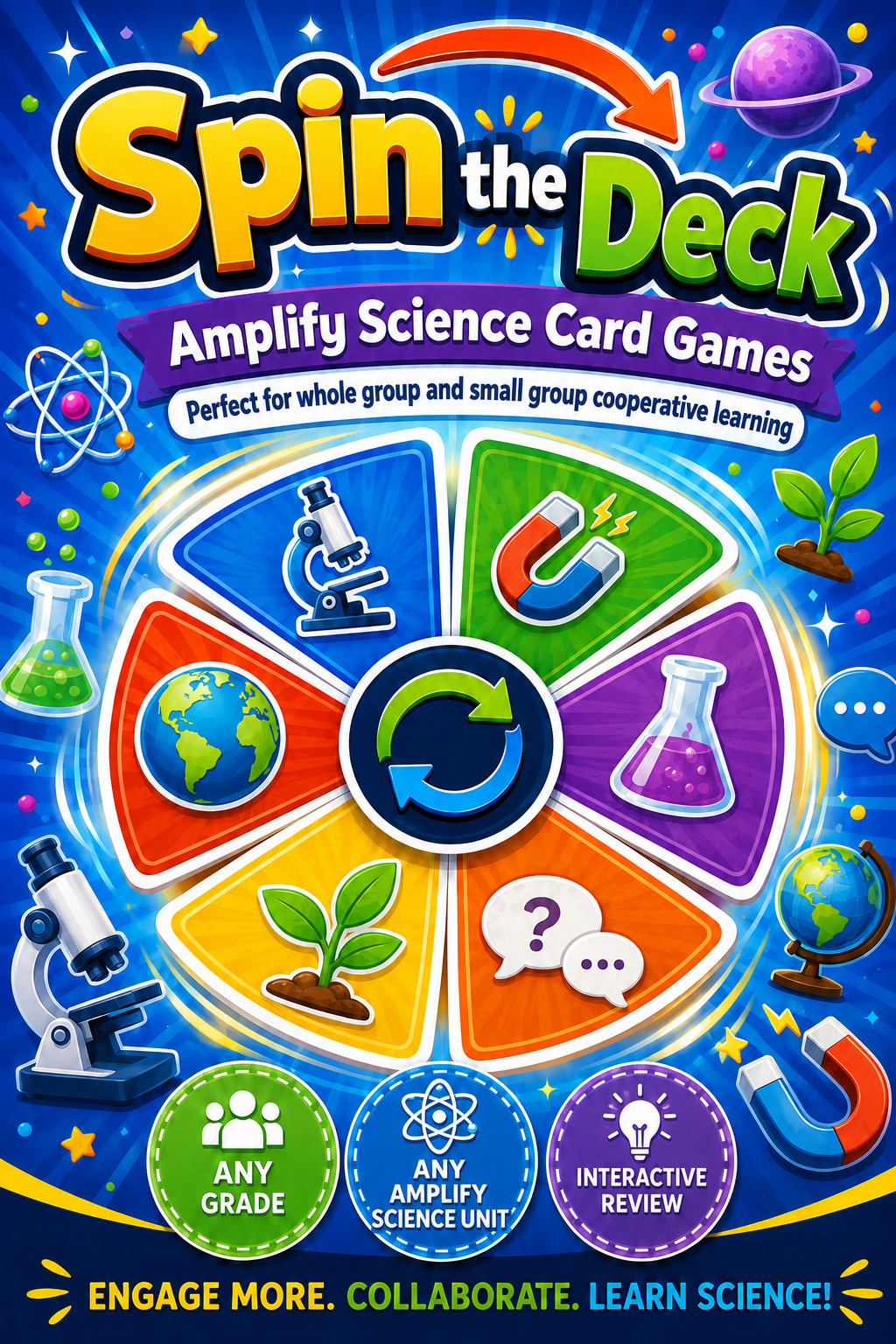
SPIN THE DECK! ENGAGE MORE. COLLABORATE. DISCOVER THE SCIENCE OF GENETICS AND INHERITANCE!
Transform Genetics, Inherited Traits, and Reproduction into an Exciting Classroom Learning Experience!
Why do siblings sometimes look different even though they have the same parents? How do genes determine an organism's traits? Why do some spiders produce stronger or more flexible silk than others? What happens when a gene changes? And how do offspring inherit characteristics from their parents?
Bring these fascinating scientific questions to life with this engaging Spin the Deck: Traits and Reproduction Review Game!
Designed to complement the Grade 8 Amplify Science Traits and Reproduction unit, this interactive collection of 100 multiple-choice science review cards helps students investigate the relationships among genes, DNA, proteins, inherited traits, genetic variation, and reproduction.
Students explore essential scientific concepts including traits, features, variations, chromosomes, alleles, genotype, phenotype, mutations, protein structure and function, sexual reproduction, asexual reproduction, fertilization, and genetic inheritance.
From investigating variations in spider silk and bristle characteristics to exploring how different combinations of inherited genes influence offspring, students develop a deeper understanding of the molecular processes responsible for similarities and differences among organisms.
The deck challenges students to distinguish inherited traits from acquired characteristics, explain how genes provide instructions for proteins, identify dominant and recessive alleles, and recognize how genetic information passes from parents to offspring.
Students also explore Punnett squares, pedigree charts, meiosis, reproductive cells, homozygous and heterozygous genotypes, genetic disorders, selective breeding, and genetic engineering.
With real-world connections to human hair color, eye color, biological inheritance, family similarities, spider characteristics, and environmental influences, students discover how genetics helps explain the diversity of living organisms.
Students strengthen their scientific reasoning by examining how DNA influences protein structure, how proteins contribute to traits, how mutations may affect organisms, and why genetic variation matters for survival in changing environments.
Move beyond traditional worksheets and transform genetics review into an exciting cooperative learning experience where students answer questions, explain their thinking, explore scientific phenomena, and collaborate with classmates!
Perfect for whole-group science review, small-group cooperative learning, science centers, partner activities, intervention, enrichment, and unit assessment preparation, this versatile resource encourages active participation while reinforcing essential life science concepts.
Help your students become confident scientific thinkers, curious investigators, and enthusiastic collaborative learners!
What's Included?
- 100 numbered multiple-choice science review cards covering Grade 8 Traits and Reproduction concepts
- Four answer choices per question to encourage careful reading, scientific reasoning, and critical thinking
- Answers printed on the reverse side for immediate feedback and student self-checking
- 50 printable PDF pages designed for double-sided printing
- 25 double-sided sheets when printed back-to-back
- Four cards per sheet, creating 100 interactive review cards
- Colorful science-themed card designs featuring vibrant blue backgrounds, scientific illustrations, laboratory equipment, and clearly numbered question cards
- Questions addressing genetics, inheritance, DNA, chromosomes, proteins, alleles, and reproduction
- Real-world examples involving human characteristics, family inheritance, and spider traits
- Scientific reasoning questions exploring mutations, protein structure, genetic variation, and environmental influences
- Reusable review cards compatible with cooperative learning games, partner activities, and science centers
Easy Preparation: Print the PDF double-sided, cut apart the four cards on each sheet, and laminate for durability. Your interactive Traits and Reproduction review deck is ready to use!
Science Concepts & Skills Covered
Understanding Traits, Features & Variations
Help students develop a foundational understanding of the characteristics of living organisms.
Topics include:
- Traits
- Features
- Variations
- Individual characteristics
- Similarities and differences
- Inherited characteristics
- Observable traits
- Species characteristics
- Biological diversity
- Genetic variation
Students investigate how individuals of the same species can share features while displaying different variations of particular traits.
Genes & Genetic Information
Explore how genes provide instructions that influence an organism's characteristics.
Topics include:
- Genes
- Genetic information
- Inherited instructions
- DNA
- Genetic material
- Biological inheritance
- Molecular processes
- Genetic similarities
- Genetic differences
- Traits
Students discover that genes contain instructions involved in producing proteins that influence traits.
DNA & the Genetic Code
Introduce students to the molecule responsible for storing genetic information.
Topics include:
- DNA
- Genetic code
- Double helix
- DNA structure
- Genes
- Genetic instructions
- Chromosomes
- Genetic information
- Mutations
- Inheritance
Students recognize DNA as the molecule that carries genetic information and identify its characteristic double-helix structure.
Chromosomes & the Nucleus
Investigate how genetic information is organized within cells.
Topics include:
- Chromosomes
- Genes
- DNA
- Nucleus
- Cell structures
- Genetic organization
- Human chromosomes
- Reproductive cells
- Inheritance
- Genetic material
Students explore how chromosomes contain genes and recognize that typical human body cells contain 46 chromosomes.
Alleles & Gene Versions
Help students understand how different versions of genes contribute to variations in traits.
Topics include:
- Alleles
- Gene versions
- Genetic variation
- Inheritance
- Dominant alleles
- Recessive alleles
- Genotypes
- Trait differences
- Genetic combinations
- Offspring
Students investigate how organisms can inherit different versions of genes from their biological parents.
Genotype & Phenotype
Challenge students to distinguish genetic makeup from observable characteristics.
Topics include:
- Genotype
- Phenotype
- Allele combinations
- Genetic makeup
- Observable traits
- Physical characteristics
- Dominant alleles
- Recessive alleles
- Inherited variation
- Genetic expression
Students discover that organisms can display the same phenotype while possessing different genotypes.
Dominant & Recessive Alleles
Explore patterns of inheritance involving dominant and recessive alleles.
Topics include:
- Dominant alleles
- Recessive alleles
- Allele expression
- Uppercase letters
- Lowercase letters
- Genetic inheritance
- Heterozygous combinations
- Homozygous combinations
- Recessive traits
- Trait prediction
Students practice identifying how dominant and recessive alleles influence traits in simple inheritance models.
Homozygous & Heterozygous Genotypes
Reinforce important genetics vocabulary through allele comparisons.
Topics include:
- Homozygous
- Heterozygous
- AA
- Aa
- aa
- Allele pairs
- Dominant genotypes
- Recessive genotypes
- Genetic combinations
- Inheritance patterns
Students identify examples of homozygous dominant, homozygous recessive, and heterozygous genotypes.
Punnett Squares & Genetic Probability
Develop students' ability to predict possible inherited traits.
Topics include:
- Punnett squares
- Genetic probability
- Allele combinations
- Dominant traits
- Recessive traits
- Genotype predictions
- Phenotype predictions
- Offspring
- Inheritance patterns
- Probability
Students recognize how Punnett squares can be used to predict possible genetic combinations and trait probabilities.
Proteins & Their Role in Traits
Explore the relationship between genetic instructions and the characteristics of organisms.
Topics include:
- Proteins
- Protein molecules
- Protein function
- Traits
- Gene instructions
- Molecular structure
- Biological processes
- Protein differences
- Inherited characteristics
- Genetic variation
Students investigate how proteins perform important cellular functions and contribute to an organism's traits.
Protein Structure & Function
Help students understand why the shape of a protein matters.
Topics include:
- Protein structure
- Protein shape
- Protein function
- Amino acids
- Amino acid sequences
- Molecular binding
- Protein interactions
- Changes in protein shape
- Genetic instructions
- Trait variation
Students explore how amino acid sequences influence protein shape and how changes in structure may affect function.
Amino Acids & Protein Building
Introduce students to the building blocks of proteins.
Topics include:
- Amino acids
- Protein chains
- Amino acid sequences
- Molecular structure
- Protein folding
- Protein shape
- Protein function
- Genes
- Genetic instructions
- Molecular processes
Students learn that proteins consist of chains of amino acids and that their sequences help determine protein structure.
RNA & Genetic Messages
Explore another molecule involved in the expression of genetic information.
Topics include:
- RNA
- Genetic messages
- Genes
- DNA
- Protein production
- Molecular instructions
- Cellular processes
- Genetic information
- Protein synthesis
- Gene expression
Students identify RNA as a molecule involved in carrying genetic messages used in protein production.
Sexual Reproduction
Investigate how offspring inherit genetic information from two biological parents.
Topics include:
- Sexual reproduction
- Biological parents
- Offspring
- Genetic inheritance
- Allele combinations
- Reproductive cells
- Genetic variation
- Fertilization
- Genetic uniqueness
- Reproduction
Students discover how sexual reproduction produces new combinations of genetic information.
Asexual Reproduction & Cloning
Compare reproduction involving one parent with reproduction involving two parents.
Topics include:
- Asexual reproduction
- Clones
- Genetic similarities
- Genetically identical offspring
- Reproduction
- Parent organisms
- Genetic information
- Inherited characteristics
- Sexual reproduction
- Genetic variation
Students recognize that asexual reproduction typically produces genetically identical offspring, apart from possible mutations.
Meiosis & Reproductive Cells
Explore how reproductive cells contribute to inheritance.
Topics include:
- Meiosis
- Gametes
- Sperm cells
- Egg cells
- Chromosome numbers
- Genetic material
- Reproduction
- Alleles
- Fertilization
- Genetic combinations
Students learn that meiosis produces reproductive cells containing half the usual number of chromosomes.
Fertilization & Zygote Formation
Investigate what happens when reproductive cells combine.
Topics include:
- Fertilization
- Sperm cells
- Egg cells
- Zygotes
- Genetic information
- Chromosomes
- Biological parents
- Offspring
- Sexual reproduction
- Genetic inheritance
Students identify fertilization as the combination of reproductive cells and recognize the resulting cell as a zygote.
Inheritance & Family Similarities
Help students explain why offspring resemble their biological parents.
Topics include:
- Inheritance
- Biological parents
- Offspring
- Genes
- Alleles
- Family resemblance
- Inherited traits
- Genetic combinations
- Siblings
- Variation
Students explore why siblings may share characteristics while inheriting different combinations of alleles.
Mutations & Genetic Changes
Introduce students to changes in genetic information.
Topics include:
- Mutations
- DNA changes
- Gene changes
- Protein differences
- Genetic variation
- Protein function
- Environmental mutagens
- UV radiation
- Chemicals
- Genetic effects
Students investigate how mutations can influence proteins and may contribute to changes in traits.
Inherited vs. Acquired Traits
Challenge students to distinguish inherited genetic characteristics from acquired changes.
Topics include:
- Inherited traits
- Acquired characteristics
- Genes
- Environmental influences
- Scars
- Hair characteristics
- Eye color
- Physical characteristics
- Genetic inheritance
- Trait development
Students examine examples of inherited traits and acquired characteristics, such as scars.
Genes & the Environment
Explore how both genetic and environmental factors influence organisms.
Topics include:
- Genes
- Environment
- Nature versus nurture
- Trait expression
- Environmental conditions
- Inherited characteristics
- Phenotypes
- Genetic influences
- Individual variation
- Biological development
Students investigate why traits may be influenced by both inherited genetic information and environmental conditions.
Spider Traits & Genetic Variation
Connect genetics concepts to spider investigations referenced in the Traits and Reproduction unit.
Topics include:
- Spider traits
- Spider silk
- Silk flexibility
- Bristle variations
- Leg length
- Protein molecules
- Genetic differences
- Trait variation
- Inheritance
- Molecular structure
Students explore how differences in genes and proteins can contribute to variations in spider characteristics.
Darwin & Greg: Comparing Spider Variations
Revisit the spider examples featured in the review cards.
Topics include:
- Darwin and Greg
- Trait variations
- Spider characteristics
- Genetic similarities
- Genetic differences
- Protein variation
- Inherited characteristics
- Scientific comparisons
- Molecular explanations
- Evidence
Students recognize how two organisms can possess different variations of the same trait.
Genetic Variation & Survival
Investigate why variation matters within populations.
Topics include:
- Genetic variation
- Trait diversity
- Environmental change
- Survival
- Helpful traits
- Inherited characteristics
- Population differences
- Adaptation
- Reproduction
- Evolution
Students examine how variation can influence which traits are advantageous under changing environmental conditions.
Evolution & Changes Across Generations
Introduce students to genetic changes occurring over many generations.
Topics include:
- Evolution
- Inherited traits
- Genetic variation
- Generations
- Populations
- Environmental changes
- Survival
- Reproduction
- Trait frequencies
- Biological change
Students recognize that evolutionary changes occur across generations rather than through individual choices or short-term changes.
Pedigree Charts & Family Inheritance
Explore how scientists track inherited characteristics through families.
Topics include:
- Pedigree charts
- Family traits
- Inheritance patterns
- Genetic conditions
- Generations
- Biological relationships
- Alleles
- Dominant inheritance
- Recessive inheritance
- Genetic analysis
Students identify pedigree charts as tools for examining patterns of inheritance.
Genetic Disorders & Carriers
Introduce students to inherited genetic conditions and carrier status.
Topics include:
- Genetic disorders
- Hemophilia
- Carriers
- Recessive alleles
- Genetic inheritance
- Biological parents
- Allele combinations
- Inherited conditions
- Genotypes
- Family inheritance
Students explore the concept of carrying a recessive allele without displaying the associated recessive trait.
Selective Breeding
Examine how humans influence the inheritance of characteristics in plants and animals.
Topics include:
- Selective breeding
- Desired traits
- Reproduction
- Genetic inheritance
- Human selection
- Offspring
- Genetic variation
- Organism characteristics
- Breeding choices
- Inherited features
Students recognize selective breeding as a process in which humans choose organisms to reproduce based on desired characteristics.
Genetic Engineering
Introduce students to the modification of genetic information.
Topics include:
- Genetic engineering
- DNA modification
- Genes
- Genetic information
- Biotechnology
- Organism characteristics
- Genetic changes
- Inherited traits
- Molecular biology
- Scientific applications
Students identify genetic engineering as the process of modifying an organism's DNA.
Genomes & Genetic Organization
Explore how scientists describe an organism's complete genetic information.
Topics include:
- Genome
- DNA
- Genes
- Chromosomes
- Genetic material
- Genetic organization
- Molecular biology
- Inheritance
- Genetic information
- Biological characteristics
Students recognize the genome as the complete set of an organism's genetic information.
Common Misconceptions About Genetics & Reproduction
Challenge students to distinguish accurate scientific explanations from common misunderstandings.
Topics include:
- Offspring do not inherit all their genes from only one parent in typical sexual reproduction
- Siblings do not necessarily inherit identical combinations of alleles
- A gene and a trait are not the same thing
- Genotype and phenotype describe different aspects of an organism
- Dominant alleles are not necessarily more common in populations
- Mutations are not always harmful
- Acquired characteristics are not automatically inherited
- Proteins influence traits through their structure and function
- Environmental conditions can influence how traits are expressed
- Asexual reproduction and sexual reproduction produce different patterns of genetic variation
Students develop more accurate explanations of genetic inheritance, molecular processes, and reproduction.
Perfect for Whole-Group & Small-Group Cooperative Learning!
Whole-Group Interactive Science Review
Engage the entire class in discussions about DNA, genes, proteins, chromosomes, inherited traits, genetic variation, and reproduction.
Fan-N-Pick
Students work in cooperative groups, taking turns selecting cards, reading questions, answering, and checking responses. This activity promotes participation, teamwork, and active listening.
Quiz-Quiz-Trade
Students pair up, quiz one another, check answers, exchange cards, and find new partners. This movement-based activity reinforces genetics vocabulary and concepts through repeated practice.
Science Centers & Stations
Create review stations focusing on genetic inheritance, protein structure, mutations, reproduction, and genetic variation.
Partner Review
Students take turns reading questions, selecting answers, explaining their reasoning, and checking responses on the reverse side.
Small-Group Genetics Investigations
Organize students into teams to compare allele combinations, explain inherited traits, analyze protein differences, and investigate patterns of reproduction.
Spin & Answer Review Games
Combine the cards with a classroom spinner or teacher-created game structure to add excitement and friendly competition to science review.
Science Test Preparation
Help students revisit important vocabulary, molecular concepts, genetic inheritance patterns, and scientific explanations before unit assessments.
Warm-Ups & Exit Tickets
Use selected cards to activate prior knowledge, encourage scientific discussions, or quickly assess understanding.
Science Intervention & Enrichment
Target specific genetics concepts for additional practice or challenge students to explain more complex relationships involving genes, proteins, and traits.
Early Finishers & Substitute Plans
Provide meaningful, low-preparation science activities that reinforce essential life science concepts.
Why Teachers Will Love This Resource!
Low-Prep and Ready to Use!
Simply print, cut, and laminate to create a reusable classroom resource.
Designed for Cooperative Learning!
Encourage students to communicate, collaborate, listen respectfully, and explain scientific ideas to classmates.
Promotes Active Student Engagement!
Transform traditional science review into an interactive experience involving discussion, movement, teamwork, and problem-solving.
Reinforces Amplify Science Concepts!
Review essential vocabulary and scientific ideas connected to the Grade 8 Traits and Reproduction unit.
Builds Scientific Reasoning!
Students strengthen their ability to explain genetic inheritance, compare genotypes and phenotypes, identify allele combinations, and investigate the relationship between genes, proteins, and traits.
Provides Immediate Feedback!
Answers on the reverse side allow students to check their understanding during independent, partner, and group activities.
Supports Differentiated Instruction!
Select questions based on student readiness, target specific concepts, or extend learning through additional scientific discussions.
Connects Science to Real-World Phenomena!
Students investigate family similarities, human characteristics, spider silk variations, inherited genetic conditions, and environmental influences.
Challenges Common Misconceptions!
Help students understand that genes contain instructions for proteins, genetic variation contributes to differences among organisms, and both genetic and environmental factors can influence traits.
Reusable Year After Year!
Laminate the cards to create a durable classroom resource that supports repeated review and cooperative learning.
Sample Review Questions
Here are eight actual questions from this collection:
Question 1: What is a "trait"?
Answer: A specific characteristic of an individual.
Question 2: Where are the instructions for building proteins located?
Answer: In the genes.
Question 3: How many copies of each gene do offspring usually inherit?
Answer: Two (one from each parent).
Question 4: A "variation" is a:
Answer: Difference in traits between individuals.
Question 5: What type of molecule determines the trait of an organism?
Answer: Protein.
Question 6: Genes are located on larger structures called:
Answer: Chromosomes.
Question 7: What does it mean if two organisms have the same trait?
Answer: They have the same protein molecules.
Question 8: An "allele" is a:
Answer: Version of a gene.
These questions are taken from the first eight numbered cards and reflect the answers printed in the resource. They introduce important genetics vocabulary while encouraging students to explore how genes, proteins, and inherited information influence organisms.
Transform Genetics Review into an Exciting Learning Experience!
Genetics helps explain the remarkable diversity of life! From the color of our eyes to variations in spider silk, inherited genetic information influences countless characteristics of living organisms.
Understanding traits and reproduction helps students explain why offspring resemble their parents, how genes provide instructions for proteins, why genetic differences exist, and how inherited variation contributes to biodiversity.
With 100 interactive Traits and Reproduction review cards, students can investigate genetic inheritance, compare genotypes and phenotypes, explore protein structure and function, identify patterns of reproduction, and discover how genetic variation influences living organisms.
Imagine students enthusiastically selecting cards, explaining why siblings may have different characteristics, identifying dominant and recessive alleles, comparing spider traits, and collaborating to solve scientific questions.
Whether you're reviewing lessons, preparing for assessments, reinforcing vocabulary, or creating collaborative learning opportunities, this resource transforms genetics review into an exciting, student-centered learning experience.
One deck. 100 questions. Endless opportunities to explore the fascinating science of genetics, inheritance, and reproduction!
SPIN THE DECK! ENGAGE MORE. COLLABORATE. LEARN SCIENCE!
Add this engaging Traits and Reproduction review game to your classroom toolkit and inspire confident, curious, and collaborative young scientists!
Important Curriculum Disclaimer
This independently created resource is designed to supplement the Amplify Science curriculum. It is not affiliated with, sponsored by, authorized by, or endorsed by Amplify Education, Inc. Amplify and Amplify Science are trademarks of their respective owner. No affiliation or endorsement is implied.
This product is a supplemental classroom review activity and is not a replacement for official Amplify Science curriculum materials, lessons, assessments, or instructional resources.
- Grade 8
- Instant digital download
- Print & reuse in class