The Five Senses Science Concept Posters
$5.00
6-Piece Visual Science Poster Set | Sight | Hearing | Smell | Taste | Touch | CER
Bring The Five Senses to life with this bold, colorful, and highly visual 6-poster Science Concept Set!
Designed to do much more than simply decorate your science wall, these posters help students identify the five senses, connect each sense to the body part that gathers information, make careful observations, describe what they notice, build science vocabulary, explore the world around them, and begin thinking like scientists.
Each poster combines large, engaging visuals with clear student-friendly explanations, discussion prompts, vocabulary, simple sensory activities, and introductory Claim-Evidence-Reasoning (CER) opportunities. Students explore how sight, hearing, smell, taste, and touch provide different kinds of information and help us learn about our surroundings.
WHAT’S INCLUDED
This set includes 6 full-color, print-ready science posters:
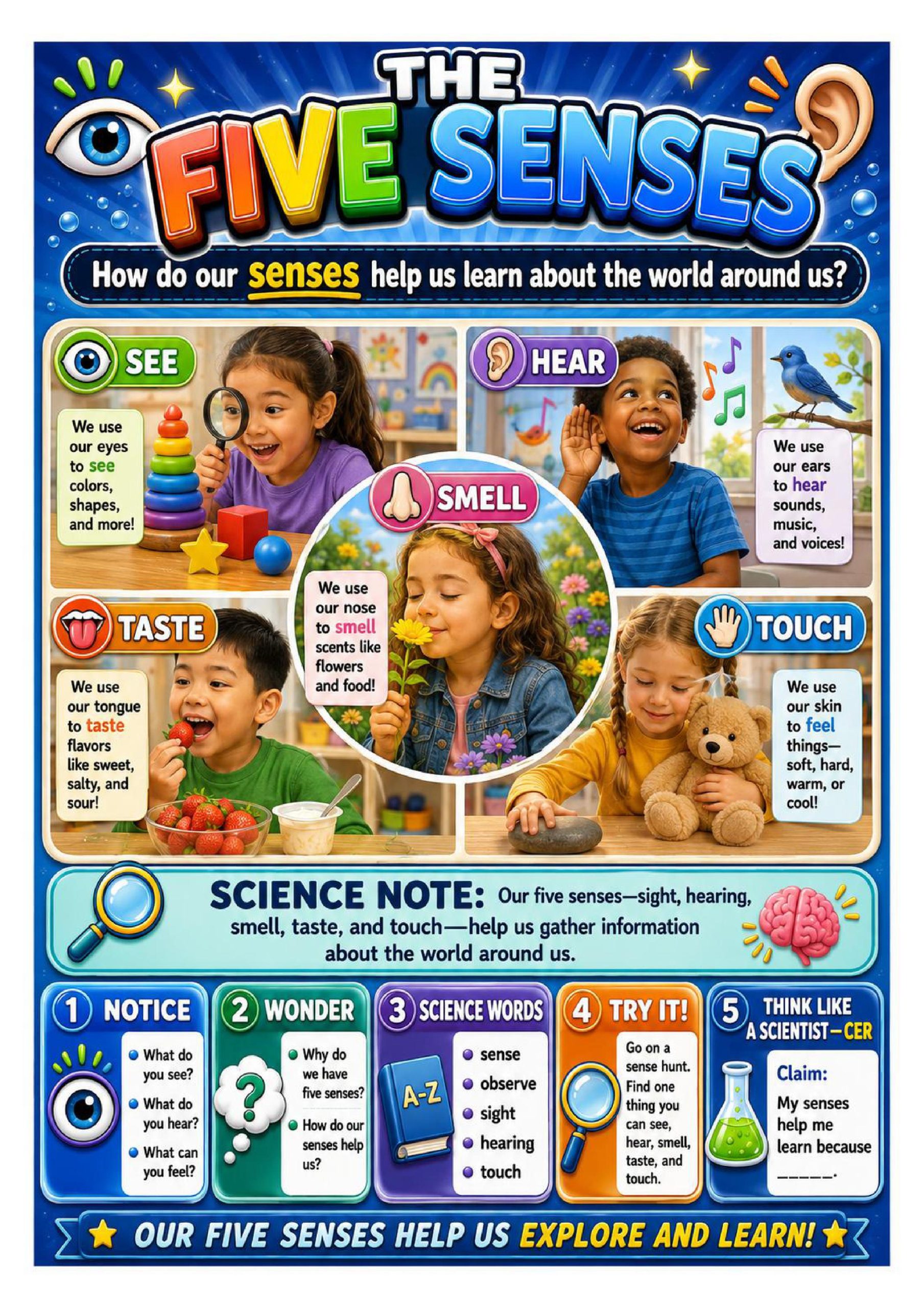
- The Five Senses — Introduce sight, hearing, smell, taste, and touch and explore how each sense helps us gather information about the world.
- See — Discover how our eyes help us observe colors, shapes, sizes, patterns, movement, and small details.
- Hear — Explore how our ears help us detect sounds from nature, people, music, machines, and animals.
- Smell — Investigate how our nose detects scents in the air from flowers, food, soap, fresh air, leaves, baked goods, and more.
- Taste — Explore how our tongue helps us notice flavors such as sweet, salty, sour, and bitter.
- Touch — Discover how our skin helps us feel texture and temperature, including soft, hard, smooth, rough, warm, and cool objects.
Each poster includes a large guiding question, vivid science illustrations, a concise Science Note, Notice & Wonder prompts, key Science Words, a Try It! activity, and a Think Like a Scientist — CER response opportunity. Science Concept Poster Set_The …
MORE THAN A POSTER — A TEACHING TOOL
These posters are designed to help students move beyond simply memorizing the names of the five senses and begin understanding how each sense provides useful information.
Students investigate questions such as:
How do our senses help us learn about the world?
What can we discover with our eyes?
What kinds of sounds can we hear?
How can smells give us clues?
How does our tongue help us notice different flavors?
What information can our skin provide?
How can our senses help us observe carefully and stay safe?
Use the posters to introduce a five senses unit, activate prior knowledge, guide whole-group conversations, reinforce vocabulary, support small-group instruction, provide science-center references, or create an engaging classroom science display.
INTRODUCING THE FIVE SENSES
The introductory The Five Senses poster gives students a clear visual overview of the complete sensory system at an age-appropriate level.
Students connect:
Sight with the eyes
Hearing with the ears
Smell with the nose
Taste with the tongue
Touch with the skin
The poster reinforces that our five senses help us gather information about the world around us.
Students see familiar examples such as looking at shapes and colors, listening to music and birds, smelling flowers, tasting foods, and touching objects with different textures and temperatures.
This creates a strong foundation before each sense is explored in greater detail.
EXPLORE THE SENSE OF SIGHT
The See poster helps students understand how much information can be gathered through their eyes.
Students explore how sight helps us notice:
- colors
- shapes
- sizes
- patterns
- movement
- details
The poster uses familiar examples such as colored pencils, geometric shapes, large and small vehicles, butterflies, leaves, flowers, and insects.
Students are encouraged to look closely and make detailed observations, creating a natural connection between the five senses and scientific observation.
EXPLORE THE SENSE OF HEARING
The Hear poster helps students discover the wide variety of sounds around them.
Students examine sounds produced by:
- nature
- people
- music
- machines
- animals
Examples include birds singing, people talking, wind blowing, music playing, drums beating, and bells ringing.
Students also begin describing sounds using words such as loud and soft and considering whether sounds come from near or far away.
The simple listening activity encourages students to close their eyes, identify sounds, and determine where those sounds came from.
EXPLORE THE SENSE OF SMELL
The Smell poster introduces students to scents carried through the air.
Students explore familiar smells associated with:
- flowers
- food
- soap
- fresh air
- leaves
- warm drinks
- baked goods
- earthy outdoor smells
Students learn that the nose helps detect scents and that smell can provide information even when we cannot immediately see the source.
The poster also encourages students to compare strong and weak smells and consider how smell can sometimes help alert us to what is happening around us.
EXPLORE THE SENSE OF TASTE
The Taste poster focuses on how the tongue helps us notice different flavors.
Students compare four familiar taste categories:
Sweet — examples include fruit and desserts
Salty — examples include pretzels, chips, and nuts
Sour — examples include lemons, limes, and green apples
Bitter — examples include greens, tea, and dark chocolate
The poster encourages students to compare foods and describe how flavors are alike or different.
It also introduces an important connection between taste and smell by encouraging students to wonder why foods taste different and how the senses can work together.
EXPLORE THE SENSE OF TOUCH
The Touch poster helps students understand that the skin provides information about objects and surroundings.
Students compare examples of things that feel:
- soft
- hard
- smooth
- rough
- warm
- cool
Familiar objects such as a teddy bear, rocks, a sponge, a warm mug, and an ice cube make these properties easy for young learners to recognize.
Students learn that touch helps us notice texture, temperature, and pressure and can also help us stay safe.
The included activity invites students to sort safe objects by texture or temperature.
BUILDS OBSERVATION AND DESCRIPTION SKILLS
A major strength of this set is its connection between the five senses and scientific observation.
Students are repeatedly encouraged to notice details and describe what they experience.
Throughout the set, students practice observing, comparing, classifying, describing properties, asking questions, collecting sensory information, using evidence, and explaining what they notice.
These foundational skills can support later science learning across topics such as matter, weather, plants, animals, sound, light, and scientific investigation.
INTRODUCES CER IN A STUDENT-FRIENDLY WAY
Each poster includes a simple Think Like a Scientist — CER section designed for elementary learners.
Students respond to sentence frames such as:
“My senses help me learn because…”
“I used sight when I noticed…”
“I heard ____. The sound was ____.”
“I knew it was ____ because it smelled ____.”
“This food tastes ____ because ____.”
“This object feels ____ because ____.”
These prompts provide an accessible introduction to using observations as evidence and explaining scientific thinking.
KEY SCIENCE CONCEPTS
Students will explore concepts including:
sense, observe, sight, eyes, light, color, shape, hearing, sound, ears, loud, soft, smell, nose, scent, odor, air, taste, tongue, flavor, sweet, salty, sour, bitter, touch, skin, texture, warm, cool, smooth, rough, evidence, compare, and describe.
PERFECT FOR
Beginning science instruction, five senses units, kindergarten science, first grade science, primary science classrooms, human body lessons, observation units, science centers, sensory investigations, science anchor charts, classroom science walls, vocabulary development, morning review, small-group instruction, CER introductions, and year-round science references.
DESIGNED FOR YOUNG SCIENTISTS
Bold headings, vivid colors, diverse student models, familiar objects, real-world sensory experiences, clear labels, simple vocabulary, and easy-to-understand examples make this set especially approachable for younger elementary learners.
The coordinated design allows all six posters to work together as a complete instructional sequence:
Introduce all five senses → explore sight → investigate hearing → discover smell → compare tastes → investigate touch
Display all six together for an engaging Five Senses science wall, or introduce them individually as students explore each sense.
Turn your classroom walls into interactive science learning tools and help students discover that their eyes, ears, nose, tongue, and skin are powerful tools for observing, exploring, and learning about the world around them.
- Grades K-5
- Instant digital download
- Print & reuse in class