The Water Cycle Science Concept Posters
$5.00
6-Piece Visual Science Poster Set | Evaporation | Condensation | Precipitation | CER
Bring The Water Cycle to life with this bold, colorful, and highly visual 6-poster Science Concept Set!
Designed to do much more than simply decorate your science wall, these posters help students observe water-cycle processes, follow the movement of water, build science vocabulary, make connections between stages, analyze evidence, and think like scientists.
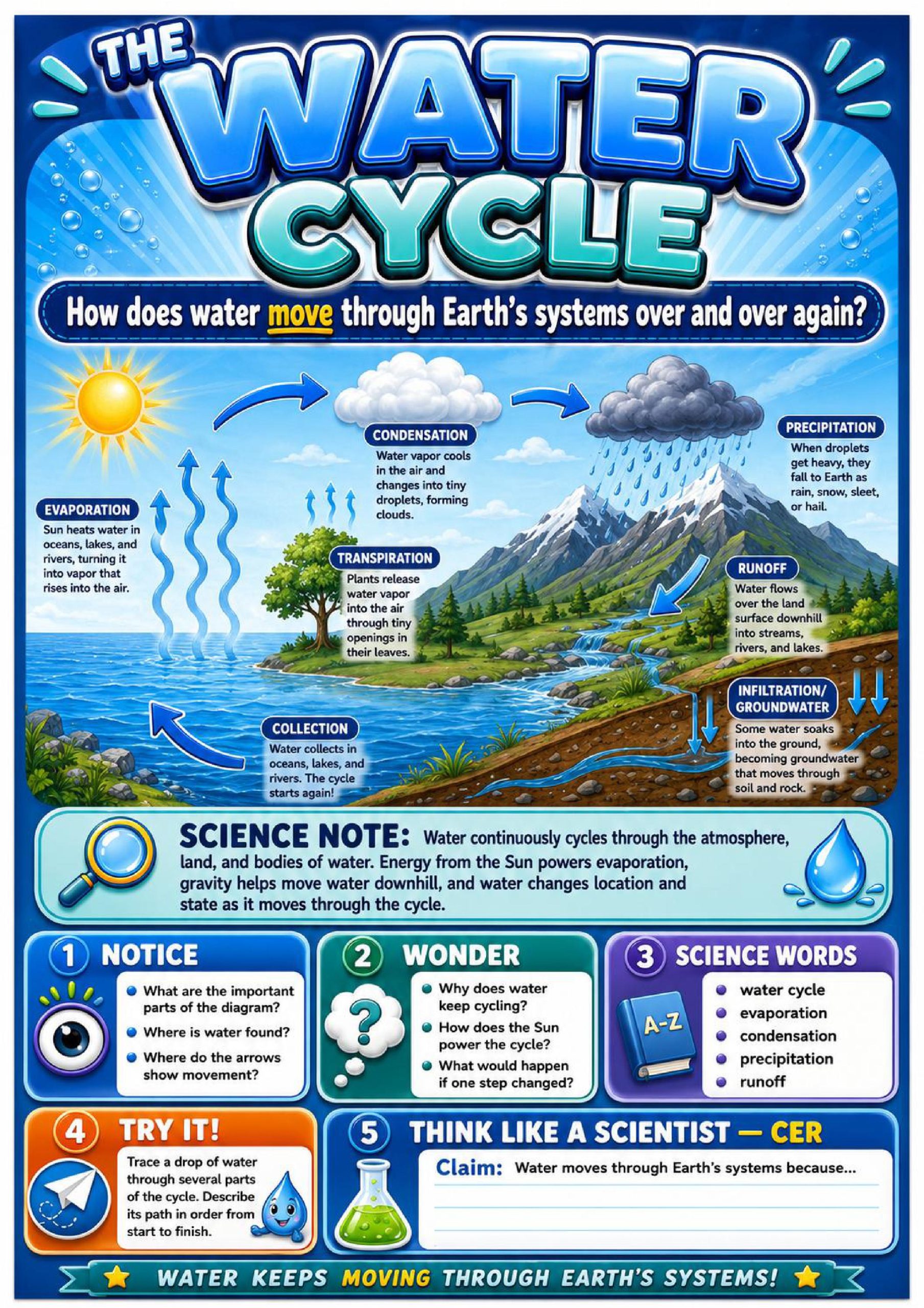
Each poster combines large, engaging science visuals with clear student-friendly explanations, discussion prompts, vocabulary, simple observation activities, and Claim-Evidence-Reasoning (CER) opportunities. Students can visually follow water as it evaporates, condenses, falls as precipitation, collects, runs off, and soaks into the ground.
WHAT’S INCLUDED
This set includes 6 full-color, print-ready science posters:
- The Water Cycle — Follow the continuous movement of water through evaporation, condensation, precipitation, runoff, collection, and infiltration.
- Condensation — Explore how cooling water vapor changes into tiny liquid droplets that can form clouds.
- Evaporation — Discover how energy from the sun heats liquid water and changes it into water vapor.
- Precipitation — Examine how water returns to Earth as rain, snow, sleet, or hail.
- The Water Cycle Never Stops! — Help students understand that the water cycle is a continuous process with no single beginning or end.
- Be the Scientist! Investigate the Water Cycle — Students observe real-world examples, record evidence, identify water-cycle processes, and explain their reasoning.
Each poster includes a large Essential Question, vivid science illustrations, a concise Science Note, Notice & Wonder prompts, key Science Words, a Try It! activity, and a Think Like a Scientist — CER response prompt.
MORE THAN A POSTER — A TEACHING TOOL
These posters are designed to help students understand the water cycle as a connected system rather than a list of vocabulary words to memorize.
Students visually follow water through oceans, lakes, rivers, clouds, mountains, soil, and groundwater while examining questions such as:
How does water move through Earth’s water cycle?
How does liquid water become water vapor?
How does water vapor form clouds and droplets?
How does water return from clouds to Earth?
Where does water go after precipitation falls?
Why does the water cycle continue again and again?
Use the posters to introduce a lesson, activate prior knowledge, guide whole-group conversations, reinforce vocabulary, support small-group instruction, review important concepts, or provide a visual reference throughout a weather or Earth science unit.
BUILDS SCIENCE THINKING
Rather than simply naming the stages of the water cycle, students are encouraged to observe evidence and explain what is happening.
The posters help students make connections between changes in water and the movement of water through Earth’s systems. They examine how the sun provides energy for evaporation, how cooling leads to condensation, how precipitation returns water to Earth, and how runoff, collection, and infiltration continue the cycle.
Students also practice interpreting arrows, comparing examples, identifying patterns, and using evidence to support scientific claims.
The culminating Be the Scientist poster extends this learning by asking students to observe examples such as a drying puddle, forming clouds, falling rain, collecting water, and water soaking into the ground. Students then identify the water-cycle process represented by each example and explain their thinking using evidence.
KEY SCIENCE CONCEPTS
Students will explore concepts including:
- water cycle
- evaporation
- condensation
- precipitation
- runoff
- collection
- infiltration
- water vapor
- clouds
- groundwater
- rain
- snow
- sleet
- hail
- observation
- evidence
PERFECT FOR
Whole-group science instruction, Earth science units, weather and water-cycle lessons, phenomenon-based learning, science anchor charts, classroom science walls, vocabulary reinforcement, morning review, small groups, science centers, CER practice, observation activities, science discussions, and unit review.
DESIGNED FOR STUDENT ENGAGEMENT
Bold headings, vivid colors, detailed landscapes, clear arrows, labeled examples, real-world connections, and easy-to-read information boxes help make the movement of water understandable and memorable for elementary learners.
The coordinated design allows all six posters to work together as a complete instructional sequence:
Explore the cycle → investigate condensation → investigate evaporation → explore precipitation → understand continuous cycling → observe and explain evidence
Display all six together for an engaging Water Cycle science wall, or introduce them individually as students progress through the topic.
Turn your classroom walls into interactive science learning tools and help students see how water is constantly changing form, moving through Earth’s systems, and cycling again and again.
- Grades K-5
- Instant digital download
- Print & reuse in class